Labor is trending above the operating target
Review: overtime and shift coverage • Next step: check affected locations
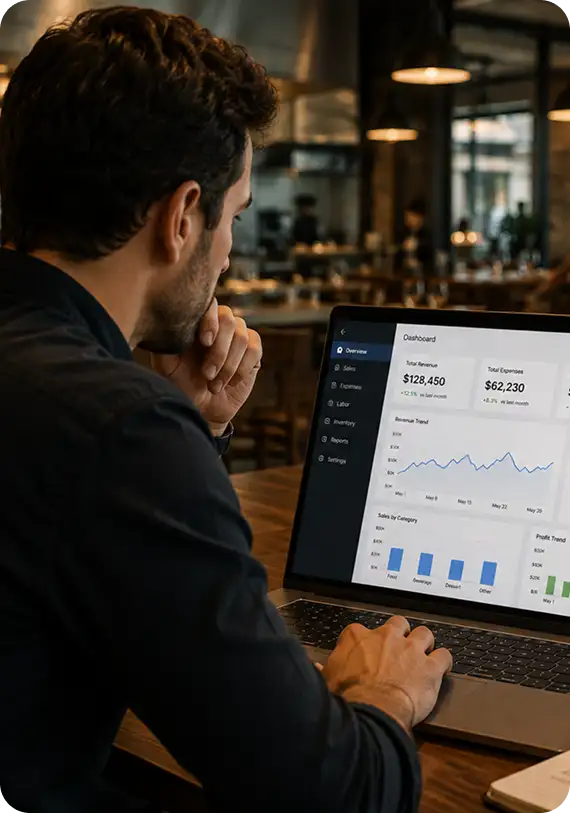
Connect restaurant sales, labor, inventory, purchasing, invoices, payroll, and restaurant accounting software so operators and finance teams can investigate margins, review exceptions, and make better-informed decisions.
Restaurant locations supported
Hourly workers supported
In restaurant technology
Human-driven support




Sales, scheduling, inventory, purchasing, invoices, payroll, and restaurant accounting systems often live in separate systems. When those signals are disconnected, it becomes harder to understand what is influencing restaurant margins.

Contextualize operational data like sales and labor while ensuring consistent accounting categorization.

Review invoices against accounting entries and route financial exceptions for proper finance team review.

Review prime costs and connect financial movements with operational drivers like supplier pricing.

Review performance results across multiple restaurants, districts, or brands.

Use current operating context and finance reviews to plan better future business steps.

Bring available sales, labor, inventory, purchasing, invoice, payroll, and financial information together so teams can review how restaurant activity influences the numbers.
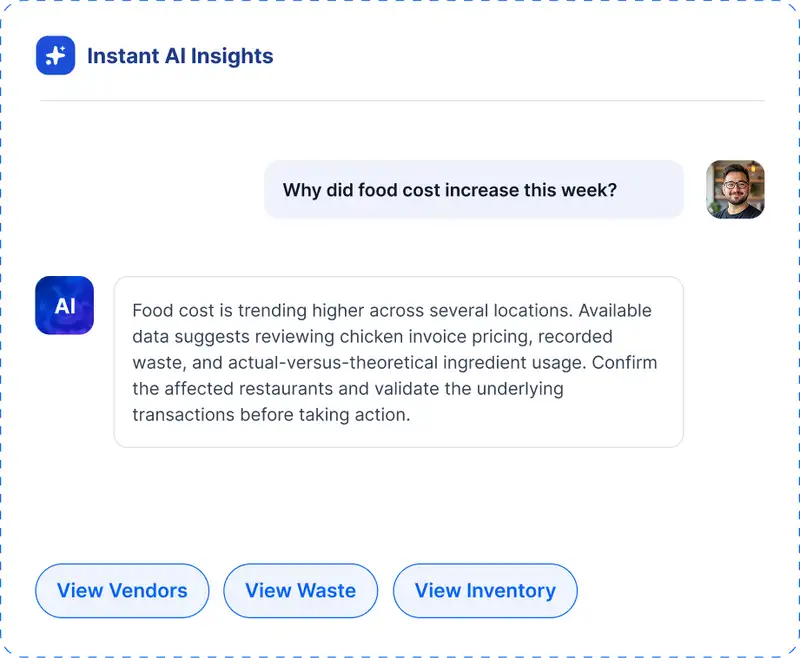
Available financial and operational information indicates that food cost has increased alongside supplier invoice pricing, recorded ingredient waste, and overtime activity. Review the affected restaurants, supplier documents, inventory variance, and schedules before deciding what action to take.
Review available financial performance by reporting period and location, then connect changes in revenue, food cost, labor, and prime cost with relevant restaurant financial software activity.
| Line Item | Budget | Actual | Var |
|---|---|---|---|
| Revenue | $1.20M | $1.24M | +3.3% |
| COGS | $420K | $430K | -2.3% |
| Labor | $310K | $315K | -1.6% |
| Prime Cost | 60.8% | 59.9% | +0.9% |
| Opex | $180K | $175K | +2.7% |
| EBITDA | 14.0% | 14.6% | +0.6% |
Use connected restaurant and financial information to surface possible explanations for food cost, labor, prime cost, invoice, or location-level changes while keeping finance teams in control with restaurant accounting software.
Bring available vendor invoice information, purchase orders, receiving records, proposed accounting classifications, and approval workflows together for restaurant accounting review.
Bring available vendor documentation into the financial workflow.
Examine vendor, items, quantities, amounts, and relevant supporting information.
Review the proposed classification and applicable accounting information.
Review available purchase-order and receiving information for discrepancies.
Give managers and finance teams visibility into exceptions and approval needs.
Process approved invoices according to the configured financial controls.
Connect available financial and operational information so teams can understand potential
cost changes, review the underlying signals, and decide on an appropriate action with restaurant accounting solutions.

Review: overtime and shift coverage • Next step: check affected locations
Review: recent supplier invoices • Next step: compare purchasing records
Review: accounts-payable due dates • Next step: assess cash planning
Review: pending invoice exceptions • Next step: confirm appropriate approval
The restaurant software is user-friendly and it's something that anyone from an inexperienced to experienced restaurant manager can understand.

Before we used a spreadsheet where we have to type out manually, now with Altametrics we have a better approach to forecasting, scheduling hours, deployment of labor, who's taking a break when, and effective cross-training.

Since we started using Altametrics, we have been able to get our labor deployment and labor forecasting much more accurate than any prior systems that we've used.

The ability to go in and do food management on a weekly basis, do all of our receiving within that system, also for it to forecast orders out is really starting to make the analytics and insight into how we better control our costs just improve ten fold.

The food management products are an integral part of how we operate our business. So it's not just restaurant software, it is part of our culture.

Food safety with Altametrics has become much easier which means we can devote more time to helping our guests and seeing their smiles on their faces.

My Hong Kong team can opt to see all their business intelligence reporting in US dollars and that reporting is done on the fly to make it very valuable for the team in that market.

What Altametrics business intelligence is doing for my operators is telling them where they need to put most of their attention. So to me, that is a tool that doesn't exist anywhere else. Everyone should use it.

As a franchise company, we need to know what all the sales are in our stores so Altametrics Business Intelligence was able to develop a system that could get that information for us.

The ability to go in and do the inventory on a weekly basis and do all of our receiving within that system. Also for it to forecast orders out is really starting to make the analytics and the insight into how we better control our cost just improve tenfold.

Sales forecasting has improved greatly since implementing eRestaurant it is much more consistent. It takes the guesswork basically out of evaluation in forecasting. It populates basically four past weeks and does the math for you and kind of gives you an average to where you can forecast for each day.

We already use Altametrics enterprise so when we heard about zip clock, we had to try it out.

The restaurant software is user-friendly and it's something that anyone from an inexperienced to experienced restaurant manager can understand.
Before we used a spreadsheet where we have to type out manually, now with Altametrics we have a better approach to forecasting, scheduling hours, deployment of labor, who's taking a break when, and effective cross-training.
Since we started using Altametrics, we have been able to get our labor deployment and labor forecasting much more accurate than any prior systems that we've used.
The ability to go in and do food management on a weekly basis, do all of our receiving within that system, also for it to forecast orders out is really starting to make the analytics and insight into how we better control our costs just improve ten fold.
The food management products are an integral part of how we operate our business. So it's not just restaurant software, it is part of our culture.
Food safety with Altametrics has become much easier which means we can devote more time to helping our guests and seeing their smiles on their faces.
My Hong Kong team can opt to see all their business intelligence reporting in US dollars and that reporting is done on the fly to make it very valuable for the team in that market.
What Altametrics business intelligence is doing for my operators is telling them where they need to put most of their attention. So to me, that is a tool that doesn't exist anywhere else. Everyone should use it.
As a franchise company, we need to know what all the sales are in our stores so Altametrics Business Intelligence was able to develop a system that could get that information for us.
The ability to go in and do the inventory on a weekly basis and do all of our receiving within that system. Also for it to forecast orders out is really starting to make the analytics and the insight into how we better control our cost just improve tenfold.
Sales forecasting has improved greatly since implementing eRestaurant it is much more consistent. It takes the guesswork basically out of evaluation in forecasting. It populates basically four past weeks and does the math for you and kind of gives you an average to where you can forecast for each day.
We already use Altametrics enterprise so when we heard about zip clock, we had to try it out.
Everything you need to know about the Altametrics platform and our enterprise restaurant management software.