What is an internal audit in a restaurant?
An internal audit in a restaurant is a structured review of daily operations to confirm that standards, policies, and procedures are being followed. It typically covers food safety, cash handling, labor practices, inventory controls, and daily operating routines.
Restaurant Internal Audit Checklist for Owners

Understanding Internal Audits
Restaurants operate on tight margins. That means even minor issues - like inaccurate portioning, missed break compliance, or inconsistent cash handling - can add up fast. An internal audit gives you a structured way to validate what is happening across your operation. Instead of relying on reports alone, you are physically or systematically verifying behaviors, processes, and outcomes.
There are three core reasons internal audits matter -
1. They protect your margins - Food waste, over-portioning, untracked comps, and inventory shrinkage are rarely caused by one big mistake. They come from repeated small breakdowns. Audits help you catch these early before they impact profitability.
2. They reduce operational risk - Food safety violations, labor law issues, and poor cash controls can create serious financial and legal exposure. Internal audits help ensure your restaurant is operating within safe and compliant standards every day - not just during inspections.
3. They improve accountability across the team - When employees know that processes are reviewed regularly, execution improves. Audits create clarity around expectations and reinforce that standards are not optional. They also give managers a clear framework to coach and correct issues consistently.
The key point is this - an internal audit turns assumptions into facts. It shows you where your operation is strong, where it is breaking down, and where you need to take action. Without it, you are managing based on what you hope is happening. With it, you are managing based on what is actually happening.
Food Safety and Sanitation Controls

Food safety and sanitation should be the first part of any restaurant internal audit. This is the area where small mistakes can create the biggest problems. A missed temperature check, poor storage practice, or weak cleaning routine can quickly turn into product loss, health code violations, or a damaged guest experience. For owners, the purpose of this audit section is not just to confirm that procedures exist. It is to verify that the team is following them correctly every day.
Here are the main points to review -
1. Check temperature control across all storage and holding areas
Start with coolers, freezers, hot holding units, and prep stations. Compare actual equipment temperatures with what employees recorded in logs. If logs are filled out but the equipment readings do not match, that is a warning sign. Temperature control problems often lead to food spoilage, safety risks, and waste.
2. Review date labels and product rotation practices
Check whether prepared and stored items are clearly labeled with the correct dates. Look for expired products, missing labels, and weak FIFO practices. This step matters because poor rotation creates unnecessary waste and raises the risk of serving food past its safe use period.
3. Audit storage setup and cross-contamination prevention
Review how food is stored in walk-ins, reach-ins, and prep areas. Raw meats should be below ready-to-eat foods. Chemicals should be stored away from food and food-contact surfaces. This part of the audit helps confirm that product organization supports safe handling, not just convenience.
4. Inspect cleaning and sanitation execution
Do not stop at checking completed cleaning logs. Inspect the actual condition of equipment, prep tables, smallwares, drains, and high-touch surfaces. Also verify sanitizer buckets and test strip use where applicable. A completed checklist does not always mean the work was done to standard.
5. Observe employee hygiene and handwashing habits
Watch what happens during normal operations. Are employees washing hands at the right times? Are gloves being changed properly? Are hygiene standards being followed during food prep and service? This is important because hygiene failures often happen during busy periods, when standards are hardest to maintain.
6. Review pest control and facility condition
Look for signs of pests, gaps under doors, standing water, damaged seals, or maintenance issues that can create sanitation risks. Many food safety problems start with weak facility upkeep, not just employee behavior.
Food safety audits should measure real execution. A restaurant does not stay safe because a policy exists. It stays safe because the team follows that policy consistently during every shift.
Elevate Food Safety, Simplify Compliance!
Experience Seamless Food Safety with Altametrics!
Review Cash Handling and POS Accuracy
Cash handling and POS controls are a critical part of any restaurant internal audit because this is where financial leakage often starts. Many losses do not come from one major incident. They come from repeated small errors, weak controls, inconsistent approvals, or gaps in daily discipline. For owners, this section of the audit should answer one core question - Is the restaurant handling transactions the way it is supposed to, every time?
Here are the main points to review -
1. Check whether cash drawers are opened and closed correctly
Review starting bank amounts, end-of-shift counts, and drawer balancing procedures. Each drawer should have a clear owner, and overages or shortages should be documented. If multiple employees use the same drawer without accountability, it becomes much harder to identify errors or loss.
2. Audit voids, refunds, discounts, and comps
These are some of the most common areas where misuse can happen. Review whether each void, refund, discount, or comp has proper manager approval and a clear business reason. Look for patterns such as high activity during certain shifts, repeated actions by the same employee, or amounts that seem outside normal operating levels.
3. Review deposit handling and cash transfer procedures
Check whether deposits are prepared correctly, stored securely, and taken to the bank according to policy. Confirm that reported deposit totals match POS records and daily sales activity. Gaps in this process can lead to reconciliation issues and unnecessary risk.
4. Verify POS user access and permission levels
Every employee should only have access to the functions required for their role. Review whether terminated employees still have access, whether shared logins are being used, and whether high-risk functions are limited to managers. Weak access controls create opportunities for both mistakes and intentional misuse.
5. Compare POS activity to actual operating behavior
Do not rely only on reports. Match what the system shows with what happens in the restaurant. For example, if the POS shows frequent edits, late clock-outs, or unusual transaction activity, confirm whether there is a valid operational reason behind it. Data should support reality, not replace verification.
6. Look for trend lines, not just one-day mistakes
One shortage or one refund may not mean much by itself. A pattern over time matters more. Internal audits should help owners spot repeated issues by employee, shift, manager, or location. This is where the audit becomes a decision-making tool, not just a review exercise.
Cash controls are only strong when they are followed consistently. A policy on paper does not protect revenue. What protects revenue is clear accountability, controlled access, regular review, and fast follow-up when numbers do not make sense.
Labor, Scheduling, and Timekeeping Practices
Labor is one of the largest and most controllable costs in a restaurant. Even small inconsistencies in scheduling, timekeeping, or compliance can quickly impact profitability and expose the business to risk. An internal audit in this area should focus on one key question - Are labor practices accurate, consistent, and aligned with both operational needs and legal requirements?
Here are the main points to review -
1. Compare schedules to actual worked hours
Start by reviewing the posted schedule versus what employees actually worked. Look for patterns of early clock-ins, late clock-outs, or frequent schedule overrides. These gaps often indicate poor planning, lack of enforcement, or operational inefficiencies that drive up labor costs.
2. Audit timekeeping accuracy and edits
Review time punches for missing entries, manual edits, and adjustments made by managers. Every edit should have a clear reason and proper documentation. High volumes of edits or unclear changes are a red flag for both compliance risk and payroll inaccuracies.
3. Check break and meal compliance
Confirm that employees are taking required breaks and meals based on local labor laws. Review missed, short, or late breaks, and whether premiums or penalties are being triggered correctly. This is a high-risk area where small mistakes can lead to significant financial exposure over time.
4. Identify overtime and labor cost drivers
Look at where overtime is occurring and why. Is it driven by poor scheduling, call-outs, or lack of staffing discipline? Internal audits should help identify whether overtime is planned and justified, or the result of avoidable breakdowns.
5. Review role assignments and labor deployment
Evaluate whether employees are scheduled in the right roles at the right times. Overstaffing slow periods or understaffing peak hours both create operational problems. This step ensures labor is being used efficiently, not just recorded correctly.
6. Check for policy compliance and potential misuse
Look for issues such as buddy punching, unauthorized early clock-ins, or extended breaks. These behaviors often go unnoticed without regular audits but can significantly impact labor costs over time.
Labor audits are about control. When scheduling, timekeeping, and compliance are aligned, restaurants can manage labor costs more effectively while reducing legal risk and improving day-to-day execution.
Check Inventory Controls and Purchasing
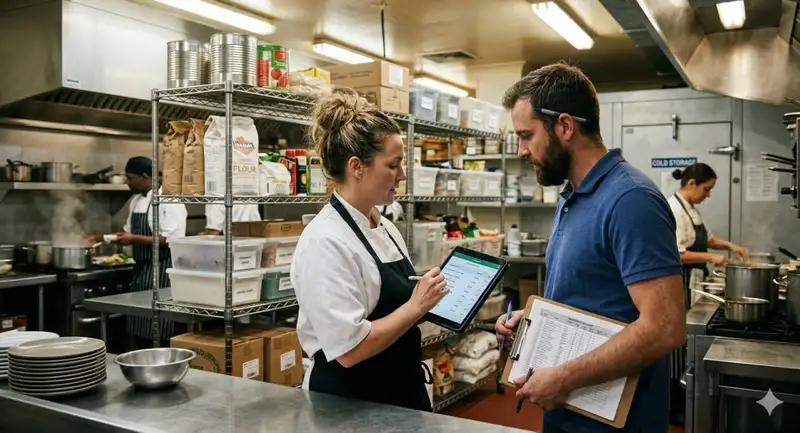
Inventory is where profit is either protected or lost. Most restaurants do not have an inventory problem because of one major mistake. They have a system problem - small breakdowns in receiving, counting, portioning, or ordering that compound over time. An internal audit in this area should answer one core question - Is your inventory system accurate, controlled, and being followed consistently?
Here are the main points to review -
1. Verify receiving procedures and invoice accuracy
Start at the point where product enters the restaurant. Check whether deliveries are being counted, weighed, and verified against invoices before acceptance. Look for blind receiving versus rushed acceptance. If errors are not caught at delivery, they become permanent cost issues.
2. Compare invoices to actual usage and cost trends
Review whether what is being purchased aligns with sales volume and menu demand. Sudden increases in ordering, price discrepancies, or inconsistent vendor pricing should be flagged. This step helps identify over-ordering, vendor issues, or poor purchasing discipline.
3. Audit inventory counts and count accuracy
Check how often inventory is counted and how accurate those counts are. Compare physical counts to system records. Large variances indicate breakdowns in counting processes, theft, waste, or incorrect data entry. Consistency in counting is just as important as accuracy.
4. Review portion control and prep consistency
Evaluate whether recipes and portion sizes are being followed. Over-portioning is one of the fastest ways to lose margin, and it often goes unnoticed without structured audits. Watch actual prep behavior, not just recipe documentation.
5. Check waste tracking and shrinkage visibility
Look for whether waste (spoilage, overproduction, errors) is being recorded and reviewed. If waste is not tracked, it cannot be controlled. High shrinkage without explanation is a clear sign of process failure somewhere in the operation.
6. Evaluate par levels and ordering discipline
Review whether par levels are set correctly and followed during ordering. Frequent stockouts or overstocking both indicate poor planning. Inventory should support demand without tying up unnecessary cash or creating excess waste.
7. Inspect storage organization and product handling
Check how products are stored, labeled, and rotated. Disorganized storage leads to missed items, duplicate ordering, and faster spoilage. Proper organization supports both food safety and cost control.
Inventory control is about building a system where purchasing, receiving, storage, and usage all align. When one part breaks down, it impacts everything - from food cost to service consistency. An internal audit helps identify exactly where that breakdown is happening so it can be corrected quickly.
Create, Implement, and Execute Multiple Daily Checklists
Streamline Your Operations with Altametrics
Opening, Closing, and Daily Operating Procedures
Daily routines are what keep a restaurant stable. Opening, closing, and shift-based procedures are designed to ensure consistency, cleanliness, readiness, and accountability. When these routines break down, the impact shows up quickly - missed prep, equipment issues, slower service, and inconsistent guest experiences. An internal audit in this area should answer one key question - Are daily procedures being completed fully, correctly, and on time?
Here are the main points to review -
1. Verify opening procedures are completed before service begins
Check whether prep is finished, stations are stocked, equipment is turned on and functioning, and the restaurant is fully ready to operate. If teams are still setting up after opening time, it creates immediate service delays and stress on staff.
2. Audit closing procedures and end-of-day discipline
Review whether cleaning, breakdown, restocking, and shutdown tasks are completed properly at the end of each shift. Incomplete closing routines often lead to problems the next day, including food safety risks, missing inventory, and delayed openings.
3. Confirm prep execution and production planning
Evaluate whether prep lists are followed and aligned with expected demand. Under-prepping leads to stockouts and slower service, while over-prepping increases waste. This step ensures production is controlled, not reactive.
4. Check equipment condition and readiness
Inspect key equipment such as grills, fryers, refrigeration, and POS systems. Look for signs of poor maintenance, improper cleaning, or equipment not being ready for use. Equipment issues often start small but can disrupt operations quickly if not addressed.
5. Review shift handoff communication
Assess how information is passed between shifts. Are managers documenting issues, low stock items, or equipment concerns? Poor communication between shifts leads to repeated mistakes and missed follow-up on important tasks.
6. Observe manager walkthroughs and oversight
Managers should be actively verifying that procedures are completed, not just assuming they are done. Check whether walkthroughs are happening and whether managers are holding the team accountable to standards.
7. Compare checklists to actual conditions
Completed checklists do not always reflect reality. Walk the restaurant and compare what is marked as "done" versus what you actually see. This is one of the most effective ways to identify gaps in execution.
When opening and closing routines are followed properly, the restaurant runs smoother, teams stay aligned, and problems are caught early. When they are ignored or rushed, issues build up and affect every part of the operation.
Staff Accountability, Documentation, and Follow-Up
An internal audit only creates value if the restaurant has a clear way to assign responsibility, document issues, and confirm that corrections actually happen. Many restaurants are good at identifying problems. Fewer are good at making sure those problems stay fixed. That is why accountability and follow-up should be a separate part of the audit, not an afterthought.
Here are the main points to review -
1. Check training records and policy acknowledgment forms
Start by confirming that employees have completed required training and signed off on key policies. This includes food safety procedures, cash handling rules, attendance expectations, harassment prevention where applicable, and any role-specific operating standards. If training is incomplete or poorly documented, accountability becomes much harder to enforce.
2. Review corrective action documentation
Look at how performance issues, policy violations, and operational errors are being recorded. Corrective action should be consistent, factual, and tied to clear expectations. If similar issues are happening repeatedly with no documentation, that usually means the restaurant is relying on verbal reminders instead of a real accountability process.
3. Audit incident logs and manager notes
Review logs for guest complaints, food safety incidents, cash discrepancies, employee issues, equipment problems, and unusual shift events. These records help owners see patterns over time. One incident may be isolated. Repeated incidents usually point to a larger process or leadership problem.
4. Check maintenance logs and repair follow-up
Equipment and facility issues should not live only in text messages or verbal updates. Confirm that maintenance problems are logged, assigned, and tracked through completion. Delayed follow-up on repairs often turns small operational issues into service interruptions or safety risks.
5. Review whether previous audit findings were resolved
This is one of the most important steps in the whole internal audit process. Go back to prior findings and confirm what was corrected, what is still open, and what has reappeared. If the same issues continue showing up, the problem is no longer awareness. It is follow-through.
6. Confirm ownership for each issue
Every identified issue should have a responsible person, a due date, and a clear expected outcome. When problems are assigned vaguely to "the team" or "management," they often remain unresolved. Accountability works best when ownership is specific.
7. Measure whether corrections are actually sustained
A problem is not fully solved just because it was fixed once. Internal audits should verify whether the correction held over time. This is what separates short-term cleanup from real operational improvement.
A strong restaurant internal audit process also proves that issues are documented, assigned, corrected, and kept under control. Without that follow-up loop, the same breakdowns will keep returning.
Turn Audit Findings Into an Action Plan
An internal audit only delivers value when findings turn into clear, prioritized action. Without structure, audits become a list of problems with no follow-through. The goal is to move quickly from observation to execution.
Start by grouping findings by risk level. Food safety, labor compliance, and cash control issues should be addressed immediately. Lower-risk items can be scheduled but should still have deadlines. Next, assign clear ownership for every issue. Each item should have one responsible person, a due date, and a defined outcome. This removes ambiguity and speeds up resolution.
Then, track progress consistently. Use a simple system to monitor open vs. completed items and revisit high-risk categories more frequently. Over time, look for patterns. Repeated issues signal a process breakdown, not a one-time mistake.
Finally, standardize your audit process so it becomes repeatable across locations and teams. Consistency is what turns audits into a long-term control system.
If you want to simplify this process, tools like Altametrics help centralize audit checklists, track corrective actions, and connect audit data to labor, inventory, and reporting systems. Instead of managing audits manually, you gain real-time visibility and accountability across your entire operation. Learn more about Altametrics by clicking "Book a Demo" below.
The result - faster corrections, stronger compliance, and better operational control.

Must-Read Content


Audit management
Audit Management Tips for QSR Owners

Operational audit
How to Conduct an Operational Audit in a Hotel

Compliance audit
What Is a Compliance Audit in a Restaurant?

Risk management audit
The Key Areas to Review in a Restaurant Risk Management Audit
Frequently Asked Questions
What should a restaurant internal audit checklist include?
A restaurant internal audit checklist should usually include food safety and sanitation, cash handling, POS controls, labor and timekeeping, inventory management, opening and closing procedures, staff documentation, and follow-up on corrective actions.
What tools can restaurant owners use to simplify internal audits?
Many owners use digital checklists, reporting dashboards, and restaurant management platforms like Altametrics to streamline audits, track issues, and improve visibility across operations.
What are the most common problems an internal audit uncovers?
Common findings include incomplete cleaning routines, incorrect temperature logs, unapproved discounts or comps, timekeeping edits, missed breaks, inaccurate inventory counts, weak prep execution, and poor follow-up on recurring issues.
What is the best way to track audit results over time?
Use a system that records scores, tracks recurring issues, and highlights trends. Over time, this allows owners to identify which areas are improving and which continue to need attention.