Know what you have. Predict what you need. Protect every dollar.

Connect AI-assisted counting, forecasting, purchasing, receiving, food-cost variance, and restaurant inventory management operations, so your team makes smarter inventory decisions at every location.

0+

Restaurant locations supported

0M+

Hourly workers supported

0+ yrs

In restaurant technology

24/7

Human-driven support

Trusted by 100,000+ restaurant professionals across the globe

steak n shake logo
outback steakhouse logo
five guys burgers logo
cicis pizza vertical logo
dunn brothers coffee logo
chipotle mexican grill
mooyah

Every disconnected decision 

can affect food cost.

Background Shape
ai inventory timeline main

One connected view of every ingredient, every decision, every location.

Altametrics brings together counts, sales, recipes, forecasts, invoices, waste, and supplier information to help teams understand what they have, investigate what changed, and decide what to do next.

  • AI-assisted counts and inventory visibility by storage location

  • Actual-versus-theoretical usage and food-cost investigation

  • Demand-informed purchasing, receiving, and invoice review

  • Waste, supplier changes, transfers, and multi-location insight

The order is one step.

Intelligence is the whole journey.

Connect the decisions restaurant teams make every day - from the first count to
the next operational improvement.

01 · Count

Know what you have

Capture on-hand inventory by item and storage location, and review unusual count changes.

Freezer count differs from expected inventory.
02 · Forecast

Predict what you need

Connect available sales history, recipes, promotions, and demand signals to anticipated usage.

Friday dinner demand is trending higher.
03 · Purchase

Review smarter orders

Evaluate suggested quantities, supplier timing, on-hand inventory, and operating needs.

Review chicken coverage before the next delivery.
04 · Receive

Check what arrived

Review deliveries, purchase orders, invoice information, and potential pricing discrepancies.

Invoice pricing differs from the expected cost.
05 · Track

Follow every ingredient

Bring together usage, waste, transfers, recipes, and other available restaurant inventory activity.

Produce should be reviewed for shelf-life risk.
06 · Analyze

Investigate food cost

Compare actual and theoretical usage to identify where managers may need to look closer.

Ground beef variance is higher than expected.
07 · Compare

See every location

Surface item-level exceptions and inventory trends across restaurants, districts, and brands.

Three stores show the same ingredient variance.
08 · Improve

Make the next decision better

Use current operating results and manager feedback to inform future inventory actions.

Review portions, prep, and upcoming demand.

Every inventory signal connected.

Better decisions at every step.

Bring available restaurant data into one clearer view of inventory, demand, purchasing, waste, variance, and food cost.

POS sales
Recipes & BOM
Inventory counts
Supplier catalog
Invoices
Forecasts
Waste logs
Transfers
AI Engine
Optimizing

Why is chicken inventory being flagged?

Recorded usage is above the recipe-based expectation, the latest count shows less on hand than anticipated, and weekend demand is increasing. Review count accuracy, recorded waste, portioning, and the next delivery before approving an order.

  • POS sales
  • Recipe usage
  • Latest count
  • Waste logs
  • Weekend forecast
  • Manager approval

An inventory intelligence

command center.

Bring inventory health, usage, food-cost signals, and manager-ready
recommendations together in one connected restaurant inventory management operating view.

ai inv showcase main

Usage heatmap

Health score

0

Inv. value

0

Usage heatmap

Inventory exceptions

Chicken wings · low coverage
Review
Burger buns · price change
Invoice
Cheddar · unusual usage
Variance
Ground beef · count reviewed
Ok

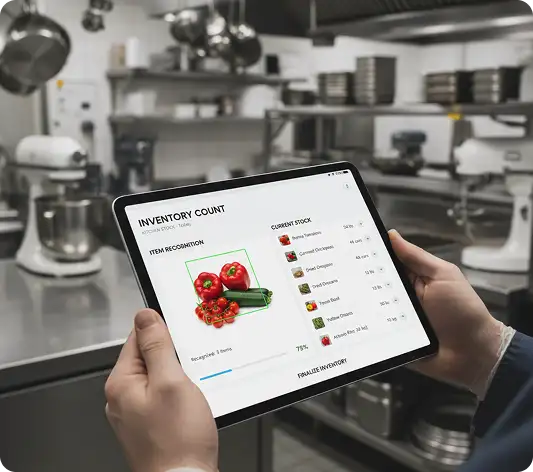
AI-assisted inventory counting

Count smarter. Understand more.

Give restaurant teams an easier way to capture inventory across shelves, coolers, freezers, and dry storage while managers review discrepancies and connect every count to food costing software decisions.

AI-assisted inventory counts
Receiving and waste capture
Count discrepancy review
Manager-approved decisions
Invoice information review
Storage-location organization

One platform for the full inventory lifecycle.

Connect counts, forecasting, purchasing, prep, food cost, suppliers, and enterprise reporting in a clearer inventory management software model for restaurants.

AI-assisted inventory counting
Capture on-hand inventory and review count exceptions
Storage-location organization
Structure counts across coolers, freezers, and dry storage
Suggested purchasing
Review demand-informed quantities and supplier timing
Inventory transfers
Include recorded transfers when reviewing inventory movement
Mobile inventory workflows
Count, receive, and review inventory from the floor
Demand and prep forecasting
Connect anticipated activity with ingredient needs
Prep and production visibility
Support more informed restaurant preparation decisions
Recipe management
Review ingredients, yields, and expected item usage
Shelf-life awareness
Identify items that may need operational attention
Waste tracking
Capture waste information for food-cost investigation
Food and beverage cost
Review available purchasing and ingredient-cost signals
Inventory variance
Compare actual and theoretical ingredient usage
Portioning and consistency
Investigate unexpected recipe-level usage patterns
Invoice review
Examine received quantities and potential pricing differences
Menu and ingredient context
Connect food-cost signals with recipes and operations
Supplier and purchasing workflows
Review available vendor information and delivery timing
Contract and invoice checks
Investigate differences in expected and recorded costs
Supplier price visibility
Surface pricing changes that may affect food cost
Inventory analytics
Understand waste, usage, purchasing, and inventory trends
Multi-location oversight
Review exceptions and inventory patterns across restaurants
AI-assisted inventory counting

Inventory works better when it knows

the whole restaurant.

Connect inventory decisions with available sales, forecasting, supplier workflows,
accounting software with inventory management, and broader restaurant operations.

air inventory sales

Sales, recipes & forecasting

Connect operating activity with anticipated ingredient needs.

air inventory suppliers

Suppliers, purchasing & receiving

Review supported ordering, delivery, and invoice workflows.

air inventory accounting

Accounting & restaurant operations

Put food cost, inventory changes, and operating results in context.

Designed for the people who run the operation

Better inventory decisions at
every level.

Ai Inventory Decisions
Restaurant teams
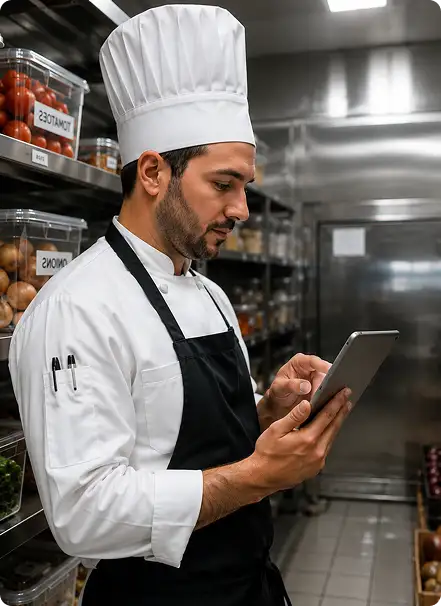
Count with greater confidence

Capture inventory by storage location, review unusual quantities, and share relevant exceptions with the manager.

Kitchen and prep leaders
Connect inventory with execution

Use recipe, usage, and forecast information to make more informed prep and ingredient decisions.

Purchasing and finance
Understand supplier and invoice changes

Review available purchasing information, pricing differences, invoice details, and food-cost trends.

General managers
Turn inventory signals into action

Investigate food-cost changes, review suggested orders, and connect counts with waste, deliveries, and demand.

District managers
See patterns across restaurants

Identify recurring ingredient variance, count discrepancies, and operational exceptions across assigned locations.

Enterprise and franchise leaders
Build a more connected operating picture

Support consistent inventory workflows and clearer multi-location visibility across the organization.

Operators run on it.

Here's what changed.

The restaurant software is user-friendly and it's something that anyone from an inexperienced to experienced restaurant manager can understand.

Before we used a spreadsheet where we have to type out manually, now with Altametrics we have a better approach to forecasting, scheduling hours, deployment of labor, who's taking a break when, and effective cross-training.

Since we started using Altametrics, we have been able to get our labor deployment and labor forecasting much more accurate than any prior systems that we've used.

The ability to go in and do food management on a weekly basis, do all of our receiving within that system, also for it to forecast orders out is really starting to make the analytics and insight into how we better control our costs just improve ten fold.

The food management products are an integral part of how we operate our business. So it's not just restaurant software, it is part of our culture.

Food safety with Altametrics has become much easier which means we can devote more time to helping our guests and seeing their smiles on their faces.

My Hong Kong team can opt to see all their business intelligence reporting in US dollars and that reporting is done on the fly to make it very valuable for the team in that market.

What Altametrics business intelligence is doing for my operators is telling them where they need to put most of their attention. So to me, that is a tool that doesn't exist anywhere else. Everyone should use it.

As a franchise company, we need to know what all the sales are in our stores so Altametrics Business Intelligence was able to develop a system that could get that information for us.

The ability to go in and do the inventory on a weekly basis and do all of our receiving within that system. Also for it to forecast orders out is really starting to make the analytics and the insight into how we better control our cost just improve tenfold.

Sales forecasting has improved greatly since implementing eRestaurant it is much more consistent. It takes the guesswork basically out of evaluation in forecasting. It populates basically four past weeks and does the math for you and kind of gives you an average to where you can forecast for each day.

We already use Altametrics enterprise so when we heard about zip clock, we had to try it out.

Frequently

Asked Questions

Everything you need to know about the Altametrics platform and our best restaurant inventory management software.

What makes Altametrics more than an automated ordering tool?

Altametrics connects the broader restaurant inventory lifecycle, including AI-assisted counting, sales and recipe information, demand forecasting, purchasing, receiving, waste, invoice review, food-cost variance, and multi-location visibility. Suggested ordering is one part of the overall operating picture.

How does AI-assisted inventory counting help restaurant teams?

AI-assisted counting helps teams capture inventory, organize items by storage location, and identify discrepancies that managers may want to review. Available functionality depends on the products and configuration selected.

How does the platform help investigate food-cost variance?

By connecting available counts, POS sales, recipes, recorded waste, transfers, purchasing information, and invoices, managers can compare actual and theoretical usage and investigate potential explanations for unexpected inventory changes.

How are AI inventory recommendations explained?

Recommendations can be presented in the context of the available operational signals behind them, such as current on-hand inventory, anticipated demand, recipe usage, supplier timing, waste, or an unusual count. Managers remain responsible for reviewing and approving decisions.

Can Altametrics connect with our existing POS, suppliers, and accounting workflows?

Altametrics can support connected workflows across restaurant sales, supplier and purchasing information, invoices, accounting, and operational reporting. Specific integrations, available data, and implementation requirements should be confirmed for each customer environment.

Does the platform support franchise groups and enterprise brands?

Yes. Altametrics supports restaurant operations ranging from individual locations to multi-unit, franchise, and enterprise organizations, with inventory visibility based on the products, locations, and configuration included in each implementation.

Does AI automatically make purchasing or inventory decisions?

AI is intended to support restaurant teams with recommendations and operating context. Managers remain in control of reviewing inventory exceptions, investigating food-cost signals, and approving purchasing or other operational decisions.