How do I measure if my marketing is working?
Track a few owner-friendly numbers - calls/directions/website clicks, orders/reservations, promo redemptions, average ticket, repeat visits, and email/SMS list growth.
Restaurant Marketing 101 - The Simple Plan to Get More Customers

Understanding Restaurant Marketing
Restaurant marketing is about doing the right few things consistently so more people can find you, choose you, and come back. Most restaurant owners don't struggle because they lack ideas - they struggle because marketing becomes random. One week you post daily. The next week you're slammed and disappear. Then you run a discount to "make up for it," but it doesn't build steady traffic. Marketing is the opposite of chaos- it's a simple system you can repeat.
At its core, restaurant marketing has three jobs -
1. Get discovered (online and locally). When someone searches "best burgers near me" or walks by your storefront, your restaurant needs to show up and look trustworthy.
2. Get chosen (over the other options). Your menu, photos, reviews, offer, and messaging should make it easy to say "yes."
3. Get repeated (turn first-time guests into regulars). The most profitable marketing is keeping customers coming back, not constantly paying to replace them.
Here's what restaurant marketing is -
- A plan built around your goals (fill slow days, grow takeout, increase catering, boost repeat visits).
- A foundation that makes you easy to find (Google profile, accurate listings, clear menu access).
- A weekly rhythm for digital marketing (simple content, basic list building, light engagement).
- Local visibility that captures your nearby community (partners, events, neighborhood outreach).
- Promotions with guardrails that drive traffic without destroying margin.
And here's what restaurant marketing isn't -
- Not "post on every platform." You don't need five social channels - you need one or two you can maintain.
- Not "run discounts whenever it's slow." Discounting is a tool, not a strategy. Used too often, it trains guests to wait for deals.
- Not "go viral." Viral moments are unpredictable. A simple plan that reliably brings in customers is the real win.
- Not "set it and forget it." Marketing needs small, consistent attention - like a weekly prep list - not a huge monthly overhaul.
Think of this article as a practical playbook for building a marketing plan that covers Online, Digital, Local, and Promotions - without needing a big budget, a marketing team, or a complicated process. The goal is steady, measurable growth you can sustain while still running your restaurant.
Set Your Foundation
Before you spend money on ads, print flyers, or plan a promotion, you need a simple foundation. Without it, marketing turns into guessing - and guessing usually leads to inconsistent results. This section is about setting three basics - your goal, your budget (time and money), and your message. When these are clear, every online post, local partnership, and promotion becomes easier to choose and easier to measure.
Start by picking one primary goal for the next 30-90 days. Most restaurants try to solve everything at once (more dine-in, more delivery, more catering, more followers), and end up doing none of it well. Instead, choose the one outcome that would make the biggest difference right now. Examples include -
- Fill slow days (like Monday-Wednesday)
- Increase lunch traffic
- Grow takeout and online ordering
- Build catering orders from nearby offices
- Increase repeat visits from first-time guests
Next, define your best guest in simple terms. You don't need a complicated profile - just enough clarity to guide decisions. Ask - Who do you want more of, and why do they choose restaurants like yours? For example - families who want quick dinner solutions, nearby office workers who need lunch in under 30 minutes, late-night customers looking for comfort food, or health-focused guests who care about ingredients. When you know who you're speaking to, your offers and messaging stop being generic.
Then write one clear message that describes your restaurant in a way customers immediately understand. A simple formula is -
"We help (type of guest) get (main benefit) with (your signature / differentiator)."
Examples -
- "Fast, fresh bowls for busy lunch breaks."
- "Comfort food classics made from scratch."
- "Family-friendly favorites with big portions and quick service."
Now choose a realistic budget, including both money and time. Marketing can work with $0, but it still requires consistency. Decide what you can sustain -
1. Time - even 60-90 minutes per week is enough to keep momentum.
2. Money - pick a monthly number you won't resent (even $100-$300 can be useful if you focus it).
Finally, decide how you'll track success. Keep it simple and measurable -
1. Traffic goals (more orders, more reservations, more walk-ins)
2. Online actions (calls, directions, website clicks)
3. Repeat behavior (return visits, loyalty sign-ups, list growth)
When your goal, guest, message, and budget are set, you're no longer "doing marketing." You're executing a plan - with purpose.
Online Must-Haves
If your restaurant marketing plan has a "home base," this is it. Before social posts, before promotions, before ads, you need your online presence to do one thing well- help customers find you and take action. For most restaurants, those actions are simple - call, get directions, view the menu, or place an order. When these basics are missing or inaccurate, you lose customers you would have earned without spending a dollar.
Start with your Google Business Profile (GBP). For many restaurants, Google is the the first source of discovery - especially for "near me" searches. Make sure your profile is complete and accurate -
- Correct name, address, phone numbe, hours, and holiday hours
- The right primary category and relevant secondary categories
- A clear link to your menu (and online ordering/catering if you offer it)
- Attributes that matter (dine-in, takeout, delivery, outdoor seating, etc.)
- Fresh photos added regularly (even a few per week helps)
Next, your website (even if it's simple) should remove friction. You don't need a complicated design, but you do need the essentials -
- Menu that's easy to view on mobile (no tiny text)
- Hours and location that match Google exactly
- A strong call-to-action - "Order Online," "Reserve," "Call," or "Catering"
- Basic info customers look for - parking, accessibility, dietary notes, and contact options
Then focus on reviews, because reviews are sales copy written by your customers. A common mistake is only thinking about reviews when something goes wrong. Instead, create a consistent review habit -
- Ask happy guests at the right moment (after a compliment, at checkout, or with takeout pickup)
- Use simple signage or a QR code that links to your review page
- Respond to reviews regularly (especially recent ones). Keep replies short, polite, and specific.
Also check your listings consistency across platforms. Customers bounce when they see conflicting hours, old phone numbers, or the wrong address. At minimum, confirm accuracy on -
- Apple Maps
- Yelp
- Facebook
- TripAdvisor (if relevant to your area)
Finally, invest in photos - because photos reduce uncertainty. Most customers decide with their eyes before they ever taste your food. You don't need professional shoots every month, but you should maintain a steady flow of quality images -
1. 5-10 of your best-selling items
2. Interior/exterior shots so people know what to expect
3. Team photos that feel real (not staged)
4. Limited-time specials posted quickly
If you do nothing else this week, tighten your Google profile, make your menu easy to access, and clean up your listings. That alone can increase calls, directions, and orders - without changing your food or spending on ads.
Digital Marketing
Digital marketing becomes overwhelming when you try to "be everywhere" and post whatever comes to mind. A better approach is to build a simple, repeatable system you can maintain even during busy weeks. Your goal isn't to entertain the internet - it's to stay visible to local customers, give them reasons to choose you, and create easy paths back (order links, reservations, list sign-ups).
First, pick one or two platforms you can realistically manage. For many restaurants, that's -
- Instagram (great for photos, Reels, Stories)
- Facebook (strong local discovery, events, community groups)
- TikTok (if you can consistently do short-form video)
Don't choose based on what's "cool." Choose based on where your customers already are and what you can execute consistently.
Next, create a content system using content buckets - repeatable categories that make posting easier. Rotate these buckets so you're not constantly inventing ideas -
1. Best sellers and cravings (your most photogenic, most ordered items)
2. People and behind-the-scenes (prep, grills, plating, team moments)
3. Limited-time offers (specials, seasonal items, weekend features)
4. Social proof (reviews, customer photos, UGC, "customer favorite" callouts)
5. Local/community tie-ins (nearby events, partnerships, neighborhood shoutouts)
Now set a lightweight schedule you can actually stick to. A solid starter plan -
1. 3 posts per week (mix of food + behind-the-scenes + promo or review)
2. 3-5 Stories per week (quick updates. "today's special," "sold out," "busy now")
3. 1 short video per week (15-30 seconds- pour shots, grilling, assembly, quick menu highlights)
Then add one of the most overlooked growth tools - email and SMS. Social media helps people discover you, but lists help you bring them back without paying for reach. Start simple -
- Collect emails/SMS at checkout, online ordering, or with a QR code on receipts
- Offer a small incentive that doesn't crush margins (free add-on, first access to specials, birthday perk)
- Send 1 message per week max to start- new special, slow-day boost, event announcement, or "today only" offer
Finally, make digital marketing measurable. At minimum, track -
- Link clicks to ordering/menu
- Calls/directions from Google or social profiles
- List growth (new emails/SMS per week)
- Redemptions of any promo codes or "mention this post" offers
Digital marketing works best when it's treated like a routine - not a creative emergency. If you can commit to a simple weekly rhythm and repeat your best-performing content buckets, you'll stay top-of-mind in your area and consistently attract more customers.
Local Marketing
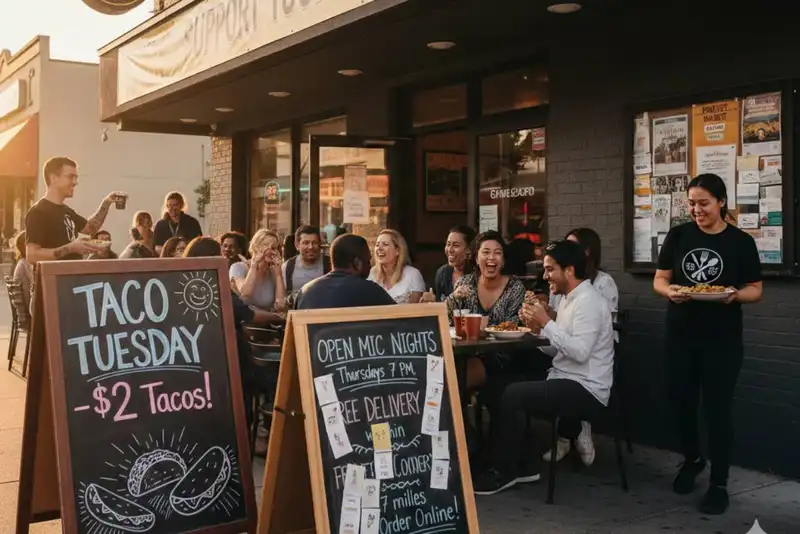
Most restaurants don't need "everyone" to know about them - they need the people who live, work, and commute nearby to choose them more often. Local marketing is how you become the obvious option in your immediate area. The best part - it's usually cheaper than digital ads and often produces higher-quality customers because you're targeting people who can actually come back.
Start by mapping your local opportunity zones. Think in terms of groups, not "the public." Common local customer sources include -
- Nearby offices and business parks (lunch and catering)
- Apartment communities (repeat dinner traffic)
- Schools (teachers, parents, events)
- Gyms and wellness studios (post-work meals)
- Hotels (visitors looking for reliable food)
- High-traffic neighbors like coffee shops, breweries, barbershops, or boutiques
Next, build local partnerships that create win-win visibility. This doesn't need to be complicated. Offer simple cross-promotion -
- Leave menus or table tents at complementary businesses (and do the same for them)
- Create a neighborhood perk - "Show your gym badge for a free add-on" or "10% off for hotel guests"
- Partner on a small event- tasting night, fundraiser, pop-up, or community day
Then focus on local visibility that catches people who are already close. This includes things owners often overlook because it feels old school, but it works when done well -
- Clear, readable signage (hours, what you sell, and a strong Order Online or Pick Up Here message)
- Sidewalk presence (A-frame sign with one simple offer, not a paragraph)
- Local community boards and neighborhood newsletters
- Posting your events or promotions in local Facebook/Nextdoor groups (follow each group's rules)
You can also use street-level promotions without wasting money. The key is relevance and targeting -
- Flyers and door hangers can work if you target a tight radius and include a specific offer with an expiration date
- "Bounce-back" cards (given at checkout) bring guests back more reliably than random coupons
- "Neighbor nights" for nearby apartments or businesses work best when you coordinate with a property manager or office admin
Finally, consider events and micro-sponsorships. You don't need to sponsor major sports teams or expensive festivals. Small, consistent involvement builds recognition fast -
- Donate gift cards to local raffles
- Sponsor a youth team with a simple banner
- Host trivia, tasting flights, or live music if it fits your concept
Local marketing is about being present where your customers already are. When you build a few strong neighborhood relationships and pair them with visible, simple offers, you stop relying only on random online discovery - and start creating steady, repeatable traffic from the people closest to you.
Get Started with Smart Data Capture
Optimize Your Marketing Efforts with Altametrics
Promotions
Promotions can be a powerful way to drive traffic - especially on slow days - but they can also quietly wreck profitability if they're built around heavy discounts. The goal of "Restaurant Marketing" promotions is simple- increase visits, increase frequency, or increase average ticket while protecting your margins. That means you need the right promo types, clear rules, and a basic calendar so you're not making last-minute decisions when sales dip.
Start with a key principle - discounting should not be your default. If your go-to move is "20% off," you may get a short spike, but you also train customers to wait for deals. Instead, use promotions that feel valuable without giving away profit. Strong options include -
1. Bundles and combos - Build bundles using items that are easy for you to execute and have decent margins. Examples - "Dinner for Two," "Family Meal," "Lunch Combo + Drink." Bundles raise ticket size and simplify decisions.
2. Add-ons and upgrades - Rather than discounting the whole meal, offer a free or low-cost add-on that has high perceived value. Examples - "Free side with entree," "Upgrade to a larger drink for $1," "Add dessert for $3."
3. Limited-time offers (LTOs) - LTOs create urgency without needing a discount. Seasonal items, rotating specials, and weekend features give people a reason to visit now.
4. Slow-day specific promos - Target MondayWednesday or off-peak hours with offers that fit your workflow. The point is to shift demand, not discount your busiest times.
5. Loyalty-based perks - Reward repeat guests, not everyone. "Members get early access," "Punch card bonus," or "Points for visits" protects margin and builds frequency.
Next, create promotion guardrails. A promo should be easy for staff to execute and hard to abuse. Define -
- Start/end dates and redemption windows
- Dine-in vs. takeout eligibility
- Minimum spend requirements (if needed)
- Limits (one per customer, one per order, etc.)
- Clear menu items included (avoid confusion at the register)
Then build a simple promo calendar so promotions support your marketing plan instead of replacing it. A practical rhythm looks like -
- Monthly theme (seasonal item, community tie-in, or menu highlight)
- Weekly feature (one consistent special day)
- One targeted "push" per month (list message + social + local outreach)
Finally, track whether promotions actually worked. You don't need complicated reporting - just make sure you can answer -
- Did traffic increase during the promo window?
- Did average ticket stay healthy (or rise)?
- Did the promo bring new guests or repeat guests?
- Was it easy for the team to execute?
Good promotions don't just "create sales." They create habits - customers learn when to come, what to order, and why you're worth returning to.
Turn First-Time Guests Into Regulars
Getting a new customer is great - but the real profit comes from getting that customer to come back. If your marketing plan focuses only on attracting new guests, you'll always feel like you're chasing sales. A Restaurant Marketing plan builds a system that turns first-time guests into repeat customers through small, consistent actions. The goal is simple- increase the number of people who visit a second time. That's when loyalty starts to form.
Start by focusing on the "second visit window." In many restaurants, if someone is going to return, it usually happens within a relatively short timeframe. Your job is to make that return easy and compelling. The most effective retention tools are not flashy - they're reliable -
1. A simple loyalty program - Loyalty should be easy to understand and easy to redeem. Complicated point systems confuse customers and frustrate staff. A good loyalty program rewards frequency, not just spending, and encourages the next visit - "Buy 8, get 1 free," "Visit twice this month, unlock a perk," or "Members get a monthly bonus." Keep it simple enough that staff can explain it in one sentence.
2. Email and SMS follow-up - Social media helps with discovery, but your list helps with repeat visits. Use your email/SMS list to stay top-of-mind with light, high-value messages -
- Welcome message (thanks + what to try next)
- Weekly special or weekend feature
- Slow-day boost (limited-time perk)
- Birthday or anniversary offer
- Win-back message if someone hasn't visited recently
You don't need to message daily - consistency matters more than frequency.
3. In-store habits that support retention - Retention isn't only marketing - operations play a role. Make it easy for guests to return by being consistent with the basics - clean dining areas, accurate orders, fast pickup, and friendly service. Then add small "repeat visit triggers" -
- Ask guests how they found you (helps you learn what's working)
- Invite them to join loyalty or your SMS list at checkout
- Train staff to recommend one next time item (If you like this, try our...)
4. Takeout and delivery retention - Off-premise orders are a major opportunity, but they're also easy to lose if the experience is inconsistent. Use packaging and inserts to drive a second order -
- A QR code to reorder quickly
- A "thank you" card with a simple next-visit perk
- A note highlighting a best seller they didn't try
The best retention strategy is to treat every first-time guest like a future regular. If you can improve repeat visits even slightly, your marketing becomes more efficient, your promotions become less necessary, and your revenue becomes more predictable.

Must-Read Content

Restaurant promotion ideas
Restaurant Promotion Ideas That Increase Sales
Food delivery promotions
Food Delivery Promotions That Drive More Orders

Online marketing for restaurants
Online Marketing for Restaurants

Digital marketing for restaurant
Digital Marketing for Restaurant Owners

Restaurant marketing strategies
Restaurant Marketing Strategies
Frequently Asked Questions
What's the difference between marketing and advertising for restaurants?
Marketing is the full system (online presence, messaging, promotions, retention). Advertising is just one tool - paid placements like Google or social ads - inside the larger marketing plan.
What local marketing tactics work best for restaurants?
Partnerships within 1-5 miles (offices, apartments, gyms, schools, hotels), community events, local group posts, and targeted neighborhood outreach work well because they reach repeatable customers.
How often should a restaurant post on social media?
A realistic starter rhythm is about 3 posts per week, a few Stories, and one short video weekly. Consistency matters more than volume.
What's the best way to get more Google reviews?
Ask happy guests at the right moment, use a QR code at checkout or on receipts, and respond to reviews regularly. Make it easy and consistent.