What are the main types of marketing for restaurants?
The main types are owned marketing (website, Google Business Profile, email/SMS), paid marketing (ads and promos), and earned marketing (reviews, word-of-mouth, social shares). Most restaurants use a mix of all three.
Types of Marketing for Restaurants

Overview
Most restaurant owners don't need "more marketing ideas." You need a clear map - so you can stop guessing, stop jumping between random tactics, and start doing the few things that reliably bring in guests.
When people say "marketing," they often mean social media. But for restaurants, marketing is much bigger than posts and hashtags. It's how customers find you (Google and maps), how they decide (reviews, photos, menu clarity), how they buy (online ordering, calls, reservations), and what makes them come back (email/SMS, loyalty, great on-premise experience). You don't need to do everything. You just need the right mix for your goals and your budget.
What Marketing Is Supposed to Do for a Restaurant
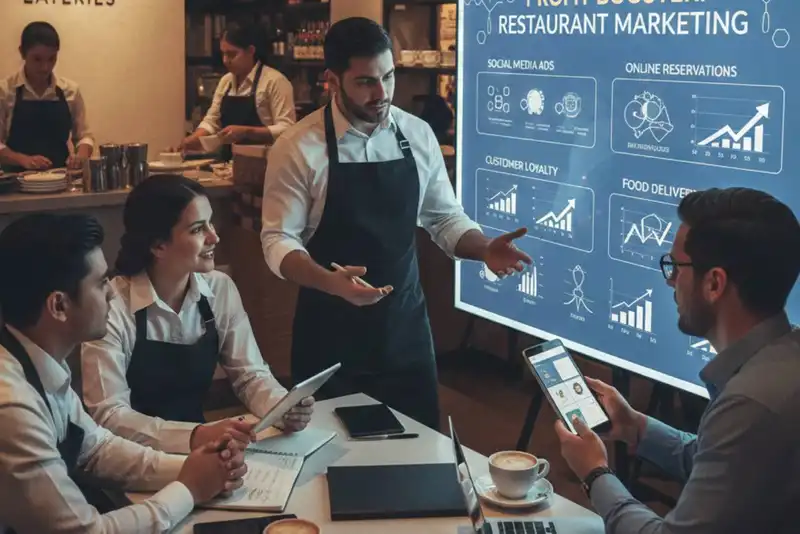
Before you choose any types of marketing - social, email, ads, partnerships - you need clarity on what marketing is actually supposed to do. Otherwise, it turns into busywork - posting when you remember, running a discount when sales dip, and hoping something sticks. In a restaurant, marketing has one practical job - bring in the right guests at the right times, then give them a reason to return.
A simple way to think about it is a three-step chain -
1. Be discoverable. People can't buy from you if they can't find you. For restaurants, "discoverable" usually means showing up when someone searches nearby (on Google and Maps), when a friend recommends you, or when your food shows up in their feed. Discovery is about visibility and credibility - clear hours, accurate location info, strong photos, and enough reviews that you feel like a safe choice.
2. Convert that interest into a visit or order. This is where many beginner marketing plans break. You might get attention, but the customer hits friction - the menu is outdated, the ordering link is hard to find, the phone number is wrong, or it's unclear what you're known for. Conversion means making the decision easy - your best sellers are obvious, your pricing and hours are clear, and your ordering/reservation process is smooth.
3. Create repeat behavior. The cheapest customer is the one who already likes you. Marketing isn't only about bringing in new people; it's about increasing frequency. If someone visits once and disappears, you're constantly paying (with time or money) to replace them. Repeat behavior comes from consistency, a strong experience, and direct channels like email/SMS or loyalty that keep you top-of-mind.
To keep this grounded, tie marketing to restaurant outcomes you can measure. Most marketing efforts should connect to one of these -
- More traffic (more covers, more orders, more calls)
- Higher frequency (more return visits from existing guests)
- Higher average check (better mix, add-ons, bundles, upsells)
Here's the most common beginner mistake - choosing a marketing activity before choosing the goal. "We need to do TikTok." "We should run ads." "Let's send a text blast." Those can all work, but only if they match a specific problem. Are weekdays slow? Are you invisible on Google? Do you have lots of first-time guests but low repeat visits? Each problem points to different types of marketing.
If you take nothing else from this section, take this - good restaurant marketing is a system, not a one-off idea. It starts with a clear goal, uses the right channels for that goal, and tracks simple signals each week so you can improve without guessing.
Owned, Paid, and Earned Marketing
Once you know what marketing is supposed to do (get discovered, convert, and bring people back), the next step is choosing the right types of marketing. The easiest "beginner's map" is to sort everything into three buckets- owned, paid, and earned. If you can keep these three straight, you'll make better decisions, waste less money, and build marketing that gets stronger over time.
Owned marketing - assets you control
Owned marketing is everything you can change today without asking permission from an algorithm or paying for reach. For restaurants, owned channels usually include your website, menu page, Google Business Profile (you control the information), email list, SMS list, loyalty program, and your social profiles (you don't control reach, but you control what's on the page). Owned marketing matters because it's the foundation that makes every other type of marketing work better. If your menu is outdated, your hours are wrong, or your online ordering link is buried, paid ads and social posts won't fix that - they'll just send more people into friction.
What to track in owned marketing -
- Website/menu clicks, online ordering clicks, reservation clicks
- Email/SMS list growth
- Offer redemptions from your own channels
- Conversions like calls, directions, and orders
Paid marketing - you pay to get attention
Paid marketing is any channel where you spend money to reach more people or to show up faster. This includes Google search ads, social ads, delivery marketplace promos, retargeting, and sometimes local media placements. Paid marketing is powerful because it can produce results quickly - but it only works when you have two things- a clear goal and a way to measure it. Beginners often make the mistake of "boosting posts" or running ads without tracking orders, calls, or reservations. If you can't connect spending to outcomes, you're not marketing - you're donating.
What to track in paid marketing
- Cost per click (CPC) and, more importantly, cost per order/lead
- Conversion rate (how many clicks turn into orders/calls)
- Return on ad spend (ROAS) when tracking is available
- Incremental lift (do you actually see more orders, not just more impressions?)
Earned marketing - other people talk about you
Earned marketing is what you don't buy and don't fully control - reviews, word-of-mouth, user-generated content, and local buzz. For restaurants, earned marketing is often the difference between being a "maybe" and a "yes." People trust other people more than they trust your ads. That's why a steady flow of recent reviews, great photos, and thoughtful owner responses can outperform a big marketing budget.
What to track in earned marketing -
- Review volume and review recency (not just rating)
- Sentiment themes (what people praise or complain about)
- Referral traffic from social shares or local mentions
Here's how these three work together in a simple funnel - Owned builds trust and conversion, Paid creates reach, Earned creates credibility. If you're a beginner, start by strengthening owned (so you convert), build earned (so you're trusted), then use paid to scale what's already working.
Local Discovery Marketing
For most restaurants, the highest-intent marketing moment happens when someone is already hungry and searching nearby. That's why local discovery marketing is one of the most important "types of marketing" to get right early. It isn't flashy, but it's practical- you show up when people search, you look credible, and you make it easy to take the next step (call, get directions, order, or book).
Start with your Google Business Profile (GBP). This is the card that appears in Google Search and Google Maps, and it heavily influences whether you get clicks or get skipped. A beginner-friendly setup checklist looks like this -
- Make sure your name, address, phone match everywhere online (website, directories, socials).
- Choose the right primary category and add relevant secondary categories.
- Keep hours accurate, including holiday hours.
- Add strong photos (exterior, interior, best sellers, menu boards, team), and update them regularly.
- Link to the correct menu and online ordering/reservations.
Next is local SEO, which is just a fancy way of saying "make it easy for Google to understand what you are and where you are." If you have a website, include your city/area naturally on key pages (home, contact, and menu). If you have multiple locations, each location should have its own page with the correct address and hours. Also, make sure your information is consistent across major listings (Yelp, Apple Maps, Facebook, TripAdvisor, delivery marketplaces). Inconsistent data creates confusion, and confusion kills conversions.
Then, prioritize reviews - because reviews are often the deciding factor. Your goal is not just a high rating, but a steady flow of recent reviews. Create a simple process- ask at the right moment (after a good experience), make it easy (QR code on receipts or table tents), and respond consistently. When responding to negative reviews, stay calm, address the issue, and show you care. That response is marketing too - future guests read it.
Track simple KPIs weekly or monthly
- Google searches (how often you show up)
- Map views
- Calls, website clicks, direction requests
- Review count and average rating
- Online order or reservation clicks (if linked)
If you only improve one thing in local discovery marketing, improve accuracy + clarity. When the basics are correct and your profile looks active, you'll win more "I'm hungry right now" decisions without spending a dollar on ads.
Social Media Marketing
Social media can feel like the most visible type of marketing because you can "see" it happening - posts, stories, comments, likes. But for restaurant owners, the best way to use social media is simple- build trust, show proof, and stay top-of-mind so the next time someone is deciding where to eat, you're an easy "yes." If you treat social like the only growth engine, it becomes exhausting. If you treat it like a supporting channel, it becomes manageable and effective.
Start by remembering what social does well for restaurants -
1. Visual proof - your food looks good, your place feels welcoming, your portions are real.
2. Freshness signals - you're open, active, and consistent - not a dead page.
3. Decision support - people check your profile before they visit, especially if you're new to them.
4. Community connection - you feel local and familiar, not anonymous.
To make social easier, organize your content into a few repeatable content buckets. This keeps you from staring at your phone thinking "what do I post today?" Use 4-6 buckets and rotate -
1. Best sellers (your top 3 items, plated well, short description)
2. Behind-the-scenes (prep, grill, baking, sauce work - simple, real)
3. Promos and limited-time offers (clear dates, clear action. order/visit)
4. People (staff spotlights, culture, hospitality moments)
5. Customer proof (reposts, reviews, UGC, what people are ordering)
6. Local/community (events, partnerships, seasonal moments)
A beginner-friendly cadence that doesn't burn you out -
1. 3-4 posts per week (photos or short video)
2. 2-3 story updates per week (quick, low-effort)
3. 1 short-form video per week if possible (even 8-15 seconds is fine)
The key is clarity. Every post should answer at least one of these quickly - What is it? Why should I care? What do I do next? Don't hide the offer, the hours, or the ordering link.
Track the metrics that actually connect to business, not vanity -
- Profile visits and website/order clicks
- DMs and inquiries ("Do you have...?" "Are you open...?")
- Saves and shares (strong intent signals)
- Promo redemptions tied to a post (even a simple "mention this post" works)
If social feels overwhelming, you don't need more creativity - you need a smaller, repeatable plan. Consistency beats complexity, and a clear weekly routine beats random posting every time.
Direct Marketing
If you're a beginner, direct marketing is one of the most "unfair advantage" types of marketing you can build - because it helps you stop relying on algorithms, slow seasons, or constantly paying for reach. Email and SMS are channels you own. Once someone opts in, you can reach them again and again at a low cost, which makes direct marketing especially good for restaurants that want more repeat visits.
First, understand the difference -
- Email is better for richer content- announcements, events, new menu items, catering options, and longer messages with photos/links.
- SMS is better for speed and urgency- today-only offers, slow-day boosts, limited quantities, short reminders, and quick loyalty nudges.
The biggest mistake restaurants make with email and texting is using it only when they're desperate. If the only time you message guests is when business is slow, you train your customers to wait for discounts. Instead, use a predictable rhythm that mixes value and offers. A simple beginner plan looks like -
- 1 email per week (what's new, featured items, event/seasonal reminder, clear call-to-action)
- 1-2 texts per month to start (target slow days or limited-time specials)
What should you send? Keep it practical -
- A weekly special or featured item with a clear photo and price
- A slow-day offer (weekday lunch, early dinner, late-night)
- Limited-time items (holiday, seasonal, chef's special)
- Loyalty prompts (double points day, "you're close to a reward")
- Catering reminders (office lunch, game days, family meals)
Next comes list growth - because direct marketing only works if you're consistently adding contacts. Easy ways to do it -
- QR code at the counter or on tables - "Get weekly specials"
- Online ordering opt-in checkbox (make it clear what they'll receive)
- Receipts and pickup bags ("Text JOIN to get deals")
- Wi-Fi sign-in opt-in (only if it's truly optional and compliant)
Track direct marketing with a few simple metrics -
1. List growth per week/month
2. Redemption rate (how many people used the offer)
3. For email. opens/clicks (directional, not perfect)
4. For SMS. clicks and unsubscribe rate (a strong quality signal)
The goal isn't to spam people - it's to create a reliable repeat-visit engine. When you send consistent, clear messages with a real reason to come in, direct marketing becomes one of the most measurable, controllable types of marketing you'll ever use.
Paid Marketing
Paid marketing is the type of marketing that can feel the most intimidating - because it involves spending money before you're sure what you'll get back. The good news is you don't need a huge budget to start. You just need a clear goal, clean basics (so you convert), and simple tracking so you're not guessing.
Start by matching the paid channel to the problem you're trying to solve -
1. Google Search Ads (high intent) - Best when people are actively searching "pizza near me," "best burger," "catering," or "late night food." These clicks tend to be more expensive, but they're often closer to purchase because the customer already wants something now.
2. Social Ads (Meta/Instagram) (demand creation) - Best when you want to reach locals who aren't searching yet, promote a new item, push an event, or remind people you exist. Great for top-of-mind, but you must make the next step easy (menu link, order link, directions).
3. Retargeting (follow-up) - Best when people have visited your website or clicked before but didn't order. It's typically cheaper and more efficient because you're advertising to warm interest.
4. Marketplace promos (if you use delivery apps) - Can boost volume, but watch margins. Paid visibility is only a win if you still profit after fees and discounts.
A beginner-friendly paid plan is - start small, run one goal, one offer, one location, for 2-4 weeks, then review. Keep your goal specific - "more online orders," "more calls," "more reservations," or "more catering leads." Avoid brand awareness until you're confident you can measure downstream results.
What to track (and what it means) -
1. Clicks are not success. They're just traffic.
2. Conversion rate - how many clicks turn into orders/calls/reservations.
3. Cost per conversion - what you paid for each order/lead.
4. ROAS (when available) - revenue from ads / ad spend.
5. Incremental lift - did total sales actually rise, or did ads just "claim credit" for sales you would've gotten anyway?
Finally, protect your budget by fixing conversion first. If your menu is confusing, ordering is slow, or your Google profile is incomplete, paid ads will amplify the leak. Paid marketing works best when your basics are solid - then it becomes a controllable lever you can scale with confidence.
In-Store and On-Premise Marketing
Many restaurant owners think marketing happens "outside" the building - ads, social posts, emails, Google. But one of the most reliable types of marketing is already happening inside your four walls every day. On-premise marketing is the way your menu, signage, and staff influence what guests buy, how they feel, and whether they come back. The best part? It usually costs less than paid ads and shows up directly in numbers you can track- average check, add-on sales, and repeat visits.
Start with the biggest lever- your menu. Your menu is not just a list of items - it's a decision tool. Beginners often make two mistakes- they include too many equal choices, or they fail to highlight what they actually want to sell. Make it easier for guests by -
- Clearly labeling best sellers and house favorites
- Using simple, specific descriptions that reduce uncertainty ("crispy," "slow-cooked," "spicy-sweet")
- Grouping items to encourage higher-margin choices (combos, bundles, "add a side")
- Limiting clutter so your top items stand out
Next, use signage that sells. Think of signage as silent staff. It should be visible, specific, and tied to an action -
1. Window signage - what you're known for + hours + easiest way to order
2. Counter/pickup signage - add-ons, desserts, drinks, loyalty sign-up
3. Table tents or receipts - QR codes for reviews, email/SMS opt-ins, and return offers
Keep messages simple. Guests are busy. They should understand it in 3 seconds.
Then train your team on natural, non-pushy scripts. You're not turning hospitality into a sales pitch - you're helping guests discover what they'll enjoy. Examples -
- "Would you like to add fries or a side salad today?"
- "Our most popular drink is --- want to try it?"
- "If you like spicy, the --- is a favorite."
Track the on-premise KPIs that prove this is working -
- Average check and items per ticket
- Attachment rate (how often add-ons are added)
- Featured item mix (what % of orders include the highlighted item)
- Loyalty sign-ups per shift/day
If you want a marketing channel you can control daily, start here. Small improvements in menu clarity, signage, and staff prompts can create meaningful gains without increasing foot traffic at all.
Get Started with Smart Data Capture
Optimize Your Marketing Efforts with Altametrics
Must-Read Content

Digital marketing
A Restaurant Owner's Guide to Digital Marketing

Email marketing
Hotel Email Marketing Made Simple

Sms marketing
How to Start SMS Marketing for Your Restaurant

Marketing campaign
Marketing Campaign Basics for Restaurants
Frequently Asked Questions
What type of marketing drives repeat customers?
Direct marketing (email and SMS) is one of the best for repeat visits because you can reach guests again without paying for reach each time. Loyalty programs and great on-premise experiences also improve repeat behavior.
What metrics matter most on social media for restaurants?
Focus on business-linked signals- profile visits, link clicks, DMs, saves, shares, and promo redemptions. Likes are fine, but they don't always translate into orders.
What's the easiest way to get more Google reviews?
Ask at the right moment (after a positive experience), make it simple (QR code on receipt/table), and train staff on a short, natural line. Consistency matters more than doing it perfectly once.
What's the most important thing on a restaurant website/menu page?
Clarity and conversion - easy-to-find hours, location, phone, menu, pricing where possible, and an obvious order/reserve button. Remove friction.