How can AI find food cost leaks?
AI can find food cost leaks by tracking differences between expected and actual ingredient usage. These gaps may come from over-portioning, waste, theft, inaccurate counts, supplier price changes, or recipes that are no longer cost correctly.
How AI Helps Restaurants Lower Food Costs

Why Food Costs Are Hard to Control
Food costs are difficult to control because they move every day. Ingredient prices change, sales demand shifts, vendors adjust costs, employees prep different amounts, and customers do not order the same menu mix every shift. For restaurant owners, this creates a constant gap between what food should cost and what food actually costs.
A restaurant may plan for a food cost percentage of 28% to 35%, but small mistakes can quickly push that number higher. If a restaurant does $100,000 in monthly food sales and food cost increases from 30% to 34%, that is an extra $4,000 in food expense for the same amount of revenue. Over a year, that can turn into $48,000 in lost margin before the owner notices the pattern.
The challenge is that food cost problems rarely come from one place. They usually come from several small leaks happening at the same time.
1. Overordering creates excess inventory that may spoil before it is sold.
2. Underordering can lead to stockouts, lost sales, and last-minute purchases at higher prices.
3. Over-prepping increases waste when demand is lower than expected.
4. Over-portioning raises ingredient usage without increasing menu price.
5. Recipe inconsistency makes the same menu item cost more depending on who prepares it.
6. Supplier price changes can reduce margins if menu prices and recipe costs are not updated.
7. Slow-moving menu items can tie up cash in ingredients that do not sell fast enough.
Manual tracking makes this harder because many restaurants only review food costs at the end of the week or month. By that point, the food has already been ordered, prepped, wasted, or sold at a lower margin. Spreadsheets, paper counts, and manager estimates can help, but they often show the problem after the money is gone.
This is where AI can change how restaurants manage food costs. Instead of waiting for reports after the fact, AI can analyze sales, inventory, purchasing, recipes, waste, and menu performance together. That gives owners earlier visibility into where food costs are rising, which ingredients are creating pressure, and what decisions need to change before small cost leaks become major profit problems.
How AI Finds Food Cost Patterns
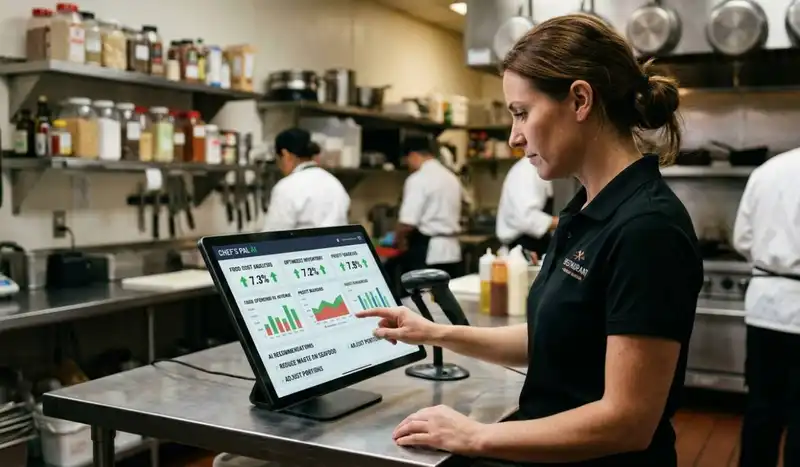
AI helps restaurants lower food costs by connecting data that is often reviewed separately. In many restaurants, sales are tracked in the POS, inventory counts are handled in spreadsheets, invoices are stored by accounting, recipes are managed by the kitchen, and waste is written down by managers. Each system may show part of the picture, but food cost control depends on seeing how all of those numbers work together.
For example, a restaurant may sell 500 chicken sandwiches in one week. If each sandwich should use 6 ounces of chicken, the expected usage is 3,000 ounces, or 187.5 pounds. If inventory records show that 225 pounds of chicken were used during the same period, there is a 37.5-pound gap. That difference may come from over-portioning, waste, incorrect prep, theft, recipe errors, or inaccurate inventory counts. Without connected data, the owner may only see that chicken costs increased. With AI, the system can help identify where the variance is likely coming from.
AI can review cost patterns across several areas -
1. Sales data shows what customers are ordering, when demand is highest, and which menu items drive the most volume.
2. Inventory data shows how quickly ingredients are being used, wasted, transferred, or reordered.
3. Recipe data shows the expected ingredient cost for each menu item.
4. Invoice data shows whether supplier prices are increasing over time.
5. Waste logs show which ingredients are being thrown away most often.
6. Menu performance data shows whether high-selling items are helping or hurting profit margins.
This matters because food cost problems often hide inside normal operations. A sauce may become more expensive because of a supplier price increase. A popular entree may sell well but use too much labor and high-cost ingredients. A prep team may prepare too much product on slow weekdays. A manager may reorder based on habit instead of actual sales trends.
AI gives restaurant owners a more accurate view of these patterns. Instead of asking only, "Why is food cost high?" owners can ask better questions- Which ingredients are causing the increase? Which menu items are creating low margins? Which days have the most waste? Which vendor price changes affected recipe costs? When the data is connected, food cost control becomes more specific, measurable, and easier to act on.
Improve Inventory Planning
Inventory planning is where food cost control often succeeds or fails before service even begins. Once the wrong amount of product is ordered, the restaurant is already exposed to waste, spoilage, stockouts, or rushed purchases. The issue is not always poor management. In many cases, managers are making inventory decisions with incomplete information.
A busy Friday, a slow Monday, a rainy weekend, a holiday, a catering order, or a local event can all change how much food the kitchen needs. If ordering is based only on last week's purchase history, the restaurant may miss what is actually coming next. AI forecasting helps close that gap by reviewing sales history, menu item demand, seasonal patterns, weather, day-of-week trends, online orders, reservations, and recent traffic changes.
For example, if a restaurant normally sells 250 chicken bowls on a weekday but demand increases to 340 when nearby offices host events, the inventory order should reflect that difference. If each bowl uses 5 ounces of chicken, that extra demand requires 450 additional ounces, or just over 28 pounds of chicken. Without a forecast, the restaurant may run short, place an emergency order, or substitute ingredients. With AI, managers can see the demand shift earlier and adjust purchasing before it affects service.
AI forecasting can help restaurant owners lower food costs by improving four key areas -
1. Ordering accuracy - AI helps managers buy closer to what the restaurant is likely to sell, reducing both excess inventory and last-minute shortages.
2. Prep planning - Forecasts can guide how much product should be prepped by shift, which helps reduce over-prep on slower days.
3. Waste control - When inventory levels match demand more closely, fewer ingredients sit unused until they expire or lose quality.
4. Cash flow - Better ordering keeps less money tied up in slow-moving stock, giving owners more control over weekly food spending.
This is important because food costs are not only affected by what a restaurant sells. They are also affected by what it buys too early, preps too much of, stores too long, or replaces at a higher price. AI gives owners and managers a clearer view of what is likely to happen before the order is placed. That makes inventory planning more proactive, more precise, and more connected to actual sales demand.
Smarter Purchasing
Purchasing is one of the fastest ways food costs can move up or down. Even when sales stay the same, a restaurant can lose margin if supplier prices increase, order quantities are too high, or managers buy ingredients that are not moving fast enough. For many owners, the problem is that purchasing decisions are often made under pressure. The kitchen needs product, the order deadline is approaching, and the manager relies on past habits instead of current data.
AI helps make purchasing more controlled by comparing what the restaurant is buying against what the restaurant is actually selling. It can review inventory levels, sales forecasts, vendor prices, recipe requirements, invoice history, and ingredient usage before an order is placed. This helps owners avoid buying based only on memory or routine.
For example, if ground beef was $4.20 per pound last month and increases to $4.80 per pound this month, that change may look small on one invoice. But if the restaurant uses 800 pounds a month, the increase adds $480 in monthly cost. If the menu price, recipe cost, or portion size is not reviewed, that added expense quietly reduces profit.
AI can support smarter purchasing in several practical ways -
1. Track supplier price changes - AI can flag when ingredient prices increase so managers can review menu pricing, vendor options, or recipe costs before margins shrink.
2. Recommend order quantities - Instead of ordering the same amount every week, AI can suggest quantities based on forecasted sales, current inventory, and expected usage.
3. Reduce unnecessary buying - AI can identify slow-moving ingredients that are already overstocked, helping restaurants avoid tying up cash in products that may expire.
4. Improve vendor visibility - By comparing invoices and purchase history, AI can show whether certain vendors are becoming more expensive over time.
5. Connect purchasing to recipes - When ingredient costs change, AI can show how those changes affect the cost of specific menu items.
This gives restaurant owners a clearer view of purchasing before it turns into a food cost problem. A manager may know that prices are rising, but AI can show which ingredients are rising, how often they are purchased, which menu items they affect, and how much margin is at risk.
Smarter purchasing does not mean always buying the cheapest product. Quality, consistency, availability, and guest expectations still matter. The value of AI is that it helps owners make purchasing decisions with better numbers. When orders are based on demand, usage, inventory, and vendor pricing, restaurants can lower food costs without guessing or cutting corners.
Reducing Waste Early
Food waste is one of the most visible signs of poor cost control, but by the time food is thrown away, the restaurant has already paid for it. The cost includes more than the ingredient itself. It also includes delivery fees, storage space, prep labor, utilities, packaging, and the lost opportunity to turn that product into revenue.
This is why waste reduction should start before the trash bin. AI can help restaurant owners identify where waste is likely to happen by reviewing sales forecasts, prep history, inventory movement, expiration dates, recipe usage, and waste logs. Instead of only recording what was wasted after service, AI helps managers adjust decisions earlier in the process.
For example, if a restaurant regularly preps 60 pounds of lettuce for Monday lunch but only uses 42 pounds, the extra 18 pounds may become a recurring cost leak. If lettuce costs $1.50 per pound, that is $27 in waste for one shift. If the same pattern happens three times per week, the restaurant could lose more than $4,000 per year from one ingredient alone. When that same issue happens across produce, proteins, sauces, garnishes, and baked goods, the total impact becomes much larger.
AI can help reduce waste by focusing on the areas where food is most likely to lose value -
1. Over-prep - AI can compare prep levels with actual sales demand, helping managers prepare less on slower shifts and more on higher-volume days.
2. Spoilage - AI can track inventory age and movement so teams can use ingredients before they expire or lose quality.
3. Slow-moving ingredients - AI can identify products that are purchased often but used slowly, which may signal a menu issue, ordering issue, or recipe problem.
4. Waste patterns by shift or item - AI can show whether waste is happening more often during certain shifts, days, menu categories, or prep stations.
5. Forecast-based prep adjustments - AI can help kitchens adjust production based on expected demand instead of using the same prep sheet every day.
The value is not just lower waste. Better waste control also improves purchasing accuracy, inventory turnover, prep efficiency, and cash flow. When managers know which ingredients are being wasted and why, they can reduce order quantities, adjust prep levels, change recipes, or update menu items before the cost repeats.
For restaurant owners, AI makes waste easier to measure and harder to ignore. It turns waste from a general problem into a specific number tied to ingredients, dollars, shifts, and decisions. That makes it easier to lower food costs without reducing portion quality or changing the guest experience.
Transform Your Restaurant Operations Now!
Effortless Inventory Tracking with Altametrics!
Tracking Recipe Costs and Ingredient Variance
Recipe costs are the baseline for food cost control. They show how much each menu item should cost based on the ingredients, portions, and preparation standards the restaurant has set. The problem is that actual kitchen usage does not always match the recipe on paper. A burger may be designed with 6 ounces of beef, but employees may serve 7 ounces. A sauce may be portioned at 2 ounces, but the kitchen may use 3 ounces during rush periods. These small differences can quietly increase food costs every day.
AI helps restaurants compare the expected cost of a menu item with the actual ingredients used to produce it. This is often called actual vs. theoretical food cost. The theoretical cost shows what the restaurant should have spent based on recipes and sales. The actual cost shows what the restaurant really used based on inventory movement, purchases, waste, and counts.
For example, if a pasta dish should cost $4.25 to make and the restaurant sells 1,000 of them in a month, the expected ingredient cost is $4,250. If actual inventory usage shows $4,900 in ingredients for that same item, there is a $650 variance. That gap may point to over-portioning, waste, incorrect prep, supplier price changes, theft, or inaccurate recipe costing.
AI helps owners find these gaps faster by reviewing -
1. Recipe standards - AI can use recipe data to calculate the expected cost of each menu item based on ingredient quantity and price.
2. Actual ingredient usage - AI can compare what should have been used against what inventory records show was used.
3. Portion control issues - If actual usage is consistently higher than expected, AI can help flag items that may need training, portion tools, or tighter prep controls.
4. Recipe cost updates - When supplier prices change, AI can help update recipe costs so owners know whether menu margins are still accurate.
5. Variance by item or ingredient - Instead of looking only at total food cost, owners can see which ingredients or menu items are creating the biggest cost gaps.
This gives restaurant owners a more accurate way to protect margins. A high food cost percentage may show that there is a problem, but ingredient variance helps explain where the problem is coming from. When owners can see the difference between planned cost and actual cost, they can make better decisions about training, portions, pricing, purchasing, and menu design.
AI does not replace recipe discipline. Restaurants still need accurate recipes, correct portions, updated ingredient prices, and consistent inventory counts. What AI adds is speed and visibility. It helps owners catch cost drift earlier, before small recipe mistakes become large monthly losses.
Improving Menu Profitability
A restaurant can have strong sales and still lose money on the wrong menu mix. This happens when popular items bring in revenue but leave very little profit after ingredient costs are removed. AI helps restaurant owners understand menu profitability by looking beyond sales volume. It can compare item sales, ingredient costs, contribution margin, recipe cost, portion size, price changes, and customer demand. This gives owners a clearer picture of which menu items are helping the business and which ones are increasing food cost pressure.
For example, a chicken entree may sell 1,200 times per month at $16. If the ingredients cost $6.50, the contribution margin is $9.50 per item. Another dish may sell only 700 times per month at $18, but if the ingredients cost $4.75, the contribution margin is $13.25 per item. The lower-selling item may actually produce more profit per order. Without this level of analysis, owners may focus too much on popularity and not enough on profitability.
AI can help improve menu profitability in several ways -
1. Identify high-volume, low-margin items - These items may look successful because they sell often, but they can raise food cost percentage if ingredient costs are too high.
2. Track ingredient cost changes - If the cost of chicken, beef, dairy, seafood, or produce increases, AI can show which menu items are most affected.
3. Support smarter pricing decisions - AI can help owners review whether menu prices still match recipe costs, vendor prices, and target margins.
4. Find menu items with weak demand - Low-selling items can create waste if the restaurant keeps buying ingredients that are not moving fast enough.
5. Improve menu engineering decisions - AI can help owners decide which items to promote, reprice, simplify, adjust, bundle, or remove.
This matters because food cost control is not only an inventory problem. It is also a menu problem. If a restaurant keeps selling items with weak margins, rising ingredient costs, or high waste risk, food costs can stay high even when ordering and prep are managed well.
AI gives owners a more data-driven way to review the menu. Instead of asking only, "What sells the most?" owners can ask, "Which items create the most profit, which items increase food costs, and which items need to be adjusted?" When menu decisions are based on cost, demand, and margin together, restaurants can lower food costs without simply cutting portions or raising every price across the board.
Start Lowering Food Costs with AI
AI works best when the restaurant already has the right data habits in place. The technology can analyze patterns, flag cost issues, and recommend better decisions, but it needs accurate information from the operation. If sales, inventory, recipes, waste, and invoices are inconsistent, the insights will be weaker.
For restaurant owners, the first step is to build a clearer food cost foundation. That means knowing what is being sold, what ingredients are being used, what products are being wasted, what vendors are charging, and how recipe costs are changing over time. Once those numbers are organized, AI can help turn them into practical actions.
A good starting point is to focus on five areas -
1. Connect sales and inventory data - The POS shows what customers are buying. Inventory data shows what ingredients are moving. When these two areas are connected, owners can see whether ingredient usage matches sales activity.
2. Keep recipes accurate - AI needs current recipe costs to measure margin correctly. If portion sizes, ingredient prices, or prep methods are outdated, menu profitability reports may be misleading.
3. Track waste consistently - Waste should be logged by ingredient, quantity, reason, and shift. This helps AI identify repeated patterns, such as over-prep, spoilage, damaged product, or slow-moving menu items.
4. Monitor vendor prices - Supplier costs can change quickly. AI can help compare invoice history and flag increases before they quietly reduce margins.
5. Review variance regularly - Actual vs. theoretical food cost should be reviewed often. If actual usage is higher than expected, owners can investigate portioning, prep, theft, counting errors, or recipe issues.
AI gives managers better numbers so they can make faster and more precise decisions. Instead of waiting until the end of the month to find out food costs are too high, owners can see warning signs earlier and adjust purchasing, prep, pricing, recipes, or menu strategy.
For restaurants that want to lower food costs, AI should be used as a daily operating tool, not just a reporting system. The value comes from using data before the money is lost. When AI connects forecasting, inventory, purchasing, waste, recipes, and menu performance, restaurant owners gain a clearer path to reducing food costs while protecting quality and consistency.
Streamline Your Inventory. Order Smartly.
Start Simplifying Your Orders with Altametrics
Must-Read Content
Ai improves restaurant operations
How AI Improves Restaurant Operations and Reduces Costs

Ai inventory management
How AI Inventory Management Improves Restaurant Forecasting

Ai menu optimization
AI Menu Optimization vs Traditional Menu Engineering

Ai scheduling
How AI Scheduling Helps Restaurants Lower Labor Costs

Ai ordering system
What Is an AI Ordering System for Restaurants?
Frequently Asked Questions
How does AI improve restaurant inventory planning?
AI improves inventory planning by forecasting demand based on sales history, day of week, seasonality, weather, events, online orders, and recent traffic trends. This helps restaurants order closer to what they are likely to sell.
How does AI help with restaurant purchasing?
AI helps with purchasing by comparing vendor prices, order history, current inventory, sales forecasts, and ingredient usage. This allows managers to order more accurately, avoid excess stock, and spot supplier price increases earlier.
How does AI help restaurants prevent overordering?
AI helps prevent overordering by comparing current inventory, expected sales, historical demand, and ingredient usage before a purchase order is created. This helps managers avoid buying more product than the restaurant is likely to use.
How does AI help restaurants avoid stockouts?
AI can warn managers when inventory levels may not be enough to support expected demand. This is especially useful for high-volume ingredients, seasonal items, catering orders, and menu items that sell heavily during certain days or shifts.