What does HACCP stand for?
HACCP stands for Hazard Analysis and Critical Control Points. It's a system for preventing food safety problems by controlling the highest-risk steps in your process.
HACCP Principles Explained for Restaurant Owners

Why Restaurants Use HACCP Principles
HACCP principles help restaurant owners run food safety like a system. Instead of relying on reminders, HACCP focuses on the specific steps where food can become unsafe - and puts controls in place to prevent problems before they reach the guest.
Restaurants use HACCP because most food safety issues happen the same way over and over - time-temperature mistakes, cross-contamination, poor cooling, improper holding, or weak sanitizer. HACCP is designed to catch these risks at the point where they can be controlled. For example, it helps you set clear rules for cooking and reheating, make cooling predictable, and keep cold foods cold and hot foods hot. That reduces the chance of harmful bacteria growing or spreading.
HACCP also improves consistency. When you run multiple shifts (or multiple locations), your food safety can't depend on one strong manager being on duty. HACCP creates standard steps everyone can follow, even when the kitchen is busy or short-staffed. It also makes training simpler because you can teach staff what to check, how to check it, and what "pass/fail" looks like.
Finally, HACCP protects your business. A strong HACCP approach reduces waste from throwaways and re-cooks, helps avoid complaints and incidents, and makes inspections easier because you can show what you control, how you monitor it, and what you do when something goes wrong.
Principle 1. Conduct a Hazard Analysis
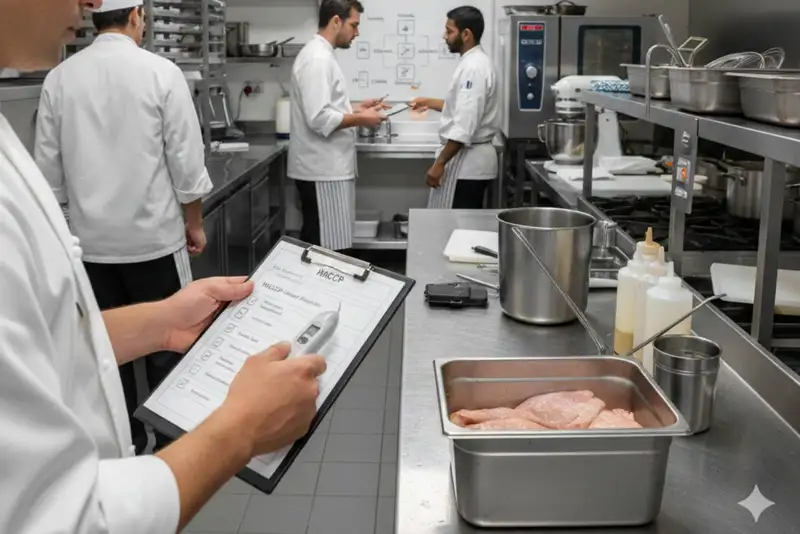
A hazard analysis is where you list the ways food can become unsafe in your restaurant, and when those risks can happen. This step matters because HACCP is not a generic checklist. It is built around your menu, your equipment, and your actual kitchen flow.
HACCP hazards usually fall into three types -
1. Biological hazards - germs that can make people sick, like bacteria and viruses. These are often tied to raw proteins, improper cooking, slow cooling, or holding food at unsafe temperatures.
2. Chemical hazards - chemicals getting into food. Common causes include sanitizer stored near food, chemicals sprayed around prep areas, or using the wrong concentration of sanitizer.
3. Physical hazards - objects that should not be in food, like bits of packaging, glass, metal, hair, or broken utensil pieces.
To do a hazard analysis, walk through your process from start to finish and look for risk points -
(1) Receiving (2) Storage (3) Prep (4) Cooking (5) Cooling (6) Reheating (7) Hot/Cold Holding (8) Service
Ask simple questions at each step -
- Could food be too warm for too long?
- Could raw and ready-to-eat foods touch or share tools?
- Could staff miss a step when things get busy?
- Could chemicals or foreign objects get near food?
You don't need to list every possible risk in the world. Focus on the hazards that are realistic in your operation and could actually happen. Start with your highest-risk items and steps- raw chicken, ground beef, eggs, rice and pasta held warm, soups and sauces cooled in bulk, seafood, and anything prepared ahead and served later.
What you document from this step should be clear and usable -
- The menu item or process
- The hazard type (biological, chemical, physical)
- Where it happens in your flow (example, cooling, holding, prep)
- A note on how it will be controlled (this leads into your CCPs)
Principle 2. Identify Critical Control Points (CCPs)
A Critical Control Point (CCP) is a step where you can prevent, eliminate, or reduce a food safety hazard to a safe level. In simple terms - it's a point in your process where you must get it right, because if you don't, the food can become unsafe.
Not every step is a CCP. Many steps are important, but they're handled through normal kitchen procedures (like handwashing, cleaning schedules, and proper storage). A CCP is different because it's tied to a hazard that can cause harm, and it's something you can control with a measurable check.
Common CCPs in restaurants
Most restaurants have CCPs in the same areas -
1. Cooking - making sure food reaches a safe internal temperature
2. Cooling - cooling cooked foods fast enough to prevent bacteria growth
3. Reheating - bringing food back up to a safe temperature quickly
4. Hot holding - keeping hot foods hot during service
5. Cold holding - keeping cold foods cold during service and storage
6. Sanitizer concentration - ensuring sanitizer is strong enough to work (especially in high-volume kitchens)
Use a practical test -
- If this step fails, can the hazard still be controlled later?
1. If yes, it might not be a CCP (it may be a standard operating step).
2. If no, it likely is a CCP.
Example -
- Cooking chicken is a CCP because if it doesn't reach a safe temperature, the hazard may not be fixed later.
- Labeling a container is important, but it's usually managed as part of daily procedures. It may support
HACCP, but it's not always a CCP unless it directly controls a major hazard in your system. One common mistake is calling everything a CCP. That creates too many checks, and people stop following the system. A good HACCP plan focuses on a few high-impact CCPs that match your real risks and menu.
Principle 3. Establish Critical Limits
A critical limit is the exact pass/fail rule for a CCP. It must be something you can measure. If the food (or process) meets the limit, it passes. If it doesn't, you must take action.
Critical limits usually apply to -
- Time
- Temperature
- Sanitizer concentration
- pH / water activity (less common in most restaurants, more common in processing)
The point is clarity. "Cook it thoroughly" is not a critical limit. "Cook to the required internal temperature" is.
Here are the CCP areas where restaurants usually set critical limits -
1. Cooking - Set a required internal temperature by food type (especially poultry, ground meats, seafood, eggs, reheated items). Make sure the limit matches your local health code requirements.
2. Cooling - Cooling is one of the most common failure points in restaurants. Your limits should define how fast food must move through unsafe temperature ranges.
3. Reheating - Reheating must be fast enough to prevent bacteria growth. The limit should be a temperature plus a time requirement when applicable.
4. Hot holding / Cold holding - Holding limits define the minimum hot temperature and maximum cold temperature during service and storage. Limits should apply to steam tables, hot boxes, reach-ins, prep tables, and grab-and-go coolers.
5. Sanitizer concentration - Your limit should match the sanitizer type you use (chlorine, quats, etc.). This is measured using test strips, not guesswork.
Make your limits usable during a busy shift
A critical limit only helps if it can be followed when the kitchen is moving fast. Good limits are -
- Specific (a number, not a description)
- Easy to verify (with a thermometer, timer, or test strip)
- Realistic for your equipment (your cooler must actually hold temp consistently)
Also decide -
- Where you will measure (thickest part of the product, center of a pan, surface vs internal)
- What tool is required (probe thermometer, infrared thermometer for surfaces only, timers, test strips)
- Who is responsible (station lead, manager, opener/closer)
Tie each limit to a written standard
For each CCP, your HACCP plan should clearly show -
- The CCP
- The critical limit
- The measurement method
This sets you up for the next step- monitoring - how you check those limits consistently.
Principle 4. Establish Monitoring Procedures
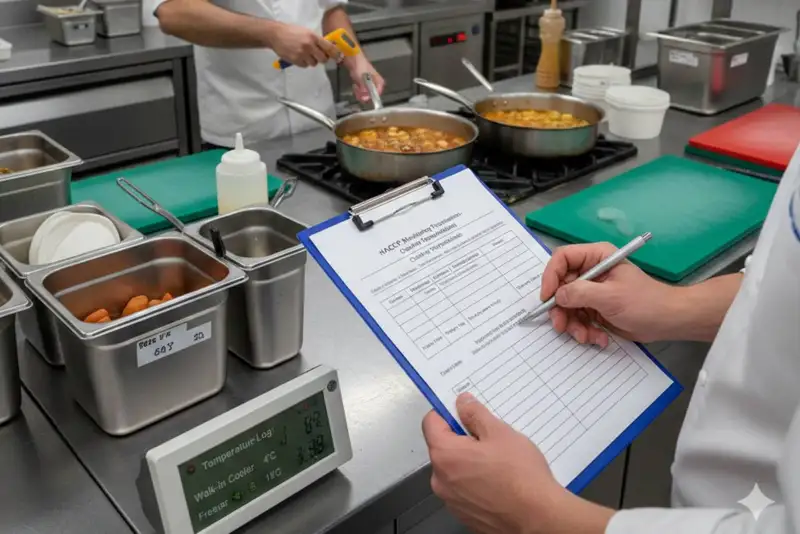
Monitoring is how you check CCPs often enough to stay in control. If critical limits are the pass/fail rules, monitoring is the routine that proves you're meeting them during real service.
Good monitoring answers four questions -
1. What are we checking?
2. How do we check it?
3. When do we check it?
4. Who is responsible?
What to monitor at common CCPs
Most restaurant monitoring falls into a few repeatable checks -
- Cooking temperatures (final internal temp before serving or hot holding)
- Cooling steps (time/temperature checks during the cooling window)
- Reheating temperatures (internal temp reached before hot holding)
- Hot holding temps (steam tables, hot boxes, warmers)
- Cold holding temps (reach-ins, prep tables, salad bars, grab-and-go)
- Sanitizer concentration (test strips for buckets, sinks, dish machine as applicable)
How to monitor (tools and method)
Monitoring should rely on simple tools -
- Probe thermometer for internal food temps
- Timers for cooling and reheat timing
- Test strips for sanitizer strength
- Simple logs (paper or digital) to record results
A key rule - measure the right way. For internal temps, check the thickest part of the food. For cooling, check the center of the container, and use shallow pans or portioning to help food cool faster.
When to monitor (frequency that makes sense)
The frequency should match the risk and volume. Examples -
Cooking - each batch, each new pan, or at set intervals during continuous cooking
Cooling - at set checkpoints during the cooling process (not just once at the end)
Holding temps - at least every few hours, and anytime equipment is refilled or adjusted
Sanitizer - at opening, after changing water, and on a regular schedule during the shift
The goal is to catch problems early, not at the end of the day.
Who monitors (clear ownership)
Assign monitoring to specific roles, not "the team."
- Grill lead checks cook temps
- Prep lead checks cooling steps
- Manager verifies holding temps
- Dishwasher or shift lead checks sanitizer strength
If no one owns it, it won't happen consistently.
Monitoring records should be fast to complete -
- Date/time
- Item or equipment name
- Measured result (temp, time, concentration)
- Initials
- Notes only when something fails
If your log takes too long, people will skip it or fill it out later from memory - which defeats the purpose.
Elevate Food Safety, Simplify Compliance!
Experience Seamless Food Safety with Altametrics!
Principle 5. Establish Corrective Actions
Corrective actions are the pre-planned steps you take when monitoring shows a critical limit failed. This is important because a HACCP plan is not just about checking temperatures and writing them down. It's about knowing exactly what to do the moment something is out of control.
A good corrective action does two things -
1. Fix the food (so unsafe food doesn't get served)
2. Fix the process (so the same problem doesn't keep happening)
Step 1. Control the food immediately
When a check fails, your first job is to keep the product from being served.
Common examples -
Cooking temp too low - keep cooking until it reaches the required temperature, then re-check.
Hot holding too low - reheat the food correctly (if allowed), then return it to hot holding, if it's been in the danger zone too long, discard.
Cold holding too high - move food to a working cooler, reduce the volume in the pan, add ice baths for the line if needed, and re-check. Discard if time/temperature exposure is unsafe.
Cooling too slow - break food into smaller portions, use shallow pans, uncover or vent as allowed, use an ice bath, move to a blast chiller if available, and restart the cooling process correctly.
Sanitizer too weak - remake sanitizer to the correct concentration, re-test, and re-sanitize affected tools/surfaces if needed.
The key is having clear rules for when food can be corrected vs. when it must be discarded. This should match your local health code and your own food safety policy.
Step 2. Identify why the limit failed
If you don't address the cause, you'll keep seeing the same failures.
Common root causes in restaurants -
- Thermometer not working or not calibrated
- Staff skipping steps during rush periods
- Cooling done in deep containers or stacked pans
- Overloaded coolers or doors left open
- Hot holding equipment not preheated or running weak
- Poor handoff between prep and line
- Inconsistent training across shifts
Step 3. Correct the process
Corrective actions should include a quick fix that prevents repeat failures, such as -
- Re-train the station on the exact check and method
- Adjust the prep method (smaller batches, shallower pans, faster cooling setup)
- Change the monitoring timing (check earlier, not later)
- Repair or replace equipment
- Add a manager verification step during peak hours
Step 4. Document what happened
Your corrective action record should show -
- What failed (item/equipment and result)
- What you did with the food (continued cooking, reheated, discarded, etc.)
- What you changed to prevent repeat issues (process/equipment/training)
- Who handled it and when
This documentation is also what supports your next principle- verification - proving the system is working over time.
Principle 6. Establish Verification Procedures
Verification is how you confirm your HACCP system is working consistently, not just being filled out. Monitoring tells you what happened in the moment. Verification checks whether your controls, tools, and routines are reliable over time.
Think of verification as "trust, but verify."
What verification looks like in a restaurant
Verification usually includes a few repeatable actions -
1. Manager review of logs
- Check that monitoring is being done on time.
- Look for missing entries, repeated failures, or numbers that don't make sense.
- Confirm corrective actions were recorded when limits were missed.
2. Thermometer checks and calibration
- If thermometers are inaccurate, every cooking, cooling, and holding check becomes unreliable.
- Set a routine for calibration checks (and replace damaged probes quickly).
3. Sanitizer verification
- Confirm test strips are the right type for your sanitizer.
- Spot-check that sanitizer buckets/sinks match the target concentration during shifts.
4. Direct observation
- Watch the process, not just the paperwork.
- Examples- how staff take temps, how they cool large batches, how they store raw vs ready-to-eat foods, how often they change sanitizer.
5. Internal food safety walkthroughs
- A short, consistent check (weekly or bi-weekly) catches issues early- cooler temps, date labels, storage order, clean equipment, and active logs.
The best schedule is one your team can actually keep. Common options -
1. Daily - quick manager sign-off on key logs (holding temps, cooking temps, sanitizer)
2. Weekly - calibration check, deeper review of cooling logs and corrective actions
3. Monthly - full review of HACCP records and whether CCPs/limits still match your menu and equipment
You should also verify anytime something changes, such as -
- New menu items or new prep steps
- New equipment (or equipment issues)
- Staff turnover, new shift leads, or retraining needs
- A food safety complaint or inspection concern
What verification should produce
Verification should give you clear outcomes -
- "We're following the process as written."
- "Our tools are accurate."
- "Our corrective actions are happening when needed."
- "We need to adjust training or procedures because failures are repeating."
Once verification is in place, the last step is making sure your records are organized and easy to maintain.
Principle 7. Establish Recordkeeping and Documentation
Recordkeeping is how you prove your HACCP controls are real and consistent. It also helps you catch patterns - like a cooler that runs warm every weekend, or a prep process that causes slow cooling every time you batch a soup.
The goal is not paperwork for its own sake. The goal is simple records that match your CCPs and are easy to maintain.
What records matter most
Most restaurants only need a small set of HACCP records to cover common CCPs -
- Cooking temperature logs (when required for your process/menu)
- Cooling logs (for any cooked foods cooled for later use)
- Reheating logs (for items reheated for hot holding/service)
- Hot holding and cold holding logs (equipment and product checks)
- Sanitizer concentration logs (buckets, sinks, dish machine checks where applicable)
- Corrective action records (what failed, what you did, and why)
If you don't have a CCP for a step, you usually don't need a HACCP log for it. Keep the focus on the controls that prevent the biggest risks.
What each record should include
A usable log is short and consistent. Most entries should capture -
- Date and time
- Item or equipment name
- Measured result (temperature, time checkpoint, sanitizer concentration)
- Initials (who checked)
- Pass/fail
- Notes only if there's a failure (and what corrective action was taken)
If staff have to write paragraphs, they'll delay it or skip it.
Keep formats consistent across shifts
Use the same names and labels everywhere -
- Same equipment names (e.g., "Reach-in 2," "Line Cooler A")
- Same product names (e.g., "Chicken Breast," "Rice Batch")
- Same measurement method (where to temp, how to take a cooling temp)
Consistency prevents confusion and makes reviews faster.
Where to store records
Pick one system and stick to it -
- Paper binders (simple and reliable if you manage them daily)
- Digital logs (easier to review across locations, better for tracking trends)
Either way, set a rule for -
- Where records live
- Who files or closes them out
- How long you keep them (follow local requirements and your internal policy)
Use records to improve operations
Records are more useful when you review them for repeat issues -
- Same CCP failures at the same time of day
- The same station missing checks
- Equipment drifting out of range
- Cooling times that are consistently slow for specific menu items
This turns HACCP documentation into a management tool - not just an inspection binder.
Create, Implement, and Execute Multiple Daily Checklists
Streamline Your Operations with Altametrics
Must-Read Content
Haccp guidance
HACCP Guidance for Restaurant Prep Stations

Haccp for cafes
HACCP for Cafes - A Simple Start-to-Finish Setup
Haccp method
HACCP Method for Restaurant Kitchens

Haccp compliance
HACCP Compliance for Hotels

Haccp for catering
HACCP for Catering
Frequently Asked Questions
What records should we keep for HACCP?
At minimum, keep records that show CCP monitoring results, corrective actions when something fails, and verification activities (like calibration checks and manager reviews).
What foods are the highest risk in a restaurant HACCP review?
Raw chicken and ground beef, cooked rice and pasta, soups and sauces cooled in bulk, seafood, eggs, deli meats, and any cooked foods held warm for long periods.
How do we prevent cross-contamination in prep areas?
Separate raw and ready-to-eat zones, use dedicated cutting boards/tools, store raw proteins below ready-to-eat food, and sanitize between tasks - especially when switching from raw to ready-to-eat.
What's the difference between a hazard and a CCP?
A hazard is something that can make food unsafe (biological, chemical, or physical). A CCP is the step where you can control that hazard using a measurable rule.