What are the most common HACCP hazards in a restaurant kitchen?
Most hazards fall into - - Biological (bacteria/viruses from time-temp abuse or cross-contamination) - Chemical (sanitizer, cleaners, allergen cross-contact) - Physical (foreign objects like plastic, metal, glass)
HACCP Method for Restaurant Kitchens

What the HACCP Method Does
The HACCP method is a practical way to keep food safe by preventing problems before they happen. HACCP stands for Hazard Analysis and Critical Control Points. That sounds technical, but the idea is simple - you look at how food moves through your kitchen, figure out where things can go wrong, and set up a few must-follow checkpoints to stop unsafe food from reaching a guest.
Most restaurant food safety issues fall into three categories -
1. Biological hazards - germs that can make people sick (like bacteria and viruses).
2. Chemical hazards - things like sanitizer residue, cleaning chemicals, or allergen cross-contact.
3. Physical hazards - foreign objects like broken plastic, metal shavings, or glass.
Instead of trying to be careful everywhere, HACCP focuses your team on the steps that matter most - especially time and temperature control and cross-contamination control. For example, cooking chicken to a safe temperature, keeping cold food cold, cooling cooked food correctly, reheating food properly, and keeping allergens from touching the wrong items.
A key HACCP concept is the Critical Control Point (CCP). A CCP is a step where you can prevent, eliminate, or reduce a hazard to a safe level. In most restaurant kitchens, CCPs usually show up around cooking, cooling, reheating, and holding. If a CCP is missed, the risk is high - so you need a clear rule for what "safe" looks like and what to do if something is off.
HACCP also helps you run a more consistent kitchen. When managers and staff follow the same checkpoints, it reduces guesswork and makes training easier. You don't need a complicated binder to start. A simple HACCP approach can be built into your daily routines with clear steps, basic tools (like a thermometer and labels), and quick checks that fit into service.
Step 1. Map Your Food Process
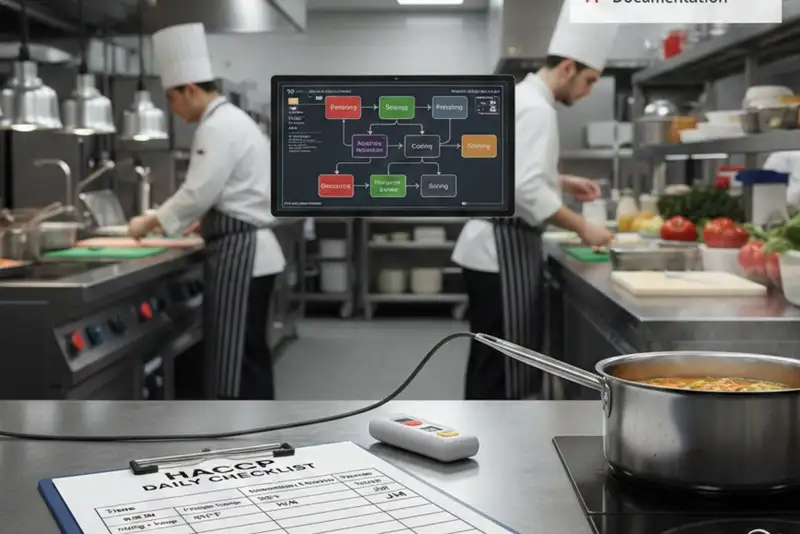
Before you set rules for food safety, you need to see how food actually moves through your restaurant. That's what a process map is. It's a simple, step-by-step picture of what happens to food from the moment it arrives to the moment it's served. The HACCP method uses this map to find the few steps where safety matters most.
Start by choosing your highest-risk foods or your most popular items. You don't have to map your entire menu on day one. A good place to start is -
- Raw proteins (chicken, ground beef, seafood)
- Cooked foods that get cooled and reheated (soups, rice, sauces, shredded meats)
- Ready-to-eat foods (salads, deli items, sandwiches)
- Allergen-heavy items (anything with nuts, dairy, gluten)
Next, write the steps in plain language. Most restaurant items follow a flow like this -
1. Receiving (delivery arrives, product is checked)
2. Storage (walk-in, freezer, dry storage)
3. Prep (washing, cutting, thawing, marinating, portioning)
4. Cooking (grill, oven, fryer, stovetop)
5. Holding (hot holding, cold holding, make-line)
6. Cooling (if the item will be saved for later)
7. Reheating (for service later)
8. Serving (plating, packaging, delivery pickup)
Now add the details that make your kitchen different. For example -
- Do you thaw proteins in the walk-in, under running water, or on a prep cart?
- Do you cool items in shallow pans, ice baths, blast chillers, or large stock pots?
- Do you hot hold on the line, in warmers, or in steam tables?
- Do you portion and label foods at night or during prep shifts?
Keep the map honest. Write what really happens on a busy Friday, not what you wish happened. This step matters because hazards usually show up in repeatable places - like thawing, cooling, make-line holding, and reheating. Once your process is mapped, you'll be able to spot exactly where to place your HACCP checkpoints.
Step 2. Spot the Hazards
Once you've mapped your food process, the next HACCP step is to identify hazards at each stage. A hazard is anything that could make food unsafe. This doesn't need to be complicated. The goal is to be realistic about your kitchen and focus on the risks that actually happen.
HACCP hazards fall into three types -
1) Biological hazards
These are the most common cause of foodborne illness. They usually show up when food spends too long in the temperature danger zone, when cooked food is contaminated after cooking, or when raw and ready-to-eat foods mix.
Common restaurant examples -
- Raw chicken juice dripping onto ready-to-eat produce in the walk-in
- Ground beef not cooked fully
- Cooked rice or pasta cooled too slowly
- Prep tables getting cross-contaminated during a rush
- Gloves being used too long without changing
2) Chemical hazards
Chemical hazards often come from mistakes with cleaning products, sanitizer, or allergens. Allergens are a major risk because a small amount can cause a serious reaction.
Common restaurant examples -
- Sanitizer concentration too strong or too weak
- Spray chemicals stored near food or used near open product
- Allergens (like nuts, dairy, wheat) transferred by shared utensils or cutting boards
- Fryer oil used for multiple items where allergen separation is expected
- Chemicals accidentally labeled or stored in the wrong container
3) Physical hazards
Physical hazards are foreign objects that can injure a guest. These risks often come from broken tools, damaged packaging, or poor handling.
Common restaurant examples -
- Pieces of broken plastic from a container lid
- Metal shavings from a damaged can opener
- Bandages, glove pieces, or packaging fragments
- Glass from a broken light or dish
Use your process map and ask one question at each step -
"What could go wrong here that could make a guest sick or cause an injury?"
Here's a quick way to think about it by step -
1. Receiving - product arrives warm, damaged packaging, expired dates
2. Storage - raw above ready-to-eat, poor labeling, wrong cooler temp
3. Prep - cross-contamination, poor handwashing, allergen mix-ups
4. Cooking - undercooking, uneven cooking, bad thermometer habits
5. Holding - food not kept hot/cold enough, long hold times
6. Cooling - food cooled too slowly, large containers, no labels
7. Reheating - not reheated hot enough, reheated multiple times
8. Serving - dirty utensils, bare-hand contact, wrong allergen ticket
You don't need to list every possible hazard. Start with the big ones that match your kitchen and your menu.
Step 3. Choose Your Critical Control Points (CCPs)
After you spot hazards, the next HACCP step is deciding where you must control them. These points are called Critical Control Points (CCPs). A CCP is a step where you can prevent, eliminate, or reduce a food safety hazard to a safe level. If the CCP is missed, the risk is high - so the rule needs to be clear and followed every time.
CCP vs. normal safety steps
Not every good practice is a CCP. For example, keeping a clean prep table is important, but it's usually managed through standard sanitation routines. A CCP is more like a hard stop pointwhere the decision is safe or not safe.
A simple way to test whether something is a CCP -
If this step goes wrong, can we fix it later?
- If no, it's likely a CCP.
- If yes, it may be a control step, but not critical.
Example -
- If chicken is undercooked, you can fix it by cooking it longer before serving (still a critical step because cooking is the kill step).
- If soup is cooled too slowly, you often can't safely fix it later. That's why cooling is usually a CCP.
- If cold food sits above 41F (5C) too long, you may not be able to save it just by putting it back in the cooler. That makes cold holding time/temperature control a CCP.
Common CCPs in restaurant kitchens
Most restaurants will find CCPs in the same areas, especially where time and temperature control safety -
1. Cooking - Cooking is often the main kill step for harmful bacteria. Example - poultry, ground beef, eggs, seafood.
2. Hot holding - Keeping cooked food hot enough during service to prevent bacteria growth.
3. Cold holding - Keeping items cold enough on the line, in prep coolers, and in storage.
4. Cooling - Cooling cooked food fast enough before storing for later use.
5. Reheating - Reheating previously cooked/cooled food to a safe temperature before serving.
Depending on your menu, you might also include -
- Receiving (especially for seafood, dairy, and temperature-controlled deliveries)
- Thawing (if you thaw large volumes or do it in different ways)
- Allergen control steps (if cross-contact is a high risk in your operation)
A common mistake is trying to make too many CCPs. That creates more logs, more steps, and less consistency. Most restaurant HACCP plans work best with a small set of CCPs that managers can actually enforce during real service.
Step 4. Set Clear Limits for Each CCP
Once you've chosen your Critical Control Points (CCPs), you need clear limits for each one. In HACCP, these are called critical limits. A critical limit is the exact point where food is considered safe or not safe. This is what makes HACCP practical, your team isn't guessing - they're checking a number or a condition.
Most restaurant critical limits are based on time and temperature, plus a few simple rules for handling.
A good critical limit is -
- Specific (a number, not hot enough)
- Easy to check (with tools you already use)
- Simple to teach (so any shift can follow it)
Examples of "too vague" limits -
- "Cook chicken thoroughly"
- "Keep food cold"
- "Cool food quickly"
Better limits -
- Chicken must reach 165F / 74C
- Cold holding must stay at 41F / 5C or below
- Cool food from 135F to 70F within 2 hours, and to 41F within 6 hours total
(Use the exact standards required by your local health department. The examples above reflect common U.S. Food Code guidance, but local rules can vary.)
Common critical limits for restaurant CCPs
Here are the CCPs most kitchens use, with typical limits to consider -
1) Cooking - Set a minimum internal temperature for each high-risk food (poultry, ground meats, seafood, eggs). Decide how you'll check it (thermometer type, where to probe, how often).
2) Hot holding - Set a minimum hot-holding temperature (often 135F / 57C or higher, depending on your rules). Decide what happens if it drops below the limit (reheat, discard, time limit).
3) Cold holding - Set a maximum cold-holding temperature (often 41F / 5C or below). Include the make-line and prep coolers, not just the walk-in.
4) Cooling - Cooling is a common failure point because it depends on pan depth, airflow, and batch size. Use a two-stage cooling standard (example above) and define approved cooling methods (shallow pans, ice bath, blast chiller, uncovered in walk-in when allowed, etc.).
5) Reheating - Set a minimum reheat temperature and time requirement (commonly reheating to 165F / 74C quickly for safety). Define "one reheat only" rules if that's your policy.
Tools you need to make limits work
You don't need fancy equipment, but you do need consistency -
- A calibrated food thermometer (and a simple calibration routine)
- Timers (for cooling and holding checks)
- Labels and markers (date/time labels for cooled items)
- A quick reference chart posted where prep and cooking happen
Your team will follow limits when they're built into how the kitchen already runs. Keep it tight -
- Use a small number of key temperatures
- Post them at the point of use (grill, fryer station, prep area)
- Train staff on how to check (where to probe, how to avoid false reads)
Next, you'll decide how to monitor these limits every shift without slowing down service.
Elevate Food Safety, Simplify Compliance!
Experience Seamless Food Safety with Altametrics!
Step 5. Monitor the CCPs
Setting critical limits is only helpful if your team actually checks them. That's what monitoring is in the HACCP method - a simple system to confirm each CCP is staying within the safe limit during real kitchen conditions.
Monitoring should answer four questions -
- What are we checking?
- Who checks it?
- When do we check it?
- How do we record it (if needed)?
What monitoring looks like in a restaurant
Monitoring is usually quick and repeatable, like -
- Taking a temperature with a probe thermometer
- Checking a cooler display thermometer and confirming with a probe if needed
- Recording a time stamp when cooling starts
- Verifying a hot-hold pan is above the limit during line checks
The key is to keep it routine-based, not when someone remembers.
Monitoring works best when it's clear who owns it -
- Line cooks check cooking temps for their station items
- Prep team starts cooling logs and labels product correctly
- Shift manager performs scheduled line checks (hot/cold holding)
- Closing manager verifies cooling items are labeled, stored correctly, and within limits
If "everyone" is responsible, it often becomes "no one."
When to check (simple schedules that work)
You don't need constant checks, but you do need consistent ones. Many restaurants use -
1. Opening checks - walk-in temps, make-line temps, sanitizer setup
2. Peak checks (during rush) - hot/cold holding quick checks
3. Mid-shift checks - re-check holding, cooling progress
4. Closing checks - cooling logs, labeling, storage organization
A practical approach is every 2-4 hours for holding temps, plus each batch for cooking temps (especially for poultry and ground meat). For cooling, the check is usually time-based, verify the product hits key temperatures within required time windows.
Logging - keep it lightweight
Some operators overdo paperwork. Monitoring records should be -
- Short
- Fast
- Easy to review
Good options -
- One-page temperature log for hot/cold holding and cooler checks
- Cooling log that captures start time, 2-hour check, and final check
- Batch cook temp log for high-risk proteins (or spot-check approach if allowed)
If logging becomes too long, people stop doing it or pencil-whip it. The best log is the one that gets used.
Tips to make monitoring more consistent
- Keep thermometers at the station, not in a drawer across the kitchen
- Use labels that include date/time and initials so accountability is clear
- Add monitoring to your manager shift checklist
- Teach staff how to take accurate temps (probe placement matters)
- Calibrate thermometers on a simple schedule (weekly or as required)
Monitoring isn't about catching people doing something wrong. It's about catching problems early - before unsafe food gets served or has to be thrown out.
Step 6. Fix Issues Fast
Even with good monitoring, things will go off track. A cooler runs warm. A batch doesn't cool fast enough. A hot-hold pan drops below the limit during a rush. In the HACCP method, corrective actions are the exact steps your team must take when a CCP fails.
A good corrective action is -
- Immediate (done as soon as the issue is found)
- Specific (clear steps, not handle it)
- Consistent (same response every time)
- Easy to follow (written in plain language)
Most corrective actions have two parts -
1. What to do with the food right now
2. What to do about the process/equipment to prevent repeat issues
Common corrective actions for restaurant CCPs
1) Cooking temps not met
Action for food. Keep cooking until the internal temperature reaches the required minimum.
Action for process. Check thermometer accuracy, probe placement, and cook procedure (batch size, grill/fryer temp, cook time).
2) Hot holding below the limit
Action for food. If the product is still within safe time limits, reheat to the proper temperature and return to hot holding. If time is unknown or exceeds your limit, discard.
Action for process. Adjust steam table/warming unit settings, reduce pan depth, stir more often, or replace failing equipment.
3) Cold holding above the limit
Action for food. Move product to proper refrigeration and rapidly cool if allowed; if it has been above the limit too long or time is unknown, discard.
Action for process. Check prep cooler seals, lid habits, loading levels, airflow, and frequency of door opening. Reduce how long product sits on the line.
4) Cooling not happening fast enough
Action for food. Break food into smaller portions, use shallow pans, use an ice bath, vent/space pans for airflow, or use a blast chiller if available. If it cannot meet required cooling time, discard.
Action for process. Change cooling method, batch size, and container type. Train staff on the correct cooling setup every time.
5) Reheating not met
Action for food. Continue reheating until the product reaches the required minimum temperature quickly. If it cannot reach temp in time or has been reworked repeatedly, discard.
Action for process. Use proper reheat equipment (stovetop/oven vs. warmers), avoid reheating large dense batches, and follow reheat once rules.
Corrective actions are what turn HACCP from a checklist into real control. They protect guests, reduce waste from repeated mistakes, and help managers coach the right behaviors.
Step 7. Verify, Train, and Keep It Running
The last step of the HACCP method is making sure your plan actually works over time. This is where many restaurants fall off. They create a few logs, do it for a week, then it fades out. HACCP stays effective when you build simple habits around verification, training, and updates.
Verification - prove the system is working
Verification means checking that your HACCP steps are being followed and your numbers are reliable. It does not have to be complicated. Most restaurants can verify with three routines -
1) Thermometer checks (calibration)
- A thermometer is only useful if it's accurate.
- Set a schedule (weekly, or based on your policy) and document it.
- Replace damaged probes and keep spare batteries on hand.
2) Manager review of logs
- A manager should quickly review monitoring logs (hot/cold holding, cooling, cooking temps).
- Look for patterns, missing checks, repeated out-of-range temps, or same handwriting for an entire day.
- The point is to catch weak spots early, not to punish staff.
3) Spot checks during real service
- Do quick, unannounced checks during a rush.
- Verify make-line temps, hot holding, and correct label use.
- If a station is struggling, coach the method and simplify the routine.
HACCP fails when it lives in one person's head. Training should be simple, repeatable, and built into onboarding.
Focus training on -
- What the CCPs are in your kitchen (your must-check steps)
- How to take temps correctly (where to probe, how to avoid false readings)
- What to do when something is out of range (corrective actions)
- Allergen basics (when to change gloves, use clean tools, and prevent cross-contact)
Keep it practical -
- Train in 10-minute blocks at the station
- Use a one-page temperature guide posted on the line
- Ask staff to demonstrate (not just yes, I understand)
Keep it running - update the plan when things change
Your HACCP method should change when your kitchen changes. Review and adjust when you -
- Add new menu items (especially high-risk foods)
- Change suppliers or ingredients
- Buy new equipment (or lose equipment)
- Change prep methods (batch size, cooling containers, holding setup)
- Move to a new location or remodel the kitchen
A simple monthly or quarterly HACCP check-in works well -
- Are CCPs still the right ones?
- Are limits still clear and posted?
- Are logs being used and reviewed?
- Are there repeat issues that need a process change?
The best HACCP plan is the one your team can follow on a busy night. If it feels too heavy -
- Reduce CCPs to the few that matter most
- Shorten the log to the minimum required checks
- Add visual reminders (posted temps, label examples, quick checklists)
With verification, training, and regular updates, the HACCP method becomes a normal part of kitchen management - not extra paperwork.
Create, Implement, and Execute Multiple Daily Checklists
Streamline Your Operations with Altametrics
Must-Read Content
Haccp guidance
HACCP Guidance for Restaurant Prep Stations
Haccp principles
HACCP Principles Explained for Restaurant Owners
Haccp for cafes
HACCP for Cafes - A Simple Start-to-Finish Setup

Haccp compliance
HACCP Compliance for Hotels

Haccp for catering
HACCP for Catering
Frequently Asked Questions
What's the difference between HACCP and general food safety training?
General food safety covers many best practices. HACCP focuses on preventing specific hazards by controlling a few critical points (like cooking, cooling, holding, and reheating) with clear limits and monitoring.
What are the most common CCPs in restaurants?
For most kitchens, CCPs usually include -
- Cooking
- Hot holding
- Cold holding
- Cooling
- Reheating
- Cooking
- Hot holding
- Cold holding
- Cooling
- Reheating
How often should we monitor CCPs?
It depends on the CCP, but common schedules include -
- Every batch for cooking temps (especially high-risk proteins)
- Every 2-4 hours for hot/cold holding checks
- Time-based checkpoints for cooling (based on your local rules)
- Every batch for cooking temps (especially high-risk proteins)
- Every 2-4 hours for hot/cold holding checks
- Time-based checkpoints for cooling (based on your local rules)
How do managers verify the HACCP method is working?
Use three habits -
- Thermometer calibration checks
- Quick review of logs
- Spot checks during real service
- Thermometer calibration checks
- Quick review of logs
- Spot checks during real service