What is a critical control point in a restaurant?
A critical control point, or CCP, is a step where control is necessary to prevent, eliminate, or reduce a food safety hazard. Common restaurant CCPs include cooking, cooling, reheating, hot holding, and cold holding.
How to Build a HACCP System for Your Restaurant

Overview
A HACCP system is a structured food safety approach that helps restaurant owners identify where food safety hazards can happen and put controls in place before those hazards turn into real problems. HACCP stands for Hazard Analysis and Critical Control Points. In simple terms, it is a preventive system. Instead of waiting for something to go wrong, such as unsafe cooking temperatures, cross-contamination, or improper cooling, the restaurant builds a process to catch and control those risks during daily operations.
For restaurant owners, that distinction is important. Food safety problems are rarely caused by one big mistake alone. More often, they happen when small failures stack up. A delivery is accepted at the wrong temperature. Raw product is stored above ready-to-eat food. Cooked food is cooled too slowly. A team member skips a check during a busy shift. A HACCP system helps reduce those gaps by giving the operation a clear method for managing risk at each step.
There is also a strong operational reason to take it seriously. Food safety failures can lead to product loss, wasted labor, guest complaints, health code violations, and damage to the restaurant's reputation. The cost of prevention is usually far lower than the cost of a breakdown. A strong HACCP system helps owners protect guests, create more consistency in the kitchen, and reduce avoidable risk.
Start by Mapping Your Food Flow
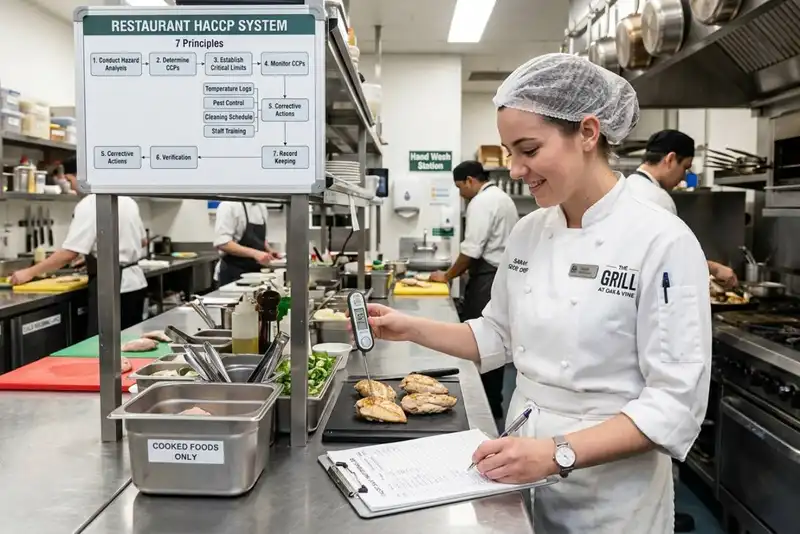
Before a restaurant can build an effective HACCP system, it needs to understand exactly how food moves through the operation. This is where food flow mapping begins. Food flow is the path food takes from the moment it arrives at the restaurant to the moment it is served to the guest. For most operations, that path includes receiving, storage, prep, cooking, cooling, reheating, hot or cold holding, and service. Each stage creates different food safety risks, which is why mapping the full process is one of the most important early steps.
For restaurant owners, it means reviewing how raw ingredients are delivered, where they are stored, how they are handled during prep, what equipment is used, how long food stays in temperature danger zones, and how finished items move to the line or dining room. A process that looks simple on paper may involve multiple handoffs, wait times, or storage points that increase risk.
Food flow mapping is useful because it shows owners where control matters most. For example, raw chicken may move through receiving, cold storage, prep, cooking, hot holding, and service. A soup may involve cooking, cooling, refrigerated storage, reheating, and holding. Even if two items are served in the same restaurant, the food safety risks may not be the same. That is why owners should map processes by menu category or food type rather than assume one plan fits everything.
Elevate Food Safety, Simplify Compliance!
Experience Seamless Food Safety with Altametrics!
Identify the Food Safety Hazards
Once the food flow is mapped, the next step is to identify the hazards that can appear at each stage. This is one of the most important parts of building a HACCP system because it turns a general food safety goal into a practical risk-control process. A restaurant cannot control hazards effectively unless it knows where they are most likely to occur and what kind of damage they can cause.
There are three main categories of hazards that restaurant owners need to review -
1. Biological hazards - these include bacteria, viruses, parasites, and other microorganisms that can grow or spread when food is handled improperly. In restaurant operations, common risks include undercooked meat, poor cooling practices, contaminated produce, or improper handwashing.
2. Chemical hazards - these involve harmful substances that can get into food during storage, prep, or cleaning. Examples include sanitizer residue, mislabeled spray bottles, pest control chemicals, or undeclared allergens that are transferred from one food to another.
3. Physical hazards - these are foreign materials that can accidentally enter food. Common examples include broken glass, metal shavings, plastic pieces, packaging debris, or fragments from damaged utensils or containers.
The goal is to identify the hazards that are reasonably likely to happen in the actual operation. For example, a restaurant that handles raw poultry has a clear biological hazard during storage and prep. A kitchen that uses multiple cleaning products has chemical exposure risks if labeling and storage are weak. A high-volume prep line may face physical hazards if equipment is worn or poorly maintained.
This step should be specific to real kitchen activity. Owners should review menu items, ingredients, equipment, employee tasks, and storage methods. A hazard analysis that is too broad becomes hard to use. A hazard analysis tied to daily operations is more accurate, more actionable, and much easier for managers to monitor. That is what makes the HACCP system practical instead of theoretical.
Determine Your Critical Control Points
After identifying the hazards in each step of the food flow, the next job is to determine the Critical Control Points, or CCPs. A CCP is a step where control is essential to prevent, eliminate, or reduce a food safety hazard to an acceptable level. In practical terms, these are the points in the process where the restaurant has the best chance to stop a serious food safety problem before it reaches the customer.
Not every step in the kitchen is a CCP. That is an important distinction. A HACCP system becomes harder to manage when owners try to treat every task as equally critical. The goal is to focus on the steps where loss of control would create the highest food safety risk.
Some of the most common CCPs in restaurant operations include -
1. Cooking - this is a major control point because proper cooking destroys harmful pathogens. If food does not reach the required internal temperature, biological hazards may remain.
2. Cooling - cooked food that is cooled too slowly can stay in the temperature danger zone long enough for bacteria to multiply rapidly. This makes cooling a common CCP for many prepared foods.
3. Hot holding and cold holding - once food is cooked or prepared, it must stay outside unsafe temperature ranges. Holding food at the wrong temperature can undo earlier safety controls.
4. Reheating - when previously cooked food is reheated for service, the process must be fast and thorough enough to return the food to a safe temperature.
The reason CCPs matter is simple - they create focus. For example, a restaurant may prep dozens of ingredients during a shift, but the most critical control may be making sure grilled chicken reaches a safe internal temperature, or that cooled soup moves through the cooling process correctly. Those are the steps where active control has the biggest impact.
By identifying the right CCPs, restaurant owners make their HACCP system more practical and easier to manage. Instead of trying to monitor everything at the same intensity, the team can pay close attention to the points that matter most for preventing food-borne illness and protecting guests.
Set Critical Limits Your Team Can Measure
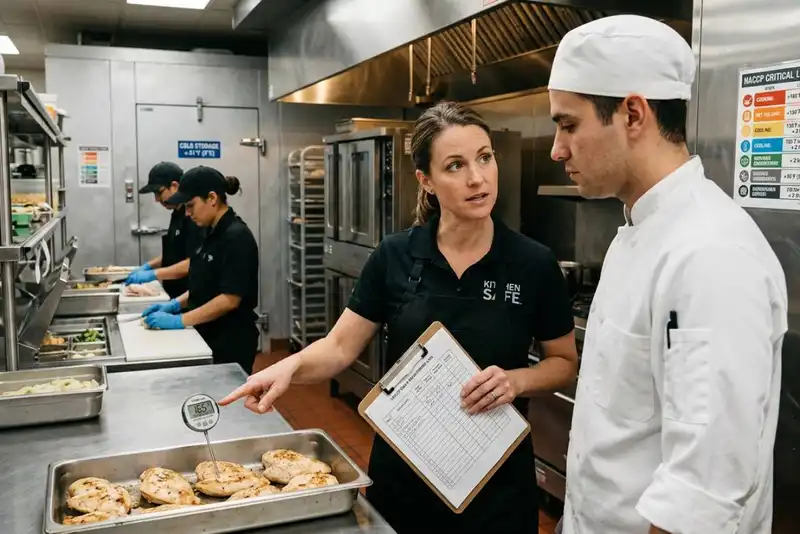
Once critical control points are identified, the next step in a HACCP system is to establish critical limits. A critical limit is the measurable boundary that determines whether a food safety control is working correctly. In practical terms, it answers a simple question for the kitchen team- what number or condition tells us the food is safe?
Critical limits must always be clear, measurable, and easy for staff to verify during daily operations. If the limit cannot be measured, it becomes difficult to enforce. For restaurant operations, most critical limits are based on time, temperature, storage conditions, or handling procedures.
Some common examples of critical limits include -
1. Cooking temperatures food must reach a minimum internal temperature to destroy harmful pathogens. For example, poultry must typically reach 165F (74C) to be considered safe.
2. Cold holding temperatures refrigerated foods should be kept at 41F (5C) or below to slow bacterial growth.
3. Hot holding temperatures prepared foods held for service should remain at 135F (57C) or above to prevent bacteria from multiplying.
4. Cooling time limits cooked food should move through the cooling process quickly, typically cooling from 135F to 70F within two hours and reaching 41F within six hours.
5. Storage practices raw meat must be stored below ready-to-eat foods in refrigeration units to prevent cross-contamination.
The purpose of critical limits is to turn food safety standards into clear operational rules. Instead of relying on judgment or guesswork, the kitchen team has specific targets they can monitor during each shift. For example, a line cook can verify whether grilled chicken reached the correct temperature with a thermometer rather than relying on appearance alone.
For restaurant owners, measurable limits create accountability and consistency. They help managers train staff, verify compliance, and quickly recognize when something is outside safe boundaries. Without clear critical limits, even a well-designed HACCP system becomes difficult to execute in a busy kitchen environment.
Create, Implement, and Execute Multiple Daily Checklists
Streamline Your Operations with Altametrics
Build Monitoring Procedures and Corrective Actions
After setting critical limits, the next step is to decide how the restaurant will monitor them and what the team will do when a limit is not met. This is where a HACCP system becomes part of daily kitchen management. A critical limit on paper only works if someone is checking it consistently, recording results, and responding quickly when something goes wrong.
Monitoring procedures should answer four practical questions -
1. What will be checked? This could include internal cooking temperatures, cold holding temperatures, cooling times, reheating temperatures, or storage conditions.
2. Who will check it? The task should be assigned to a specific role, such as a line cook, prep cook, shift lead, or manager. If responsibility is unclear, monitoring becomes inconsistent.
3. How often will it be checked? Some controls need to be checked every batch, while others may be checked at set intervals during the shift. High-risk foods and high-volume periods often require more frequent checks.
4. How will it be recorded? Results should be documented in logs, checklists, or digital systems so managers can verify that the process is being followed.
Corrective actions are just as important. A corrective action is the step the team takes when a monitored value falls outside the critical limit. These actions should be written in advance so staff do not have to guess during a busy shift.
Common corrective actions include -
1. Continue cooking food that has not reached the required internal temperature.
2. Discard product that has been held in unsafe conditions for too long.
3. Rapidly re-cool or reheat food when timing and safety standards allow.
4. Adjust equipment if a cooler, steam table, or hot holding unit is not maintaining temperature.
5. Retrain staff or review procedures if the same issue happens repeatedly.
A practical HACCP system depends on consistency. Monitoring shows whether the control is working. Corrective action defines what happens when it is not. Together, these two pieces help restaurant owners reduce guesswork, improve accountability, and prevent small food safety failures from becoming larger operational problems.
Create Verification Steps and Recordkeeping Practices
Monitoring tells the restaurant whether a food safety check was completed. Verification goes one step further. It confirms that the overall HACCP system is actually working as intended. This distinction matters because a restaurant may complete logs every day and still have weak execution if the process is not reviewed, tested, and corrected over time.
Verification should focus on whether food safety controls are accurate, consistent, and being followed across shifts. In practical terms, restaurant owners should build verification into routine management tasks rather than treat it as a separate compliance project.
Common verification steps include -
1. Reviewing logs and checklists - managers should regularly review temperature logs, cooling records, receiving logs, and sanitation checks to confirm that monitoring is happening correctly and consistently.
2. Checking thermometer accuracy - calibration matters because inaccurate tools create false confidence. A cooking temperature record is only useful if the thermometer itself is reliable.
3. Observing staff procedures - managers should watch how employees receive deliveries, store raw product, prep food, cook items, and handle holding procedures. This helps confirm that the written HACCP plan matches actual behavior.
4. Auditing corrective actions - if food falls outside a critical limit, management should confirm that the corrective action was completed properly and documented.
5. Updating the plan when operations change - new menu items, new equipment, layout changes, or updated food handling rules can all affect food safety risks and may require HACCP adjustments.
Recordkeeping supports all of this. Restaurants should maintain practical, usable records such as cooking logs, cooling logs, cold holding checks, receiving records, sanitation logs, allergen procedures, and corrective action reports. These records create visibility into what is happening in the kitchen and help identify patterns before they turn into larger problems.
For restaurant owners, recordkeeping should not be treated as paperwork for paperwork's sake. It is an operational management tool. Good records make it easier to spot repeated failures, coach staff, defend standards during inspections, and improve food safety performance over time. That is what makes verification and documentation such an important part of a working HACCP system.
Train the Team and Keep the HACCP System Updated
A HACCP system is only as strong as the people using it. Even a well-written plan will fail if employees do not understand the procedures, do not follow them consistently, or do not know what to do when something goes wrong. For restaurant owners, this means training cannot be treated as a one-time task during onboarding. It has to be part of daily operations, manager oversight, and ongoing process improvement.
Training should be tied directly to real kitchen work. Staff do not need a broad lecture on food safety theory if they are unclear on what to do during a lunch rush. They need to know the exact procedures connected to their role.
Key training priorities include -
1. Teach employees the critical control points they actually handle - cooks should know required cooking and reheating temperatures, prep staff should understand storage and cross-contamination risks, and managers should know how to review logs and verify compliance.
2. Show staff how to monitor and document correctly - employees should know how to take temperatures, complete logs, recognize unsafe conditions, and report problems immediately.
3. Train corrective actions in advance - staff should not have to guess what to do when food falls outside a critical limit. Clear actions reduce delays and inconsistent decisions.
4. Reinforce food safety during routine operations - line checks, pre-shift meetings, and manager walkthroughs are practical ways to keep HACCP standards active rather than forgotten in a binder.
5. Update the HACCP plan when the operation changes - a new menu item, prep method, supplier, storage process, or piece of equipment can introduce new hazards or change control points.
6. Review the system regularly - scheduled reviews help restaurant owners catch gaps before inspections, guest complaints, or food safety incidents force attention.
For restaurant owners, the goal is not just to create a HACCP document. The goal is to build a system the team can actually use. When training is practical and the plan is reviewed consistently, HACCP becomes part of how the restaurant operates every day. That is what makes the system useful, sustainable, and far more effective at protecting both guests and the business.
Must-Read Content

Incident management process
Incident Management Process for Restaurants

Osha reporting requirements
OSHA Reporting Requirements for Restaurants

Osha compliance
Restaurant OSHA Compliance Checklist

Workplace incident report
What to Include in a Restaurant Workplace Incident Report

Incident management best practices
Incident Management Best Practices for Restaurants
Frequently Asked Questions
What are the seven principles of HACCP?
The seven principles of HACCP are hazard analysis, identifying critical control points, setting critical limits, establishing monitoring procedures, defining corrective actions, creating verification procedures, and maintaining recordkeeping and documentation.
What does HACCP stand for in a restaurant?
HACCP stands for Hazard Analysis and Critical Control Points. It is a food safety system that helps restaurants identify where hazards can happen and set up controls to prevent unsafe food from reaching the customer.
What tools help restaurants manage a HACCP system?
Restaurants often use tools such as digital temperature logs, food safety checklists, inventory systems, kitchen monitoring software, and calibrated thermometers to track food safety controls and maintain accurate records.
What types of hazards does a HACCP system address?
A HACCP system addresses three main types of hazards - biological hazards, chemical hazards, and physical hazards. These include bacteria, allergens, cleaning chemicals, glass, metal, plastic, and other risks that can affect food safety.