What types of incidents should a restaurant track?
Restaurants should track employee injuries, guest accidents, food safety incidents, equipment and facility problems, security issues, conduct-related complaints, and near misses. Tracking a broad range of incidents helps owners identify repeat problems before they become more serious.
Incident Management Best Practices for Restaurants

The Real Cost of Inconsistent Incident Handling
In a restaurant, incidents are not isolated events. They affect multiple parts of the business at the same time. One employee injury can disrupt staffing for a full shift. One guest accident can create service delays, complaints, and possible liability concerns. One food safety incident can lead to wasted product, lost trust, and urgent operational changes. That is why incident management matters more than many owners first assume. It is not just about recording what happened. It is about protecting the business from the ripple effects that follow.
Restaurants operate in a high-risk environment by design. Teams work around wet floors, hot surfaces, knives, heavy lifting, cleaning chemicals, crowded walkways, and time pressure. Add in guest traffic, third-party delivery activity, and shift changes, and the number of variables increases quickly. Without a consistent way to respond to incidents, owners are left with incomplete information, uneven manager decisions, and preventable confusion after the fact.
Strong incident management improves clarity. When reports are completed the same way every time, owners are in a better position to understand what happened, who was involved, what actions were taken, and whether additional follow-up is required. That clarity matters for internal accountability, insurance documentation, safety reviews, and legal protection. A vague verbal summary is rarely enough when facts are questioned later.
It also improves speed. When managers know exactly what to do after an injury, guest complaint, equipment problem, or security issue, the response becomes more controlled. That reduces delays, helps protect people faster, and lowers the chance of making the situation worse.
Most importantly, incident management creates useful data. When incidents are documented consistently, owners can look beyond one event and identify patterns. Repeated burns at one station, recurring slips during closing, or multiple guest issues in the same area usually point to an underlying operational weakness. Good incident management turns those events into practical information owners can act on before the next problem happens.
The Types of Incidents
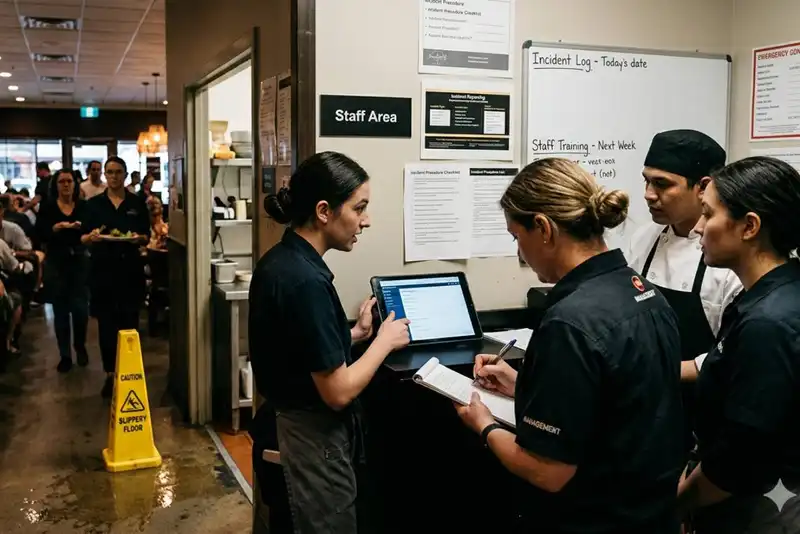
The main goal of incident management is to make sure restaurant problems are handled quickly, documented clearly, and used to prevent repeat issues. Every restaurant, regardless of size or service style, deals with operational risk throughout the day. Employees move between hot equipment, sharp tools, wet floors, heavy lifting, cleaning chemicals, guest traffic, and time-sensitive tasks. In that kind of environment, incidents are not rare exceptions. They are events owners need to be prepared to track in a consistent, organized way.
A strong incident management process starts by understanding the main types of incidents a restaurant should monitor. There are five core categories owners should be tracking -
1. Employee safety incidents - such as slips, falls, burns, cuts, lifting strains, or chemical exposure that affect team members during daily operations.
2. Guest-related incidents - including guest slips, falls, allergic reactions, spills, broken glass near dining areas, or disputes that affect the customer experience and may create liability concerns.
3. Food safety incidents - such as temperature abuse, contamination risks, allergen cross-contact, foreign objects in food, or improper storage and handling conditions.
4. Equipment and facility incidents - including refrigeration failures, gas leaks, plumbing backups, electrical issues, damaged flooring, or unsafe walkways that disrupt operations and create safety concerns.
5. Security and conduct incidents - such as theft, harassment complaints, threats, violence, vandalism, or cash-handling problems that require immediate review and follow-up.
By tracking incidents in these categories, restaurant owners can move beyond one-off reactions and start seeing useful patterns. For example, repeated slips near the dish area may point to a floor maintenance issue. Frequent burns during peak hours may signal a training gap or rushed kitchen workflow. Multiple guest complaints in one section of the dining room may highlight a layout or service problem.
This is what makes categorization valuable. It turns scattered events into usable operational data. Instead of asking, "What happened today?" owners can start asking, "What keeps happening, where, and why?" That shift helps restaurants make smarter decisions about training, maintenance, staffing, safety procedures, and accountability.
Elevate Food Safety, Simplify Compliance!
Experience Seamless Food Safety with Altametrics!
Incident Reporting Process
In a restaurant, incidents move fast. A server may slip during a rush. A line cook may get burned during peak volume. A guest may report an allergic reaction while the dining room is full. If the event is not documented in a consistent way, important details can be lost within minutes. That weakens follow-up, delays decisions, and increases risk.
A strong reporting process should include several core steps.
1. Immediate response - The first priority is always safety. The area should be secured, the immediate hazard should be addressed, and the affected employee or guest should receive the right level of attention. Reporting should never come before stabilizing the situation.
2. Clear fact collection - Once the situation is under control, managers should document the basic facts- who was involved, what happened, when it happened, where it happened, and what conditions were present at the time. Reports should be specific and factual, not vague or opinion-based.
3. Witness input - If other employees or guests saw the event, their statements should be collected while details are still fresh. Waiting too long usually reduces accuracy.
4. Supporting evidence - Photos, video references, damaged equipment notes, temperature records, or other relevant documentation should be attached when appropriate. This strengthens the report and gives owners better context.
5. Manager review and escalation - The report should be reviewed by a manager and escalated when needed. Serious injuries, food safety concerns, security issues, or incidents involving possible liability should never stay at the shift level without further review.
6. Secure recordkeeping - Reports should be stored in one organized system so they can be retrieved later for trend analysis, internal review, insurance needs, or compliance follow-up.
A strong reporting process does more than document a problem. It creates a repeatable system owners can trust when the details matter most.
Best Practices Owners Should Standardize
In many restaurants, the biggest weakness in incident management is not the lack of effort. It is inconsistency. One manager writes detailed reports. Another gives a short verbal summary. One location escalates a guest injury immediately. Another waits until the next day. When that happens, owners are not managing incidents through a system. They are managing them through individual habits.
There are several best practices every restaurant should standardize.
1. Use one incident report format - Every manager should document incidents using the same form and the same required fields. That makes reports easier to review, compare, and store.
2. Set a reporting deadline - Reports should be completed as close to the incident as possible, ideally during the same shift. Delayed reporting usually means weaker details and more guesswork.
3. Define what must be reported - Owners should clearly identify which types of incidents always require documentation. This should include injuries, guest accidents, food safety concerns, equipment failures, security issues, and near misses.
4. Separate facts from opinions - Reports should focus on what was observed, stated, and done. Personal assumptions or emotional language reduce the reliability of the record.
5. Create clear escalation rules - Managers should know exactly when to notify ownership, HR, maintenance, insurance contacts, or other leaders based on the type and severity of the incident.
6. Store reports in one system - Incident records should not be spread across texts, emails, paper files, and memory. Centralized storage improves retrieval, review, and accountability.
7. Review incidents on a routine schedule - Standardization is not complete unless reports are actually reviewed. A monthly review helps owners identify repeat problems, location-specific risk, and process failures.
These best practices create consistency, and consistency creates control. That is what allows owners to move from reactive problem handling to a more disciplined and measurable incident management process.
How to Train Managers and Employees

The main goal of incident management training is simple but essential - to make sure employees know how to report a problem and managers know how to respond in a consistent, accurate, and timely way. Even the best incident policy will fail if people do not know what to do in the moment. In a restaurant, that matters because incidents usually happen during busy, high-pressure periods when teams are already moving fast and attention is divided.
Training should start with a clear expectation- incidents must be reported immediately, not later when the shift slows down. Employees should understand that reporting is not just for major accidents. It also applies to near misses, unsafe conditions, food safety concerns, guest issues, equipment problems, and conduct-related events. If a team member notices water pooling near the dish station, a broken floor tile near the service path, or a cooler that is not holding temperature, that information needs to be reported before it leads to a larger problem.
Managers need more detailed training because they are usually responsible for first response and documentation. Their training should cover five key areas -
1. How to secure the situation - protect the employee, guest, or work area first.
2. How to gather facts - document who, what, when, where, and what immediate action was taken.
3. How to avoid assumptions - write what was observed, not what they think happened.
4. How to escalate serious incidents - know when to notify ownership, HR, maintenance, or other leaders.
5. How to complete the report the same shift - delays reduce accuracy and weaken accountability.
Training should also be practical, not theoretical. Owners should walk through common restaurant scenarios such as slips, burns, cuts, guest injuries, food contamination concerns, and equipment failures. This helps teams apply the process under real operating conditions.
Most importantly, training should be repeated. Incident management should be reinforced during onboarding, manager training, safety meetings, and periodic refreshers. Repetition builds consistency, and consistency is what makes the process work when something actually goes wrong.
Create, Implement, and Execute Multiple Daily Checklists
Streamline Your Operations with Altametrics
Use Incident Data to Reduce Repeat Problems
The main goal of incident tracking is not just to create records. It is to turn everyday problems into information owners can use to improve the business. When incident reports are completed consistently, they become a source of operational data. That data helps owners move beyond reacting to one event at a time and start identifying where risk is building across the restaurant.
A useful review process starts with a few basic questions. What type of incidents are happening most often? Where are they happening? When are they happening? Who is involved? What conditions appear repeatedly? These questions help owners look for patterns instead of treating every incident as unrelated.
There are several data points worth reviewing on a regular basis -
1. Incident type - Are slips, burns, cuts, guest complaints, food safety issues, or equipment failures occurring most often?
2. Location - Are incidents concentrated near the dish area, fryer station, walk-in cooler, dining room entrance, or parking lot?
3. Time and shift - Do more incidents happen during opening, peak service, closing, or overnight prep?
4. Role or task - Are problems linked to cooks, dishwashers, servers, delivery handoff, cleaning duties, or unloading inventory?
5. Cause or contributing factor - Are incidents tied to spills, poor workflow, weak training, equipment problems, rushed procedures, or lack of maintenance?
This kind of review helps owners find repeat risk. For example, if several burns are happening at the same station over a 30-day period, that may point to a training issue, workstation layout problem, or unrealistic pace during rush hours. If guest slips are repeatedly documented near the entrance, that may signal a floor condition, mat placement issue, or poor wet-weather controls.
The value of incident data is that it supports action. Owners can use it to adjust cleaning schedules, improve training, repair equipment faster, redesign workflows, reinforce accountability, and focus safety attention where it is most needed. Over time, this makes incident management a practical tool for prevention, not just documentation.
Must-Read Content

Haccp system
How to Build a HACCP System for Your Restaurant

Incident management process
Incident Management Process for Restaurants

Osha reporting requirements
OSHA Reporting Requirements for Restaurants

Osha compliance
Restaurant OSHA Compliance Checklist

Workplace incident report
What to Include in a Restaurant Workplace Incident Report
Frequently Asked Questions
What should be included in a restaurant incident report?
A restaurant incident report should include who was involved, what happened, when and where it happened, what conditions were present, what immediate action was taken, whether there were witnesses, and any supporting evidence such as photos or related records.
When should an incident be reported in a restaurant?
An incident should be reported as soon as possible, ideally during the same shift. Prompt reporting improves accuracy because details are fresh, witness accounts are easier to collect, and managers can respond before the situation becomes harder to review.
Can technology improve restaurant incident management?
Yes. Digital tools can help standardize forms, organize records, improve reporting speed, reduce missing information, and make it easier to review incident trends across shifts or locations. This improves consistency and supports better follow-up.
How can multi-location restaurants manage incidents consistently?
Multi-unit operators should use the same reporting system, forms, and escalation rules across all locations. Centralized tracking allows owners to compare data, identify location-specific risks, and maintain consistent standards across the business.