What is restaurant loyalty program integration?
Restaurant loyalty program integration is the process of connecting your loyalty system with core tools like POS, online ordering, and payments so customer data, transactions, and rewards update automatically in real time.
What to Know About Restaurant Loyalty Program Integration

Loyalty Program Integration Explained
Loyalty program integration is often misunderstood as simply "connecting" a rewards platform to your restaurant. In practice, it means something much more specific - and much more important.
At a basic level, integration means that your loyalty program shares data automatically with the systems you already use to run your restaurant. This includes your POS, online ordering platform, payment processor, and customer database. But the key is not just connection - it is how consistently and accurately data flows between them.
A fully integrated loyalty setup ensures that every transaction is tied to a guest profile in real time.
For example, when a customer places an order -
- Their purchase is recorded in the POS
- Their loyalty account is identified automatically (via phone number, app, or login)
- Points are earned instantly based on the transaction
- Any available rewards can be applied without manual steps
- The data is stored and updated across all systems simultaneously
This entire process should happen without staff intervention.
The difference between an integrated and disconnected setup becomes clear during daily operations.
In a disconnected system -
- Loyalty points may update hours lateror not at all
- Rewards may only work in-store but not online (or vice versa)
- Staff may need to manually apply discounts or fix errors
- Guest data may exist in multiple places with no consistency
In an integrated system -
- Data updates in real time across all channels
- Rewards work consistently whether the order is placed in-store, online, or through mobile
- Staff follow the same process for every transaction
- Guest profiles reflect complete and accurate purchase history
This consistency is what drives both operational efficiency and better decision-making.
Another critical aspect of integration is data centralization. Without integration, customer data is fragmented. You may have one set of data in your POS, another in your online ordering system, and a separate set in your loyalty platform. These datasets do not align, making it difficult to understand true customer behavior.
With integration, all of that data connects into a single, unified view.
This allows you to answer practical, high-impact questions -
- How often do guests return after their first visit?
- Which promotions actually increase repeat purchases?
- What is the average spend of loyalty members vs. non-members?
- Which channels (in-store vs. online) drive the most loyalty engagement?
Without integrated data, these questions are difficult to answer accurately. For restaurant owners, the key takeaway is this - loyalty program integration is not just about adding a feature - it is about creating a system where guest activity, transactions, and rewards are all connected.
The Cost of Poor Integration

When loyalty program integration is weak or incomplete, the impact is not just operational - it directly affects revenue. The losses are not always obvious, but they show up consistently in missed opportunities, inaccurate promotions, and preventable inefficiencies.
One of the most common issues is missed loyalty participation at checkout. If your system does not automatically recognize guests, staff must ask for phone numbers or scan apps manually. During busy periods, this step is often skipped to keep lines moving. The result is simple - fewer transactions are tied to loyalty accounts, which means fewer repeat visits driven by your program.
Another major issue is inconsistent reward application. When loyalty systems are not fully integrated -
- Rewards may work in-store but fail online
- Points may not update in real time
- Guests may be unable to redeem offers when they expect to
This creates friction at the exact moment you are trying to reinforce loyalty. Instead of building trust, the experience becomes unreliable. Guests are less likely to engage with a program that does not work consistently.
Revenue is also lost through poor promotion tracking. Without integrated data, it is difficult to measure whether promotions are actually driving incremental sales. You may see high redemption rates, but that does not necessarily mean increased revenue. In many cases, restaurants end up discounting purchases that would have happened anyway.
This leads to a critical gap - you are giving away margin without clear visibility into the return.
Manual processes add another layer of loss.
If staff need to -
- Adjust rewards manually
- Fix missing points
- Reconcile discrepancies between systems
Discounts may be applied incorrectly, rewards may be overused, and transactions may not be tracked properly. Over time, these small inconsistencies compound into measurable financial impact.
There is also a data visibility problem. When loyalty activity is not tied directly to transaction data, you lose the ability to understand customer behavior accurately. You cannot clearly identify -
- High-value repeat guests
- Frequency of visits tied to specific promotions
- Differences in spend between loyalty members and non-members
Without this visibility, decisions become reactive instead of data-driven.
Ultimately, the biggest revenue risk is missed repeat business. A loyalty program is designed to increase visit frequency and customer lifetime value. But if the system behind it is inconsistent or disconnected, it fails to influence behavior in a meaningful way. Guests may sign up once, but they do not stay engaged.
Core Systems for Loyalty Integration
For loyalty program integration to work effectively, it cannot operate in isolation. It must be directly connected to the core systems that run your restaurant every day. Without these connections, data becomes fragmented, processes slow down, and execution becomes inconsistent.
There are five critical systems your loyalty program must integrate with -
1. POS System (Point of Sale) - Your POS is the center of every transaction. Loyalty must be tied directly to it. This ensures that -
- Every purchase is linked to a customer profile
- Points are earned automatically based on actual spend
- Rewards can be applied instantly at checkout
If loyalty is not fully integrated with your POS, you lose accuracy at the most important pointthe transaction itself.
2. Online Ordering Platforms - Today's guests interact with your restaurant across multiple channels. If loyalty only works in-store, you are missing a significant portion of activity. Integration with online ordering ensures -
- Guests earn and redeem rewards consistently across channels
- Digital orders contribute to loyalty engagement
- No disconnect between in-store and off-premise experiences
Without this, you create two separate customer experiences instead of one unified system.
3. Payment Systems - Loyalty is ultimately tied to spending. Integration with your payment system ensures that rewards are based on actual completed transactions - not partial or failed ones. This helps -
- Prevent errors in point calculation
- Ensure accurate reward eligibility
- Align financial data with loyalty activity
This connection is critical for maintaining both accuracy and trust.
4. Customer Database (CRM) - A loyalty program is only as strong as the customer data behind it. Integration with a centralized customer database allows you to -
- Build complete guest profiles based on real behavior
- Track visit frequency, spend patterns, and preferences
- Segment customers for targeted promotions
Without this, your data remains incomplete and difficult to act on.
5. Reporting and Analytics Tools - Integration must extend into reporting. If loyalty data is not included in your reporting systems, you cannot measure performance effectively. A strong setup allows you to -
- Track redemption rates and promotion performance
- Measure repeat visits and customer lifetime value
- Compare loyalty vs. non-loyalty customer behavior
This is what turns loyalty from a feature into a measurable business driver.
When these systems are fully connected, loyalty becomes part of your operational flow - not an added step. Transactions are tracked automatically. Rewards are applied consistently. Data is captured once and used across all systems. Staff follow the same process every time, regardless of how the order is placed.
Integration and Guest Experience
Guest experience is where loyalty program integration becomes visible. While much of the work happens behind the scenes, the outcome is felt directly by customers during every interaction with your restaurant.
When integration is strong, the experience is simple and predictable.
Guests do not need to think about how to earn points or redeem rewards. The system recognizes them automatically, tracks their activity in real time, and applies benefits without extra steps. This reduces friction at key moments - ordering, paying, and returning.
From an operational standpoint, this consistency matters. If a guest earns points in-store but cannot redeem them online, or if rewards appear delayed or missing, it creates confusion. Even small inconsistencies weaken trust in the program. Over time, that reduces engagement and lowers the likelihood of repeat visits.
Integration removes these gaps. With a fully connected system -
- Guests earn rewards regardless of how they order (in-store, online, or mobile)
- Points and rewards update immediately after each transaction
- Offers are applied automatically at checkout without staff intervention
- The experience is consistent across every visit
This consistency directly impacts retention.
When guests know the system works, they are more likely to use it. When they use it regularly, they are more likely to return. This is how loyalty programs influence behavior - not through occasional promotions, but through reliable, repeatable interactions.
Integration also enables personalization. When loyalty data is tied to actual transactions, you can move beyond generic offers. Instead of sending the same promotion to every customer, you can target based on -
- Purchase history
- Visit frequency
- Average spend
- Preferred ordering channel
This allows you to create offers that are more relevant and more likely to drive action.
From a data perspective, this improves efficiency. Rather than increasing the number of promotions, you improve the quality of each one. This reduces unnecessary discounting and focuses incentives on the guests most likely to respond.
Another important factor is speed of service. When loyalty is integrated, staff do not need to manage the process manually. There is no need to enter information, troubleshoot missing rewards, or explain inconsistencies to guests. This keeps transactions moving and reduces pressure during peak hours.
How to Evaluate Loyalty Integration
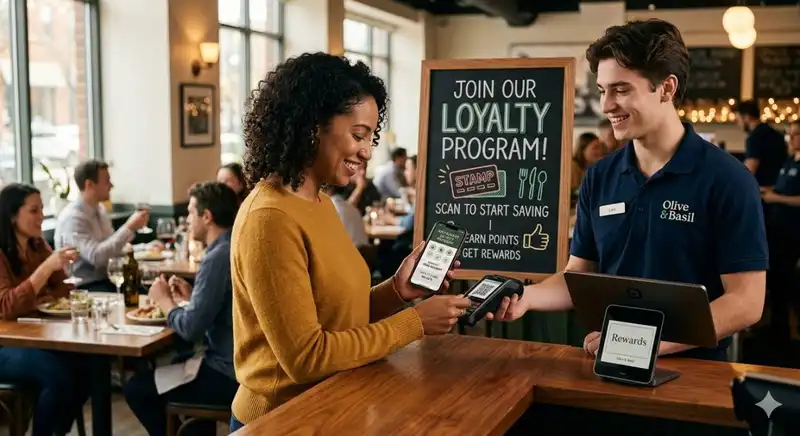
Choosing a loyalty program is not just about features - it is about how well the system fits into your daily operations. The wrong integration creates more work for your team. The right one removes friction and improves execution.
Before making a decision, there are a few critical areas restaurant owners should evaluate.
1. Real-Time Data Syncing - Timing matters. If loyalty data updates with delays, it creates immediate problems -
- Guests may not see points after a purchase
- Rewards may not be available when expected
- Staff may need to manually fix discrepancies
A strong integration should update transactions, points, and rewards instantly across all systems.
2. Ease of Use for Staff - Your team will use this system during peak hours. If the process is not simple, it will not be followed consistently. Evaluate -
- How many steps are required at checkout
- Whether staff need to manually enter or adjust rewards
- How easy it is to identify loyalty members during a transaction
If it slows down service, it will be skipped.
3. Compatibility With Existing Systems - Your loyalty integration must work with what you already use. This includes -
- POS system
- Online ordering platforms
- Payment processing
- Reporting tools
If compatibility is limited, you will end up with partial integration - which leads to data gaps and operational issues.
4. Consistency Across Channels - Guests expect the same experience whether they order in-store or online. Confirm that -
- Points can be earned and redeemed across all channels
- Promotions apply consistently regardless of order source
- Guest data remains unified across platforms
Any inconsistency here directly impacts engagement.
5. Data Visibility and Reporting - A loyalty program should give you clear, actionable data - not just basic metrics. You should be able to track -
- Repeat visit frequency
- Redemption rates tied to actual transactions
- Spend behavior of loyalty vs. non-loyalty guests
- Promotion performance
If reporting is limited, you cannot measure ROI effectively.
6. Scalability for Growth - What works for a single location may not work for multiple units. Evaluate whether the system can -
- Support multiple locations with consistent rules
- Centralize reporting across stores
- Maintain data accuracy at higher transaction volumes
Scaling issues often appear later - when they are harder to fix.
A loyalty program should not add complexity to your business. It should fit into your existing workflows, automate key processes, and provide reliable data you can act on.
For restaurant owners, the key is to look beyond surface-level features. Focus on how the system performs during real transactions, under real conditions.
Signs Your Loyalty Integration Isn't Working
Loyalty program issues are not always obvious at first. In many cases, the system appears to functionbut small breakdowns start to show up in daily operations. Over time, these gaps affect both staff efficiency and guest engagement.
The key is to recognize the warning signs early.
1. Staff Are Manually Managing Rewards - If your team needs to -
- Enter phone numbers repeatedly
- Adjust points or discounts manually
- Troubleshoot missing rewards during checkout
Loyalty should run in the background, not require constant intervention.
2. Guests Report Missing Points or Rewards - Frequent complaints about -
- Points not updating
- Rewards not appearing
- Inconsistent redemption experiences
Even occasional issues reduce trust in the program.
3. Loyalty Works in Some Channels but Not Others - If guests can earn or redeem rewards in-store but not online - or vice versa - you are operating with a disconnected system. This creates inconsistent experiences and limits engagement.
4. Data Does Not Match Across Systems - When loyalty data, POS data, and reporting metrics do not align, it becomes difficult to trust your numbers. This often shows up as -
- Different transaction totals across systems
- Inaccurate redemption tracking
- Gaps in customer history
Without alignment, reporting loses value.
5. Limited Visibility Into Customer Behavior - If you cannot clearly answer questions like -
- Who are your most frequent guests?
- How often do loyalty members return?
- Which promotions actually drive repeat visits?
Then your integration is not capturing or connecting data properly.
6. Promotions Are Difficult to Track or Evaluate - If you are running offers but cannot measure their impact on revenue, visit frequency, or spend, you are operating without full visibility. This often leads to over-discounting without clear results.
7. The System Slows Down Operations During Peak Hours - Any system that creates delays at checkout - especially during busy periods - will eventually be bypassed by staff. If loyalty steps are skipped to maintain speed, the program loses effectiveness.
These warning signs point to a single issue- lack of operational alignment. A loyalty program should simplify processes, not complicate them. When integration is weak, the burden shifts to your staff, and consistency breaks down.
For restaurant owners, the takeaway is straightforward- if your team has to "work around" the loyalty system, it is not working as intended. Identifying these issues early allows you to address them before they impact guest retention, data accuracy, and overall performance.
What Strong Loyalty Integration Should Deliver
A loyalty program should not create extra work or uncertainty. When integration is done correctly, it becomes a reliable part of your operation - something that runs consistently in the background while giving you clear, actionable data.
At a minimum, a strong loyalty program integration should deliver real-time accuracy across every system.
Every transaction should be instantly connected to a guest profile. Points should be earned without delay. Rewards should be available and applied at the exact moment they are expected. This level of accuracy eliminates confusion for both staff and guests.
Consistency across all channels is equally important. Whether a guest orders in-store, online, or through mobile, the experience should be the same -
- Points are earned automatically
- Rewards are visible and usable
- Guest data is updated in a single system
This creates a unified experience that encourages repeat engagement.
A strong integration also removes manual work from your team. Staff should not need to -
- Enter or verify loyalty details repeatedly
- Adjust rewards manually
- Troubleshoot system inconsistencies during service
Instead, the process should be embedded into the normal flow of transactions. This keeps operations fast and predictable, especially during peak hours.
From a management perspective, visibility is critical. You should be able to clearly track -
- Repeat visit frequency
- Redemption rates tied to actual sales
- Customer lifetime value trends
- Promotion performance based on real data
This is what allows you to move from guesswork to informed decision-making.
Finally, a well-integrated loyalty system should scale with your business. As you add locations, increase order volume, or expand digital channels, the system should maintain the same level of accuracy and consistency. Integration should not break as complexity increases - it should support it.
If your loyalty program feels disconnected from your daily operations, the issue is not the concept - it is the integration behind it. Altametrics helps restaurant operators connect loyalty programs with the systems that matter most - POS, online ordering, labor, and reporting - so data flows automatically and accurately.
With the right integration in place, you can -
- Eliminate manual work and reduce operational friction
- Ensure rewards and promotions work consistently across all channels
- Gain full visibility into customer behavior and repeat visits
- Make data-driven decisions that improve retention and profitability
Instead of managing multiple disconnected tools, you create a single, reliable system that supports both operations and growth. Explore how Altametrics can help you turn loyalty into a measurable, operational advantage by clicking "Book a Demo" below.
All in One Workforce Management Solution
Streamline Your Restaurants Success with Altametrics
Must-Read Content

Online ordering pos integration
Online Ordering POS Integration for Restaurants

Restaurant system integration
Restaurant System Integration Checklist for Owners

Inventory integration
5 Signs Your Restaurant Needs Better Inventory Integration

Payment system integration
How to Evaluate Payment System Integration for Your Restaurant
Integration tools
Restaurant Integration Tools That Improve Accuracy and Efficiency
Frequently Asked Questions
What should I look for when choosing a loyalty program integration?
Focus on real-time data syncing, ease of use for staff, compatibility with your existing systems, consistent performance across channels, strong reporting capabilities, and scalability for growth.
How does loyalty program integration improve guest experience?
It allows guests to earn and redeem rewards seamlessly across all channels, ensures real-time updates, and removes friction during checkout - making the experience faster, more consistent, and more reliable.
What metrics should restaurant owners track for loyalty performance?
Key metrics include repeat visit rate, redemption rate, average spend per loyalty member, customer lifetime value, and promotion-driven revenue to evaluate true program effectiveness.
What systems should a loyalty program integrate with?
Your loyalty program should connect with your POS, online ordering platforms, payment systems, customer database (CRM), and reporting tools to ensure accurate data and smooth operations.