What HR tools are useful for restaurants?
Useful HR tools for restaurants include scheduling software, time tracking systems, payroll integrations, onboarding checklists, employee document storage, compliance alerts, reporting dashboards, and mobile employee communication tools.
How Restaurant Owners Can Build a Strong HR System

HR as a Growth Tool
Running a restaurant is not only about food, service, and sales. It is also about managing people. Every shift depends on cooks, servers, cashiers, bartenders, hosts, dishwashers, delivery staff, and managers showing up on time and working together. When employee processes are unorganized, small issues can quickly become missed shifts, payroll mistakes, poor training, high turnover, and compliance problems.
This is why restaurant owners need a strong HR system. Human resources creates structure for hiring, onboarding, scheduling, time tracking, training, employee communication, performance management, and workplace policies. Without that structure, managers may rely on memory, paper forms, text messages, or inconsistent rules.
A strong HR system gives employees clear expectations. They know how to request time off, how breaks should be handled, when they are scheduled, what behavior is expected, and who to contact when there is a problem. Managers also have a better way to track attendance, document issues, review performance, and make fair staffing decisions.
For restaurant owners, the value is both operational and financial. Better HR processes can reduce turnover, improve labor planning, lower payroll errors, and help prevent compliance risks. In simple terms, HR helps restaurants run smoother, protect profits, and build a more reliable team.
Start with Clear HR Policies

A strong HR system starts with clear written policies. In a restaurant, many employee problems happen because rules are communicated verbally, handled differently by each manager, or only explained after something goes wrong. That creates confusion for employees and inconsistency for the business.
For restaurant owners, HR policies turn expectations into a system. Instead of asking managers to "use their judgment" every time someone is late, misses a shift, skips a break, or violates dress code, written policies give the team a clear standard to follow.
The most important policies should cover daily labor issues that directly affect operations and costs.
1. Attendance and punctuality
Late arrivals, no-shows, and last-minute call-outs can quickly damage service. If a restaurant schedules 12 employees for a dinner shift and 2 do not show up, that is nearly 17% of the scheduled team missing. The result may be slower ticket times, longer wait times, stressed employees, and lower customer satisfaction. A clear attendance policy should explain how employees report absences, how much notice is required, and what happens after repeated issues.
2. Timekeeping and breaks
Payroll accuracy depends on clean time records. Employees should know when to clock in, when to clock out, how to record breaks, and why they should never clock in for another employee. Even small timekeeping errors can add up across dozens of employees and hundreds of shifts each month. A written policy helps reduce payroll disputes and protects the restaurant from wage and hour problems.
3. Conduct and workplace behavior
Restaurants are fast-paced environments, and conflict can happen quickly during busy shifts. Policies should explain expectations for respect, harassment prevention, teamwork, customer interaction, phone use, food safety, alcohol service, and manager communication. This gives managers a fair way to address problems before they become larger workplace issues.
4. Discipline and documentation
A strong HR system should also define how performance problems are documented. For example, a restaurant may use verbal coaching for a first issue, written documentation for repeated problems, and further action if the behavior continues. This creates a record that helps owners make consistent decisions instead of relying on memory.
Clear HR policies do more than protect the business. They help employees understand what is expected, help managers enforce rules fairly, and help restaurant owners reduce avoidable labor problems.
Innovative Restaurant Software Solutions
Modernize Your Recruitment Process with Altametrics
Build a Better Hiring Process
A strong HR system depends on hiring the right people before they ever appear on the schedule. In restaurants, hiring mistakes can become expensive quickly because one poor fit can affect service speed, team morale, customer experience, and manager workload. When the hiring process is rushed or informal, owners may fill an open shift today but create a turnover problem next month.
For restaurant owners, the goal is to move from reactive hiring to structured hiring. Instead of waiting until the restaurant is short-staffed, owners should have a repeatable process for finding, screening, interviewing, and selecting employees.
1. Write clear job descriptions
Every role should have a written job description that explains the position, responsibilities, required skills, availability expectations, physical requirements, pay range, and reporting manager. A server, line cook, host, cashier, dishwasher, bartender, and shift lead should not all be hired with the same generic job post.
Clear job descriptions help reduce mismatched expectations. For example, if a cook position requires weekend availability, late-night shifts, lifting requirements, and experience with high-volume prep, those details should be stated before the interview. This helps filter out applicants who are not a good fit.
2. Screen for availability early
Availability is one of the biggest hiring factors in restaurants. An applicant may have great experience, but if they cannot work the restaurant's busiest shifts, they may not solve the staffing problem. Owners should ask about weekday, weekend, holiday, morning, lunch, dinner, and closing availability before moving too far into the hiring process.
For example, if 60% of weekly sales happen between Friday night and Sunday evening, hiring employees who cannot work weekends creates a labor gap during the highest-revenue periods. A strong HR system should match hiring decisions to actual business demand.
3. Use consistent interview questions
Managers should ask each candidate a similar set of questions. This makes hiring more fair and easier to compare. Questions should focus on reliability, customer service, teamwork, conflict handling, food safety awareness, speed, and past restaurant experience.
For example, a restaurant may ask, "Tell me about a time you handled a difficult customer," or "How do you stay organized during a busy rush?" These questions give managers a better view of how the candidate may perform under pressure.
4. Check for culture and role fit
Skills matter, but attitude and reliability are just as important. Restaurants need employees who can work quickly, communicate clearly, follow procedures, and stay calm during peak hours. A strong hiring process should look for both technical ability and team fit.
A better hiring process helps restaurant owners reduce turnover, improve shift coverage, and build a team that can support consistent service. When hiring is structured, managers make better decisions and employees start with clearer expectations.
Create a Consistent Onboarding Program
Hiring the employee is only the beginning. The next step is making sure they understand the restaurant's standards before they are expected to perform during a busy shift. A consistent onboarding program helps new employees learn the rules, tools, tasks, and expectations of the job in a structured way.
Without onboarding, many restaurants rely on shadowing, quick verbal instructions, or whatever the manager has time to explain that day. This can create uneven training. One new server may learn how to handle guest complaints, while another may never be shown the proper process. One cook may receive detailed prep instructions, while another may guess based on what other employees are doing.
For restaurant owners, onboarding should reduce confusion and help new employees become productive faster.
1. Start before the first shift
A strong onboarding process should begin before the employee works on the floor or in the kitchen. New hires should complete required paperwork, tax forms, direct deposit information, handbook acknowledgments, food safety requirements, and policy reviews before their first scheduled shift whenever possible.
This helps prevent delays and gives managers more time to focus on training instead of chasing missing documents.
2. Explain restaurant policies clearly
New employees should understand attendance rules, break policies, dress code, timekeeping procedures, tip policies, call-out expectations, harassment prevention, safety rules, and communication standards. These policies should not be buried in a handbook and forgotten. Managers should review the most important rules during onboarding so employees know what is expected from day one.
3. Train by role, not just by location
Each position should have its own onboarding checklist. A cashier needs training on POS use, payment handling, refunds, customer greetings, and order accuracy. A line cook needs training on prep standards, recipes, food safety, portion control, cleaning tasks, and ticket timing. A server needs training on menu knowledge, upselling, table service, allergy communication, and side work.
Role-based onboarding helps employees learn what matters most for their job instead of receiving generic training.
4. Use checklists to track progress
Restaurant owners should not rely on memory to know whether a new employee has been trained properly. A checklist can show which tasks have been completed, who trained the employee, and whether the employee is ready to work independently.
For example, a server onboarding checklist may include greeting standards, POS training, menu test, allergy protocol, payment process, side work, and closing duties. This gives managers a clear way to measure readiness.
A consistent onboarding program helps reduce early turnover, improve service quality, and create a smoother employee experience. When new hires know what to do, how to do it, and who to ask for help, they are more likely to succeed.
Track Time, Attendance, and Scheduling
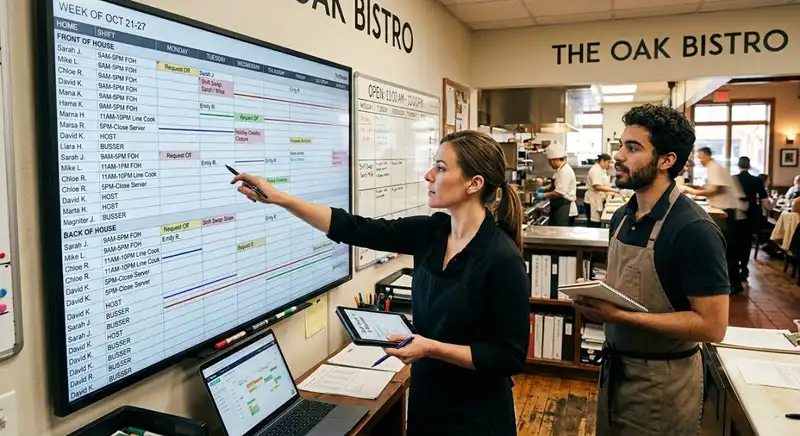
A strong HR system should give restaurant owners a clear view of when employees are scheduled, when they actually work, and how labor costs are changing. In restaurants, labor is one of the largest controllable expenses, so even small scheduling and timekeeping mistakes can affect profit margins.
If a restaurant has 40 employees and each employee records just 10 extra minutes per shift because of early clock-ins, missed clock-outs, or inaccurate break tracking, those minutes can add up quickly. Across hundreds of shifts each month, the restaurant may pay for hours that were not planned in the labor budget. This is why accurate time and attendance tracking is not only an HR task. It is a financial control.
1. Connect schedules to actual clock-ins
Owners should compare scheduled hours to actual worked hours. If an employee is scheduled from 4 p.m. to 10 p.m. but clocks in at 3.45 p.m. and clocks out at 10.20 p.m., that extra time may seem small. But if the same pattern happens across multiple employees and shifts, weekly labor costs can rise without the owner noticing.
A strong HR system should show the difference between planned labor and actual labor so managers can correct issues early.
2. Track breaks and overtime carefully
Breaks and overtime need close attention because they can affect both payroll and compliance. Employees should know when breaks are required, how to record them, and what to do if a break is missed. Managers should also be alerted before an employee approaches overtime instead of discovering it after payroll is processed.
For example, if an employee works 39 hours by Friday and is scheduled for an 8-hour Saturday shift, the restaurant may create overtime without planning for it. Better tracking helps managers adjust schedules before costs increase.
3. Manage availability and shift changes
Restaurants often deal with changing availability, school schedules, second jobs, call-outs, and shift swaps. If these updates are handled through text messages or verbal conversations, mistakes are more likely. An employee may think a shift was covered, while the manager still expects them to arrive.
A strong HR system should keep availability, time-off requests, approved swaps, and schedule updates in one place. This reduces confusion and helps managers maintain proper coverage.
4. Use labor data to protect margins
Scheduling should be based on demand, not guesswork. Owners should review sales patterns, peak hours, labor cost percentage, overtime hours, and employee attendance trends. If lunch sales are slow on Mondays but labor hours stay high, the schedule may need to be adjusted. If Friday dinner sales are strong but the team is understaffed, service may suffer.
Accurate time, attendance, and scheduling data helps restaurant owners control labor costs, reduce payroll errors, and build schedules that match real business needs.
Train Managers
A restaurant HR system is only effective if managers know how to use it. Owners may create clear policies, onboarding checklists, schedules, and timekeeping rules, but managers are usually the people enforcing those standards during daily operations. If managers handle employee issues inconsistently, the HR system can break down quickly.
Restaurant managers often deal with HR problems while also managing food quality, customer complaints, vendor deliveries, staffing shortages, and sales goals. That pressure can lead to rushed decisions. One manager may ignore lateness because the employee is a strong performer. Another manager may send someone home for the same issue. Over time, this creates confusion and can make employees feel that rules are not applied fairly.
For restaurant owners, manager training should focus on consistency, documentation, and communication.
1. Teach managers how to document issues
Employee problems should not be handled only through memory or informal conversations. Managers should document repeated lateness, missed shifts, customer complaints, policy violations, performance problems, and workplace conflicts. Documentation should include the date, issue, people involved, action taken, and any follow-up needed.
For example, if an employee is late 4 times in one month, the manager should be able to show the pattern clearly. This helps the owner make better decisions and reduces confusion if the employee disputes the issue later.
2. Standardize coaching and discipline
Managers should understand the difference between coaching, correction, and formal discipline. A first mistake may require a conversation. A repeated issue may require written documentation. A serious violation may require immediate action.
A structured process helps prevent emotional or inconsistent decisions during stressful shifts. It also gives employees a fair chance to improve before stronger action is taken.
3. Train managers to handle complaints
Employee complaints should be taken seriously, especially when they involve harassment, discrimination, safety, wage concerns, scheduling fairness, or manager behavior. Managers should know when to listen, when to document, and when to escalate the issue to the owner or HR contact.
Ignoring complaints can create larger workplace problems. A strong HR system gives managers a clear process so issues are handled quickly and professionally.
4. Improve performance conversations
Managers should be trained to give specific feedback instead of vague criticism. Saying "you need to do better" is not as useful as saying, "Your ticket times were slower during dinner rush because prep was not completed before service." Specific feedback helps employees understand what needs to change.
When managers know how to handle HR issues properly, the restaurant becomes more consistent, fair, and organized. Employees know what to expect, managers feel more confident, and owners have better control over workplace problems.
Use HR Data
A strong HR system should do more than store employee records. It should help restaurant owners understand what is happening inside the workforce. When HR data is tracked correctly, owners can spot labor problems earlier, make better staffing decisions, and reduce the guesswork that often leads to high turnover and rising labor costs.
Many restaurants already have useful employee data, but it is often scattered across schedules, payroll reports, time clocks, manager notes, hiring records, and training checklists. When that information is not reviewed together, owners may miss important patterns. For example, a restaurant may know that employees are quitting, but not know whether turnover is higher among new hires, closing-shift employees, cooks, servers, or one specific location.
1. Track turnover by role and location
Turnover is one of the most important HR metrics for restaurant owners. A high turnover rate can increase hiring costs, training time, manager workload, and service inconsistency. Instead of only looking at total turnover, owners should break it down by position, department, shift, and location.
For example, if most turnover happens within the first 30 to 60 days, the issue may be hiring expectations or onboarding. If turnover is highest among line cooks, the problem may be workload, pay, scheduling, training, or kitchen leadership.
2. Monitor absenteeism and lateness
Attendance data can show whether staffing issues are isolated or part of a larger pattern. If one employee is frequently late, that may require coaching. If several employees are calling out on the same shifts, the schedule may be too demanding, morale may be low, or managers may need a better coverage plan.
Tracking absenteeism helps owners reduce last-minute labor gaps before they damage service.
3. Review overtime and labor cost trends
Overtime can be useful during busy periods, but consistent overtime may signal poor scheduling, understaffing, or weak availability planning. Owners should review overtime hours by employee, department, and week.
For example, if a restaurant regularly pays overtime while also hiring new employees, the issue may not be headcount. It may be that the right employees are not available during the right shifts.
4. Measure training completion and performance
Training data helps owners see whether employees are prepared for their roles. If customer complaints, order mistakes, or slow service increase after new hires start, the onboarding process may need improvement. Tracking completed training modules, manager sign-offs, and performance notes gives owners a clearer picture of employee readiness.
HR data helps restaurant owners make decisions based on patterns instead of opinions. When owners understand turnover, attendance, overtime, training, and performance trends, they can build a stronger team and protect labor margins.
Choose the Right HR Tools
A strong HR system becomes easier to manage when restaurant owners use the right tools. Paper forms, spreadsheets, text messages, and verbal updates may work for a small team, but they become harder to control as the restaurant grows. When schedules, employee records, time-off requests, training documents, and payroll information are stored in different places, managers spend more time chasing information and less time running the business.
For restaurant owners, HR tools should support daily operations, not create extra work. The goal is to choose systems that make hiring, onboarding, scheduling, time tracking, payroll, compliance, and reporting easier to manage from one place.
1. Look for scheduling and time tracking features
Scheduling and time tracking are two of the most important HR functions in a restaurant. The right tool should allow managers to build schedules, track employee availability, approve time-off requests, manage shift swaps, and compare scheduled hours against actual hours worked.
This matters because labor costs can change quickly. If employees clock in early, miss breaks, or work overtime without approval, payroll costs may rise before the owner notices. A strong HR tool should help managers catch those issues before they affect margins.
2. Keep employee documents organized
Restaurant owners need a reliable way to store employee documents, including tax forms, handbook acknowledgments, certifications, training records, disciplinary notes, emergency contacts, and signed policies. If these records are scattered across paper files, inboxes, and manager notes, they may be difficult to find when needed.
A centralized HR system helps owners stay organized and reduces the risk of missing important documentation.
3. Use tools that support onboarding and training
New employees should not receive a different training experience depending on which manager is working that day. HR tools can help standardize onboarding with checklists, role-based training tasks, policy acknowledgments, and manager sign-offs.
For example, a new server may need to complete menu training, POS training, allergy communication, payment procedures, side work, and service standards before working independently. A digital checklist helps managers confirm that each step was completed.
4. Review reporting and compliance support
The best HR tools give owners visibility into turnover, overtime, attendance, labor cost trends, missed breaks, training completion, and schedule changes. These reports help owners make better staffing decisions and identify problems early.
Restaurant owners should also look for tools that support labor compliance, especially around breaks, overtime, minor labor rules, timekeeping, and recordkeeping. While software does not replace legal advice, it can help managers follow consistent processes.
Choosing the right HR tools helps restaurant owners reduce manual work, improve accuracy, and build a more reliable employee management system. When HR information is organized and easy to access, managers can make faster decisions and employees get a smoother experience.


Employee scheduling
Human Resource Management for Restaurants
Employee scheduling
Common Payroll Challenges in Restaurants

Sales forecasting
How to Use Restaurant Analytics to Improve Profitability

Restaurant management
The Complete Guide to Restaurant Reputation Management

Accounting payroll
Restaurant Cash Handling Procedures

Accounting payroll
How to Manage Restaurant Finances

Employee scheduling
How to Motivate Restaurant Staff

Software integration
10 Ways Technology Can Help Control Food Cost in Restaurants

Frequently Asked Questions
What HR data should restaurant owners track?
Restaurant owners should track turnover rate, absenteeism, lateness, overtime hours, labor cost percentage, training completion, schedule changes, and employee performance trends. These numbers help owners spot staffing problems before they become larger operational issues.
What is the biggest HR mistake restaurant owners make?
One of the biggest HR mistakes is relying on verbal rules instead of written policies. When expectations are not documented, managers may handle the same issue differently, which can create confusion, unfair treatment, and compliance risk.
What HR reports should restaurant owners review each month?
Restaurant owners should review reports on turnover, overtime, absenteeism, lateness, labor cost percentage, training completion, missed breaks, schedule changes, and employee performance trends. These reports help owners find labor problems early.
What should be included in restaurant onboarding?
Restaurant onboarding should include required paperwork, policy review, timekeeping instructions, food safety training, role-specific training, POS training, customer service standards, scheduling procedures, and manager introductions. Each role should also have a checklist to confirm the employee is ready to work independently.