How can restaurant owners reduce food cost variance?
Owners can reduce variance by improving portion control, updating recipe costs, tracking waste, counting inventory accurately, reviewing invoices, training staff, monitoring supplier prices, and checking POS menu mapping.
Theoretical vs Actual Food Cost Formula for Restaurants

Food Cost Explained
Actual vs. theoretical food cost is one of the most important comparisons restaurant owners can use to understand where money is being made or lost. Both numbers look at food cost, but they answer two different questions.
Actual food cost shows what your restaurant really spent on food during a specific period. It is based on beginning inventory, purchases, ending inventory, and actual product usage. In simple terms, actual food cost tells you what left your shelves, coolers, freezers, and storage areas. This number reflects real activity, including normal sales, waste, spoilage, theft, over-portioning, incorrect prep, employee meals, comps, missing invoices, and inventory count errors.
Theoretical food cost shows what your restaurant should have spent based on what was sold. It uses menu item sales, recipes, portion sizes, ingredient costs, and expected yields to calculate the ideal cost of producing those sales. For example, if your POS shows that you sold 100 burgers, theoretical food cost calculates how much beef, buns, cheese, produce, and condiments should have been used based on the recipe.
The difference between these two numbers is called the food cost variance or the gap between actual and theoretical food cost. If actual food cost is higher than theoretical food cost, the restaurant used more product than expected. That gap may come from large portions, waste, spoilage, prep mistakes, theft, incorrect recipe costing, supplier price changes, or poor inventory control.
For restaurant owners, this comparison matters because actual food cost alone does not explain the full story. It may show that food cost is too high, but it does not show why. Theoretical food cost creates a benchmark. It gives owners a clear target for what food cost should have been if recipes, portions, pricing, inventory, and kitchen execution were followed correctly
The Formula Behind Food Cost
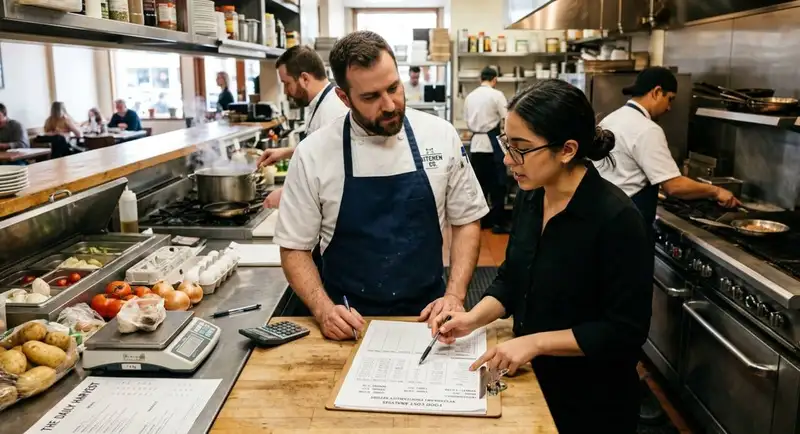
The actual vs. theoretical food cost formula matters because it helps restaurant owners move from guessing to measuring. Many owners know their food cost is high, but they do not always know why. Without comparing actual food cost to theoretical food cost, it is easy to blame menu prices, supplier costs, or slow sales when the real issue may be waste, over-portioning, poor prep habits, missing invoices, or inaccurate inventory counts.
Actual food cost tells you what happened. Theoretical food cost tells you what should have happened. The formula brings those two numbers together so owners can see the gap between expected cost and real cost. That gap is where operational problems often hide.
For example, a restaurant may have a target food cost of 30%, but the actual food cost comes in at 36%. On the surface, the owner knows costs are too high. However, that number alone does not explain the cause. When theoretical food cost is added to the review, the owner may see that the menu should have produced a 31% food cost based on recipes and sales. That means the extra 5% may be coming from execution problems, not pricing alone.
This matters because every percentage point affects profit. In a restaurant with high sales volume, even a small gap between actual and theoretical food cost can represent thousands of dollars in lost margin each month. If the gap is not reviewed regularly, those losses can become part of normal operations without anyone noticing.
The formula also helps owners make better decisions. Instead of raising prices too quickly, cutting portion sizes without a plan, or blaming the kitchen team, owners can review the data and investigate the right areas first. They can look at high-cost ingredients, recipes with large variances, waste logs, inventory counts, purchase records, and menu items that are not performing as expected.
The Actual Food Cost Formula
The actual food cost formula shows how much food your restaurant truly used during a specific period. This could be one week, two weeks, one month, or any period that matches your inventory and accounting process. For restaurant owners, this formula is important because it connects inventory, purchasing, and sales into one clear number.
The basic formula is -
Beginning Inventory + Purchases - Ending Inventory = Actual Food Cost
Each part of the formula matters.
1. Beginning inventory is the value of food you had on hand at the start of the period. This includes items in dry storage, walk-ins, freezers, prep areas, and any other food storage location.
2. Purchases are the food products bought during the period. This should include all vendor invoices, emergency purchases, credits, and any adjustments that affect food cost.
3. Ending inventory is the value of food still on hand at the end of the period. This number is subtracted because those items were not used yet. They are still available for future sales.
For example, if a restaurant starts the week with $8,000 in inventory, purchases $12,000 in food, and ends the week with $7,000 in inventory, the actual food cost would be-
$8,000 + $12,000 - $7,000 = $13,000
That means the restaurant used $13,000 worth of food during that week.
To turn this into a percentage, use this formula -
Actual Food Cost / Food Sales x 100 = Actual Food Cost Percentage
If the restaurant had $40,000 in food sales, the calculation would be-
$13,000 / $40,000 x 100 = 32.5%
This means the restaurant spent 32.5 cents on food for every dollar of food sales.
However, the formula is only as accurate as the data behind it. If inventory counts are rushed, invoices are missing, credits are not entered, or products are counted in the wrong unit, the actual food cost number may be misleading. A restaurant may think food cost is improving or getting worse when the issue is really bad data.
That is why owners should treat actual food cost as both a financial number and an operational checkpoint. It shows how much product was used, but it also reveals whether inventory counts, receiving habits, purchasing records, and storage controls are being managed correctly.
The Theoretical Food Cost Formula
The theoretical food cost formula shows what your restaurant should have spent on food based on the menu items sold. Unlike actual food cost, which looks at inventory movement and purchases, theoretical food cost is built from recipes, portions, ingredient prices, and POS sales data.
The basic formula is -
Menu Items Sold x Recipe Cost = Theoretical Food Cost
For example, if your restaurant sold 200 chicken sandwiches and each sandwich has a recipe cost of $3.25, the theoretical food cost for that item would be -
200 x $3.25 = $650
This means your restaurant should have used $650 worth of ingredients to produce those chicken sandwich sales, assuming the recipe was followed correctly every time.
To calculate theoretical food cost percentage, use this formula -
Theoretical Food Cost / Food Sales x 100 = Theoretical Food Cost Percentage
If those 200 chicken sandwiches generated $2,600 in food sales, the calculation would be -
$650 / $2,600 x 100 = 25%
This means the chicken sandwich should have produced a 25% food cost based on the recipe and selling price.
The key word is should. Theoretical food cost assumes that every portion was correct, every ingredient was used as planned, and every recipe was followed consistently. It does not automatically include waste, spoilage, theft, over-portioning, incorrect prep, or untracked employee meals. That is why theoretical food cost is often lower than actual food cost.
For the formula to work, restaurant owners need accurate recipe costing. Each recipe should include the correct ingredient amounts, current supplier prices, prep yields, cooked yields, trim loss, sauces, garnishes, sides, modifiers, and packaging if those costs are part of the item. Even small errors can create misleading results. If the recipe cost is outdated or the portion size in the system is wrong, the theoretical number will not reflect reality.
Menu mix also matters. A restaurant may sell more high-cost items one week and more low-cost items the next. Theoretical food cost helps account for that by tying cost directly to what was actually sold, not just total sales.
For restaurant owners, this formula creates a clear benchmark. It shows what food cost should look like when pricing, recipes, portions, and kitchen execution are aligned. Once owners know the theoretical number, they can compare it to actual food cost and start identifying where the gap is coming from.
How to Calculate the Food Cost Variance

Once restaurant owners know their actual food cost and theoretical food cost, the next step is to compare the two numbers. This comparison is called food cost variance. It shows the gap between what the restaurant actually used and what it should have used based on sales, recipes, portions, and ingredient costs.
The basic formula is -
Actual Food Cost - Theoretical Food Cost = Food Cost Variance
For example, if your actual food cost for the week is $13,000 and your theoretical food cost is $11,500, the calculation would be -
$13,000 - $11,500 = $1,500
This means the restaurant used $1,500 more in food than expected. That extra amount is the food cost gap. It may be caused by waste, over-portioning, spoilage, theft, prep mistakes, incorrect recipes, inaccurate inventory counts, supplier price changes, or missing purchase records.
Restaurant owners can also calculate the variance as a percentage -
Actual Food Cost Percentage - Theoretical Food Cost Percentage = Food Cost Variance Percentage
For example, if actual food cost is 32.5% and theoretical food cost is 28.75%, the calculation would be-
32.5% - 28.75% = 3.75% variance
This means the restaurant's actual food cost is 3.75 percentage points higher than expected. That may not sound large at first, but the dollar impact can be significant. If a restaurant does $100,000 in monthly food sales, a 3.75% variance could represent $3,750 in lost margin.
A variance is not always negative, but it should always be reviewed. A small gap may be normal depending on the type of restaurant, menu complexity, inventory process, and reporting accuracy. However, a large or growing gap usually means something in the operation needs attention.
Owners should not use the variance number by itself to assign blame. Instead, they should use it as a starting point for investigation. The next step is to break the variance down by category, ingredient, menu item, shift, vendor, or location. This helps owners see whether the issue is connected to a specific product, recipe, team habit, ordering pattern, or inventory process.
Food cost variance is valuable because it turns food cost from a general percentage into an operational signal. It shows where the restaurant is losing control, how large the loss may be, and where owners should focus first to protect profit margins.
Transform Your Restaurant Operations Now!
Effortless Inventory Tracking with Altametrics!
Common Reasons Actual Food Cost Is Higher Than Theoretical
When actual food cost is higher than theoretical food cost, it means the restaurant used more product than expected. The formula shows the gap, but the real value comes from understanding what caused that gap. For restaurant owners, this is where food cost control becomes operational, not just financial.
One of the most common causes is over-portioning. If a recipe calls for 6 ounces of chicken but the kitchen regularly serves 7 ounces, the extra ounce may not seem like much on one plate. Across hundreds or thousands of orders, that small difference can create a major food cost problem.
Another major cause is prep waste. Poor knife skills, incorrect batch sizes, expired prep, burned items, or food made too early can all increase actual food usage without increasing sales. If waste is not tracked, owners may only see the problem after food cost rises.
Spoilage is another hidden cost. When ingredients sit too long, are stored incorrectly, or are ordered in quantities that do not match demand, the restaurant pays for product that never becomes revenue. This is especially risky with produce, seafood, dairy, meats, and prepared items with short shelf lives.
Actual food cost can also rise because of inaccurate inventory counts. If items are missed, counted in the wrong unit, double-counted, or valued incorrectly, the actual food cost formula becomes unreliable. A small counting error on high-cost ingredients can make food cost look better or worse than it really is.
Other common causes include missing invoices, unrecorded vendor credits, employee meals, comps, theft, transfer errors, incorrect recipes, and supplier price changes. For example, if beef prices increase but recipe costs are not updated, theoretical food cost may stay too low. The report may show a large variance, but part of the problem is outdated recipe data.
Menu substitutions and modifiers can also create gaps. If guests frequently add extra sauces, proteins, toppings, or sides and those items are not priced or tracked correctly, the restaurant gives away cost without capturing enough revenue.
The key is to treat every variance as a clue. A higher actual food cost does not always mean one big problem. It is usually the result of several small issues happening at the same time. By reviewing portion control, waste, inventory accuracy, purchasing records, recipe costs, and staff execution, restaurant owners can identify where the gap starts and take action before it becomes a normal part of operations.
How to Improve Formula Accuracy
The actual vs. theoretical food cost formula is only useful when the data behind it is accurate. If recipes are outdated, inventory counts are inconsistent, ingredient prices are old, or sales items are mapped incorrectly, the report may show a gap that is not fully reliable. For restaurant owners, improving formula accuracy starts with strengthening the daily habits that feed the calculation.
The first step is accurate recipe costing. Every menu item should have a clear recipe with the correct ingredient amounts, portion sizes, prep yields, cooked yields, garnishes, sauces, sides, and packaging costs when applicable. If a burger recipe uses cheese, sauce, lettuce, tomato, bun, protein, fries, and a to-go container, each cost should be included. Leaving out small items can make theoretical food cost look lower than it really is.
The second step is keeping ingredient prices updated. Supplier prices change often, especially for meat, seafood, produce, dairy, and oil. If recipe costs are based on old prices, the theoretical number becomes outdated. Owners should review invoice pricing regularly and update ingredient costs so reports reflect current purchasing conditions.
Inventory accuracy is just as important. Counts should be done at the same time, using the same units, and following the same storage order each period. For example, if chicken is purchased by the case but counted by the pound, the system needs the correct conversion. If one manager counts cases and another counts pounds without consistency, actual food cost can be distorted.
Owners should also track waste, comps, employee meals, transfers, and spoilage. These items affect product usage, but they may not always show up clearly in sales. Without tracking them, the restaurant may think it has a portion control issue when the real problem is expired prep, excessive staff meals, or unrecorded transfers between locations.
POS mapping is another area to review. Each menu item, modifier, combo, and substitution should connect to the correct recipe or ingredient usage. If a modifier adds avocado, extra cheese, or an additional protein, that cost should be included in theoretical usage. Otherwise, the restaurant may sell add-ons without properly accounting for the product used.
To improve accuracy, restaurant owners should build a repeatable review process. Check recipes, update prices, confirm inventory units, review invoices, track waste daily, and audit POS item mapping on a regular schedule. The cleaner the data, the more useful the formula becomes.
When the numbers are accurate, the actual vs. theoretical comparison becomes more than a report. It becomes a reliable tool for finding food cost problems, training staff, improving purchasing decisions, and protecting restaurant margins.
How to Use the Formula to Close the Food Cost Gap
Calculating actual vs. theoretical food cost is helpful, but the real value comes from using the numbers to improve daily operations. The formula shows the gap between what food cost should have been and what it actually was. Once restaurant owners understand that gap, they can take focused action instead of guessing.
1. Start with the largest variances first
Do not try to fix every item at once. Begin with the ingredients, categories, or menu items that have the biggest dollar impact. High-cost products like beef, chicken, seafood, dairy, cooking oil, and produce should be reviewed closely. A small variance on a high-volume item can create a larger loss than a big variance on an item that rarely sells.
2. Review variance by category
Breaking the gap into categories helps owners find patterns. If meat costs are higher than expected, the issue may be over-portioning, trimming loss, theft, or supplier pricing. If produce is off, the problem may be spoilage, over-prepping, poor storage, or inaccurate ordering. Category-level review makes the problem easier to investigate.
3. Check recipes and portion control
Theoretical food cost depends on accurate recipes and consistent portions. If the system assumes a 6-ounce portion but the kitchen serves 7 ounces, actual food cost will rise. Owners should confirm that recipes are current, measuring tools are available, prep sheets are clear, and staff are trained to follow standards.
4. Track waste every day
Waste should be recorded by item, amount, reason, and date. This helps owners see whether food is being lost through expired prep, cooking mistakes, poor storage, incorrect ordering, or slow sales. Daily waste tracking turns hidden losses into visible data.
Waiting until the end of the month can make problems harder to fix. A weekly actual vs. theoretical review allows managers to catch issues faster, adjust ordering, retrain staff, update recipes, and correct portioning habits before losses grow.
Must-Read Content

Inventory management for restaurants
How to Improve Inventory Management for Restaurants
Multi location restaurant inventory
A Complete Guide to Multi-Location Restaurant Inventory

Bar and liquor inventory
How to Manage Bar and Liquor Inventory
Stock control
Stock Control Best Practices for Restaurant Owners
Perishable food inventory
Perishable Food Inventory Management for Restaurant Owners
Frequently Asked Questions
What data is needed to calculate theoretical food cost?
Restaurants need accurate recipes, ingredient costs, portion sizes, yield percentages, menu item sales, modifiers, substitutions, and food sales. The more accurate the data, the more useful the theoretical food cost calculation becomes.
How does recipe costing affect theoretical food cost?
Recipe costing is the foundation of theoretical food cost. If recipes do not include correct ingredients, portions, yields, garnishes, sauces, sides, or packaging, the theoretical number will not show what the restaurant should have spent.
What should owners review first when variance is high?
Owners should start with high-cost and high-volume ingredients. Proteins, seafood, dairy, produce, cooking oil, and top-selling menu items usually have the biggest impact on food cost. Fixing these areas first can produce faster savings.
What role does POS data play in theoretical food cost?
POS data tells the restaurant what was sold. Theoretical food cost depends on that sales data being connected to the correct recipes, modifiers, combos, and menu items. If POS items are mapped incorrectly, the theoretical food cost report may not match real usage.