
Restaurant Payroll Basics
The first payroll number owners need to understand is gross pay. Gross pay is the total amount an employee earns before taxes and deductions are taken out. For an hourly cook, gross pay may be based on hours worked. For a server or bartender, gross pay may include hourly wages plus reported tips. For a manager, it may include salary, bonuses, or other compensation. If employees work different roles, such as server one shift and shift lead another shift, payroll may need to calculate different pay rates within the same pay period.
The second number is net pay. Net pay is the amount the employee actually receives after withholdings and deductions. These may include federal income tax, Social Security, Medicare, state taxes, benefits, garnishments, or other approved deductions. Restaurant owners also have employer-side payroll costs, such as payroll taxes, unemployment insurance, workers' compensation, and any employer-paid benefits.
Restaurant payroll also depends heavily on accurate time data. Every clock-in, clock-out, break, overtime hour, and schedule adjustment affects payroll. If time records are wrong, payroll will likely be wrong too. This is why payroll compliance starts before payroll is processed. It begins with how employees track time during each shift.
Tips add another layer of complexity. Restaurants need a clear process for tracking reported tips, credit card tips, cash tips, tip pooling, tip sharing, and service charges. These amounts can affect taxable wages, payroll records, and employee paychecks. Owners also need to understand that tips and service charges are not always treated the same way for payroll purposes.
Payroll basics also include employee classification. Restaurant owners need to know whether workers are hourly, salaried, exempt, nonexempt, full-time, part-time, seasonal, or independent contractors. Misclassification can create wage, tax, and overtime problems. For example, calling someone a manager does not automatically mean they are exempt from overtime. Their duties, pay structure, and legal requirements matter.
A strong payroll process gives restaurant owners a clear view of labor costs. It shows how much the restaurant is spending on wages, overtime, taxes, benefits, and tipped labor. This matters because labor is one of the largest controllable costs in a restaurant. When payroll data is accurate, owners can make better decisions about scheduling, staffing levels, menu pricing, and profitability.
Tipped Employees and Tip Reporting Rules
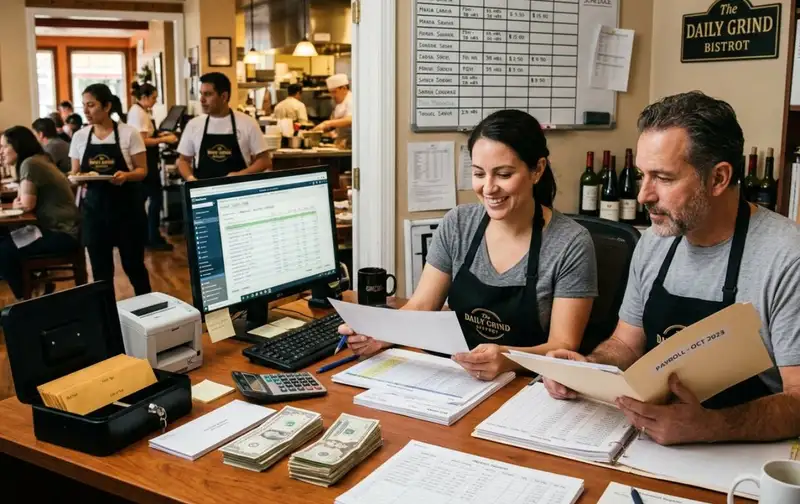
For example, if a server earns $480 in hourly wages during a pay period and reports $620 in tips, the restaurant cannot treat payroll as only $480 in wages. The reported tips also affect taxable income, payroll tax reporting, Social Security, Medicare, and year-end wage records. If the restaurant does not track those tips correctly, the paycheck may still be issued, but the records behind it may not support compliance.
Tip reporting is important because restaurant payroll depends on accurate employee tip information. Employees who receive reportable tips are generally responsible for reporting those tips to the employer. Restaurant owners should have a consistent process for collecting tip reports, reviewing them, and storing them with payroll records. Without a clear system, managers may rely on handwritten notes, verbal updates, or incomplete POS data.
A simple way to understand tipped payroll is this -
1. Cash tips - Tips customers give directly to employees in cash.
2. Credit card tips - Tips paid through card transactions and usually tracked through the POS.
3. Tip pooling - Tips collected and redistributed among eligible employees.
4. Tip sharing - Tips shared with support staff based on restaurant policy.
5. Service charges - Mandatory charges added by the restaurant, which may be handled differently than voluntary tips.
This difference matters because tips and service charges are not always treated the same way. A voluntary tip is different from an automatic gratuity, banquet fee, catering charge, or service fee. If a restaurant adds mandatory charges, owners should review how those amounts are recorded, taxed, and paid to employees.
Tip pooling also needs strong documentation. If $1,500 in tips is pooled during a shift, the restaurant should be able to show who contributed, who received a share, and how each amount was calculated. Clear records reduce confusion and help protect the business if employees question their pay.
Restaurant owners should review tip reporting the same way they review labor cost. A strong process should include daily tip tracking, POS records, written tip reports, tip pool rules, manager approval, payroll review, and secure record storage.
Experience a Hassle-free Payroll Processing
Streamline Your Payroll Process with Altametrics
Minimum Wage, Tip Credit, and Overtime
For example, if a server works 38 hours as a tipped employee and 6 additional hours as a non-tipped prep employee, payroll may need to account for different duties, wage rates, and overtime rules. If the restaurant simply pays one flat rate without reviewing the total hours and job roles, the paycheck may be inaccurate. The risk becomes larger when this happens across multiple employees every pay period.
Tip credit is another area that requires careful attention. In some locations, restaurants may be allowed to pay tipped employees a lower direct cash wage if the employee's tips bring total earnings up to the required minimum wage. But this does not mean the restaurant can ignore the minimum wage requirement. If an employee's direct wages plus tips do not meet the required minimum wage, the employer may need to make up the difference.
A simple way to understand the difference is this -
1. Minimum wage - The lowest hourly amount an employee must legally receive.
2. Direct cash wage - The hourly wage paid directly by the restaurant.
3. Tip credit - The portion of tips that may count toward minimum wage where allowed.
4. Overtime pay - Extra pay owed when nonexempt employees work more than the overtime threshold.
5. Regular rate of pay - The rate used to calculate overtime, which may include more than the base hourly wage.
Overtime compliance is especially important in restaurants because schedules change often. A cook may pick up an extra shift. A server may stay late after a rush. A bartender may cover for a call-out. A manager may approve extra hours without realizing the employee is close to overtime. If these hours are not tracked before payroll is processed, the restaurant may not see the true labor cost until it is too late.
For example, if an employee earns $18 per hour and works 46 hours in one workweek, the extra 6 hours may need to be paid at the proper overtime rate. If payroll treats all 46 hours as regular time, the restaurant underpays the employee and creates a compliance issue. Even small overtime errors can become expensive when repeated across several employees.
Restaurant owners should also be careful with deductions. Uniform costs, walkouts, cash shortages, breakage, or register shortages can create wage problems if deductions reduce an employee's pay below the required wage level. This is especially risky for tipped employees, because tip credit rules already require close wage tracking.
State and local rules can make compliance more complicated. Some states do not allow a tip credit. Some cities have higher minimum wages than the federal rate. Some locations have stricter rules for breaks, scheduling, sick leave, or overtime. A restaurant with locations in different cities may need different wage settings for each location.
Restaurant owners should review wage compliance the same way they review daily sales or prime cost. If labor hours increase, overtime risk increases. If tipped wages are used, tip credit compliance needs regular review. If employees work multiple roles, pay rates should be checked before payroll is approved.
Time Tracking and Scheduling
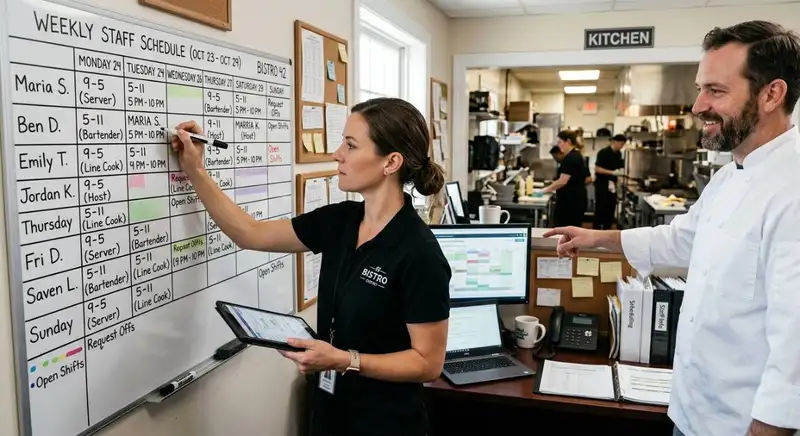
For restaurant owners, this matters because schedules often change fast. A slow lunch may cause managers to send employees home early. A busy dinner rush may require staff to stay longer than planned. A call-out may force another employee to pick up extra hours. These changes are normal in restaurants, but each one affects payroll.
For example, a schedule may show that a line cook is planned for 32 hours in a week. But if that employee stays late three nights, covers one extra shift, and clocks in early for prep, the actual hours may move closer to 40 or even overtime. If the owner only reviews the schedule instead of the time records, labor cost and compliance risk may be understated.
The difference is important -
1. Scheduled hours - The hours an employee was expected to work.
2. Actual hours - The hours the employee actually worked.
3. Edited hours - Time records changed after a missed punch or correction.
4. Break records - Documentation of meal or rest breaks, where required.
5. Approved hours - Final hours reviewed before payroll is processed.
Restaurant owners should not assume scheduled hours and actual hours match. Payroll should be based on verified time records, not the original schedule. A schedule is a plan. A timecard is the payroll record.
Break tracking is another area that deserves attention. Depending on the state or local rules, restaurants may need to track meal breaks, rest breaks, missed breaks, or break premiums. Even when federal rules do not require a specific break structure, state rules may be stricter. This means restaurants should have a clear process for recording breaks and reviewing exceptions before payroll is approved.
Scheduling also affects overtime. If managers build schedules without checking total weekly hours, employees may cross overtime thresholds before anyone notices. This is especially common when employees work across multiple roles or locations. A server may pick up a hosting shift. A dishwasher may cover prep. A bartender may help at another location. If those hours are tracked separately instead of together, overtime may be missed.
Timecard edits should also be controlled. Missed punches are common in restaurants, but every edit should have a reason, a manager approval, and a record. For example, changing a clock-out from 11.42 p.m. to 11.00 p.m. without documentation can create wage disputes. Employees should have a way to review or confirm corrected time before payroll is finalized.
A strong time tracking process helps restaurant owners catch problems early. Managers should review missed punches, early clock-ins, late clock-outs, unapproved overtime, skipped breaks, role changes, and timecard edits before payroll is submitted. This turns payroll from a rushed back-office task into a controlled weekly review.
Payroll Taxes and Employer Responsibilities

For restaurants, this can become complicated because taxable pay may include hourly wages, overtime, reported tips, bonuses, service charge payouts, and other compensation. If the payroll system does not capture all taxable wages correctly, the tax records may also be wrong.
For example, if a restaurant pays an employee $900 in hourly wages and the employee reports $600 in tips during the pay period, the payroll tax calculation should not be based only on the $900. The reported tips also need to be included in the payroll records. If the restaurant leaves those tips out, the employee's taxable wages, tax withholding, and year-end wage reporting may be inaccurate.
A simple way to understand restaurant payroll taxes is this -
1. Federal income tax withholding - Money withheld from employee wages based on tax forms and withholding rules.
2. Social Security tax - A payroll tax paid by both the employee and employer.
3. Medicare tax - A payroll tax paid by both the employee and employer.
4. Unemployment taxes - Employer taxes that help fund unemployment insurance programs.
5. State and local payroll taxes - Additional requirements that vary by location.
These taxes matter because payroll compliance is not finished when employees receive their checks. The restaurant also needs to deposit taxes, file required forms, report wages correctly, and keep payroll records that match the amounts paid.
Timing is a major part of payroll tax compliance. Some payroll taxes must be deposited regularly during the year, while others are reported quarterly or annually. If a restaurant misses a deposit deadline, underreports wages, or files an inaccurate return, the issue can create penalties and extra accounting work. This is why payroll tax planning should be part of the restaurant's regular financial routine, not something handled only at year-end.
Tips add another layer of responsibility. Reported tips are generally part of taxable wages, which means they affect income tax withholding, Social Security, Medicare, and W-2 reporting. Restaurant owners should make sure tip reports, POS tip data, payroll registers, and employee wage records match before payroll is finalized. If those records do not line up, the restaurant may have trouble explaining the numbers later.
Service charges should also be reviewed carefully. A mandatory service charge, banquet fee, delivery fee, or automatic charge may need to be handled differently from a voluntary customer tip. If these charges are paid out to employees, they may be treated as wages for payroll purposes. That means owners should clearly separate tips, service charges, and regular wages in their payroll records.
Restaurant owners with multiple locations need even stronger controls. One location may have different state tax rules, local wage requirements, unemployment rates, or payroll filing obligations than another. A single payroll setup may not work for every location if the rules are different.
A strong payroll tax process should include accurate employee tax forms, verified wage rates, reported tips, payroll tax deposits, quarterly filings, annual W-2 reporting, unemployment tax reviews, and secure record storage. Owners should also review payroll reports before deposits and filings are submitted.
Take Your Restaurant to the Next Level
Let Altametrics Simplify Your Restaurant's Finances
Payroll Records
A restaurant may believe payroll was handled correctly, but without records, it can be difficult to prove. For example, if a server questions whether overtime was paid correctly three months later, the owner should be able to review the employee's timecards, pay rate, tip records, schedule changes, payroll register, and any manager-approved edits. If those records are missing or incomplete, the restaurant has less support for its payroll decision.
The most important records usually fall into several categories -
1. Employee information - Name, address, Social Security number, job title, classification, and pay rate.
2. Time records - Clock-ins, clock-outs, total hours worked, missed punches, edits, and manager approvals.
3. Wage records - Regular wages, overtime wages, salary payments, bonuses, deductions, and reimbursements.
4. Tip records - Cash tips, credit card tips, declared tips, tip pool calculations, and tip-out documentation.
5. Tax records - Withholding forms, payroll tax filings, deposits, wage statements, and year-end forms.
6. Break and schedule records - Meal periods, rest breaks, missed breaks, schedule changes, and shift approvals.
7. Payroll corrections - Any adjustment made after payroll, including the reason and approval.
Restaurants should also keep records that explain unusual payroll situations. If an employee worked two different roles in the same week, the records should show which hours were tied to each role. If a manager corrected a missed punch, the reason should be documented. If a tip pool was used, the restaurant should be able to show how the total was collected and distributed.
Recordkeeping is especially important for restaurants with multiple locations. A multi-location business may deal with different wage rates, local rules, tax requirements, and manager practices. Without a consistent recordkeeping system, one location may follow a different process than another, which can create compliance gaps.
Restaurant owners should review payroll records before problems happen. Waiting until an audit or employee complaint to organize records creates unnecessary stress. A better approach is to build recordkeeping into the payroll process every week. Before payroll is approved, managers should review hours, tips, overtime, breaks, deductions, and corrections.
Payroll Software for Compliance
For example, a manager may know that an employee worked extra hours on Saturday, but if those hours are not entered correctly, payroll may be wrong. A server may earn tips through the POS, but if the tip data does not flow into payroll, taxable wages may be incomplete. A cook may work at two locations in the same week, but if hours are not combined correctly, overtime may be missed. Payroll software helps bring these details into one system before payroll is approved.
The biggest benefit is visibility. Restaurant owners can see payroll data before it becomes a paycheck. Instead of waiting until the end of the pay period to discover overtime, missed punches, or incorrect job codes, managers can catch issues earlier.
Useful payroll software features for restaurants include -
1. Time clock integration - Connects clock-ins, clock-outs, and breaks directly to payroll.
2. Scheduling integration - Compares scheduled hours against actual hours worked.
3. Tip tracking - Helps record cash tips, credit card tips, tip pools, and tip-outs.
4. Overtime alerts - Flags employees who are near or over overtime thresholds.
5. Multiple pay rates - Supports employees who work different roles at different rates.
6. Payroll approval workflows - Gives managers a chance to review hours before payroll runs.
7. Tax reporting support - Helps organize payroll tax data, filings, and year-end forms.
8. Audit trails - Shows changes, approvals, edits, and corrections.
This matters because many restaurant payroll problems are not caused by one large mistake. They are often caused by small errors repeated over time. A missed punch here, an unreported tip there, a late schedule change, or an incorrect overtime calculation may not seem major on one shift. But across dozens of employees and multiple pay periods, those errors can create serious compliance exposure.
Payroll software can also help restaurant owners manage labor costs more accurately. When time tracking, scheduling, tips, and payroll are connected, owners can see the real cost of each shift. They can compare scheduled labor to actual labor, monitor overtime, review tip records, and identify payroll problems before they become expensive.
For multi-location restaurants, software becomes even more important. Different locations may have different wage rates, tax rules, overtime issues, or manager approval processes. A centralized payroll system can help owners standardize records while still applying location-specific rules where needed.
Automate, Manage, Distribute
Simplify Tip Process with Altametrics
Frequently
Asked Questions
How does overtime affect restaurant payroll compliance?
What payroll mistakes should restaurant owners avoid?
How can multi-location restaurants manage payroll compliance?
What is payroll leakage in restaurants?
Must-Read Content

10 Employee Retention Strategies for Restaurant Owners
Restaurant owners can cut turnover by paying fairly, onboarding well, scheduling flexibly, promoting growth, recognizing effort, offering meaningful benefits, listening to feedback, and hiring carefully for fit.

Employee Time Tracking Tips for Restaurants
Use these time tracking tips to improve restaurant employee timekeeping, reduce payroll errors, monitor overtime, track breaks, and simplify workforce management.
7 Scheduling Mistakes Restaurant Owners Should Stop Making
Avoid common scheduling mistakes by improving labor forecasting, balancing shift coverage, respecting employee availability, controlling overtime, and using scheduling software to optimize restaurant operations.