What topics should restaurant cross contamination training include?
Restaurant cross contamination training should cover handwashing, glove use, personal hygiene, raw and ready-to-eat food separation, safe storage, equipment and utensil handling, cleaning and sanitizing, allergen cross-contact prevention, employee illness reporting, and procedures for identifying and correcting contamination risks quickly.
Cross Contamination Training for Restaurant Employees

Cross Contamination Training Basics
Cross contamination training teaches restaurant employees how harmful bacteria, allergens, chemicals, and other contaminants can transfer between food, hands, utensils, equipment, and surfaces. The aim is to help employees identify risks and follow procedures that keep food safe during receiving, storage, preparation, cooking, and service.
Cross contamination can happen during everyday restaurant tasks. For example, an employee may use the same cutting board for raw chicken and vegetables without cleaning and sanitizing it. Raw meat may be stored above ready-to-eat food, allowing juices to drip onto prepared ingredients. Employees can also spread contaminants by touching food after handling raw products or dirty equipment.
Training should match each employee's responsibilities. Kitchen staff should learn how to separate raw and ready-to-eat foods, change gloves, clean equipment, and use designated utensils. Front-of-house employees should understand risks involving shared utensils, drink garnishes, dirty dishes, and food allergens.
Cross contamination training should also cover allergen cross-contact and chemical contamination, not just bacteria. Restaurant owners should introduce these procedures during onboarding and reinforce them through demonstrations, checklists, observations, and refresher sessions.
Consistent training helps employees recognize contamination risks and follow safer food-handling practices throughout daily restaurant operations.
Handwashing and Personal Hygiene
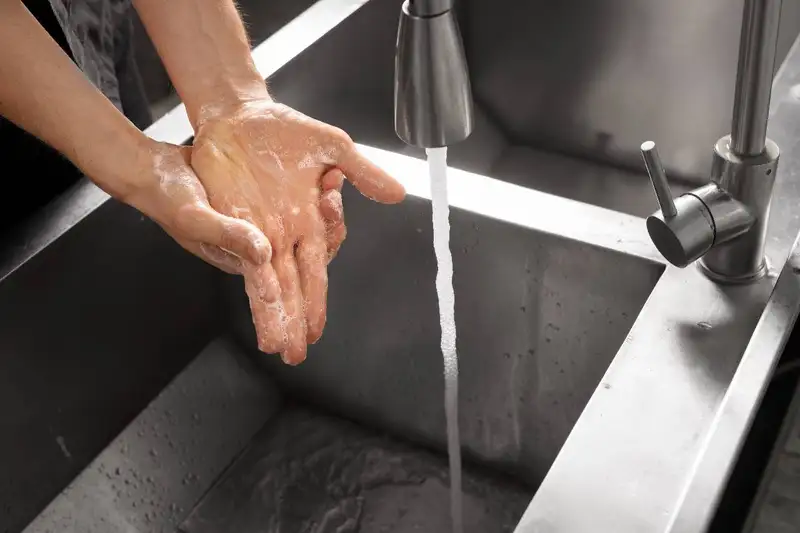
Handwashing and personal hygiene should be a major part of cross contamination training because employees frequently move between raw ingredients, equipment, dishes, food-contact surfaces, and ready-to-eat foods during a shift. CDC research shows that food workers complete activities requiring handwashing about nine times per hour, yet workers were observed washing their hands only two to three times per hour.
Restaurant owners should therefore build training around specific, measurable behaviors rather than simply telling employees to "wash their hands frequently."
Set a Clear Handwashing Standard
Employees should be trained to wash their hands with soap and water for at least 20 seconds before and after handling food. Training should also identify common situations that require employees to wash their hands, including after handling raw animal products, touching dirty equipment, using the restroom, touching their face or body, and before working with ready-to-eat food.
The need for reinforcement is significant. CDC observations found that only 1 in 4 workers washed their hands after preparing raw animal products or handling dirty equipment. Only 1 in 10 washed after touching their face or body.
Train Employees on Proper Glove Use
Gloves should support hand hygiene rather than replace it. FDA guidance recommends avoiding bare-hand contact with ready-to-eat foods by using barriers such as disposable gloves, deli paper, or utensils.
Employees should learn when gloves need to be changed, especially when moving from raw foods to ready-to-eat foods. CDC research found that one-third of workers did not always change their gloves between touching raw meat or poultry and handling ready-to-eat food.
Include Employee Health and Personal Hygiene
Cross contamination training should also explain employee illness policies, proper wound protection, clean uniforms, hair restraints, and behaviors such as avoiding unnecessary face or hair touching while preparing food. FDA guidance emphasizes handwashing, employee illness reporting, restricting sick employees when appropriate, and preventing bare-hand contact with ready-to-eat foods as important controls for limiting disease transmission.
For restaurant owners, the training goal should be consistency. Employees should be able to demonstrate when to wash, how to wash, when to change gloves, and when health or hygiene issues must be reported. Managers can reinforce these behaviors through onboarding demonstrations, handwashing signs, shift observations, and regular refresher training.
Automate temperature sensors and digitize paper logs for real-time accuracy!
Elevate your food safety with Altametrics!
Separate Raw and Ready-to-Eat Foods
Separating raw foods from ready-to-eat foods should be a core part of cross contamination training because bacteria can move from raw meat, poultry, seafood, and eggs to foods that may receive no additional cooking before service. The FDA Food Code specifically addresses separating raw animal foods from ready-to-eat foods during storage, preparation, holding, and display. The Food Code serves as a model for food-service regulations, although specific requirements depend on the rules adopted by each state or local jurisdiction.
Restaurant owners should turn this principle into clear, observable employee behaviors.
Set Clear Storage Rules
Employees should understand exactly where raw products belong in refrigerators and walk-ins. Raw meat, poultry, and seafood should be stored in containers or trays that prevent juices from reaching ready-to-eat foods.
CDC research illustrates why this deserves specific training. Among retail delis studied -
1 in 4 did not store raw meat in separate containers, bins, or trays away from ready-to-eat food.
1 in 10 with cold-storage units stored raw meat above ready-to-eat food.
1 in 10 showed potential raw-to-ready-to-eat cross contamination during food preparation.
These findings give restaurant owners measurable behaviors to inspect during daily operations.
Separate Food During Preparation
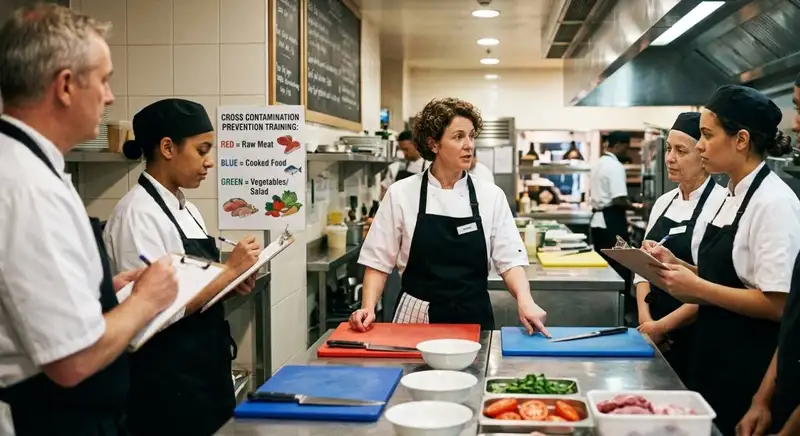
Storage is only one part of the risk. Employees should also keep raw products separated during prep. CDC recommends using separate cutting boards or plates for raw meat, poultry, and seafood and for produce, bread, and other foods that will not be cooked. Raw products should also be securely wrapped or placed in sealed containers so juices cannot leak onto other foods.
Training can establish simple controls such as designated cutting boards, knives, prep containers, and preparation areas. When dedicated equipment is not available, employees must know when equipment must be properly cleaned and sanitized before switching tasks.
Managers should also teach employees to think about workflow direction. An employee preparing raw chicken should not immediately begin assembling salads, sandwiches, garnishes, or other ready-to-eat foods without completing the required handwashing, glove-changing, and equipment-cleaning steps.
The training goal should be easy to verify - raw food stays physically separated from ready-to-eat food from storage through preparation. Managers can reinforce this standard by checking cooler organization, observing prep stations, and correcting separation problems as soon as they appear.
Equipment, Utensils, and Food-Contact Surfaces
Equipment and utensils can become major cross contamination points when employees use the same knives, cutting boards, slicers, containers, or preparation surfaces for different foods without proper cleaning and sanitizing. CDC identifies contaminated cutting boards, preparation tables, utensils, and other surfaces as potential pathways through which pathogens can move to food.
Restaurant owners should make equipment handling a measurable part of cross contamination training.
Establish Separate Equipment Practices
Employees should be trained to use separate cutting boards, plates, and utensils for raw meat, poultry, and seafood and for foods that will not receive additional cooking. CDC recommends this separation to reduce the chance that germs from raw products reach produce, bread, or other ready-to-eat foods.
Restaurants can make this easier by assigning -
- Color-coded cutting boards
- Designated knives and utensils
- Separate containers for raw ingredients
- Specific preparation areas when space allows
CDC restaurant research found that workers reported multiple color-coded cutting boards and separate work areas as resources that helped prevent the spread of germs.
Train Employees When to Clean and Sanitize
Employees need to understand that wiping equipment is not always sufficient. Surfaces and utensils that contact raw foods must be properly cleaned and sanitized before they are used with ready-to-eat foods.
The FDA Food Code contains detailed requirements for equipment and utensil cleaning and sanitation and serves as a model used by regulatory jurisdictions when developing food-service rules. Restaurants should verify the specific requirements adopted in their state and local jurisdiction.
Inspect Equipment Condition
Training should also teach employees to report damaged equipment. CDC found that 3 in 5 delis studied had damaged slicers, which can make effective cleaning more difficult. Only 1 in 4 reported inspecting slicers for damage every four hours.
Restaurant owners can convert these risks into a simple training standard - separate, clean, sanitize, inspect, and verify. Managers should routinely observe prep stations, check sanitizer procedures, inspect high-use equipment, and confirm that employees switch utensils or sanitize them correctly between tasks.
Cross contamination training is more effective when employees understand exactly which equipment must be separated, when cleaning is required, and how managers will verify that procedures are being followed.
Include Allergen Cross-Contact Prevention
Allergen cross-contact should be a dedicated part of cross contamination training because even a small, unintended transfer of an allergen can create a serious risk for a customer with a food allergy. The FDA defines allergen cross-contact as the unintentional incorporation of a food allergen into another food.
Restaurant employees should first learn the nine major food allergens recognized under U.S. federal law -
- Milk
- Eggs
- Fish
- Crustacean shellfish
- Tree nuts
- Peanuts
- Wheat
- Soybeans
- Sesame
Sesame became the ninth major food allergen effective January 1, 2023. FDA guidance also notes that these major allergens account for the large majority of severe food-allergic reactions in the United States.
Build Allergen Awareness Into Employee Training
The FDA Food Code states that employee food-safety training programs should include awareness of the nine major allergens and recommends that food establishments consider operation-specific allergen training. The Food Code is a model rather than federal law, so restaurant owners should also verify requirements adopted by their state and local jurisdictions.
Training should teach employees to -
- Check ingredient labels and recipes before answering allergy questions
- Communicate allergy requests clearly between servers and kitchen employees
- Change gloves before preparing an allergy-sensitive order
- Use clean utensils, containers, cutting boards, and preparation surfaces
- Keep allergen ingredients separated when practical
- Avoid assuming that a menu item is allergen-free without verifying its ingredients
Ingredient verification should happen consistently because product formulations can change. FDA specifically advises checking labels even for products that have been purchased previously.
Teach the Correct Cleaning Process
Restaurant owners should emphasize that simply wiping a surface may not adequately address allergen cross-contact. FDA research tested peanut-, milk-, and egg-containing foods on stainless steel, textured plastic, and wood surfaces. The study found that a complete wash-rinse-sanitize-air dry process was effective at removing allergens and minimizing their transfer. Pre-scraping food before full cleaning also improved allergen removal.
The research also found that wet cloths and certain sanitizing wipes removed allergens more effectively than dry wiping, while textured plastic surfaces were more difficult to clean than stainless steel or wood.
For restaurant owners, the training standard should be clear - identify the allergen, communicate the order, prevent cross-contact, clean correctly, and verify ingredients before serving the meal. Managers should regularly test employees on these steps so allergen procedures become part of normal restaurant operations rather than something employees consider only when an allergy request occurs.
Perfect Solution for Your Training and Development Needs
Teach Your Staff with Altametrics LMS
Cleaning and Sanitizing Procedures
Cleaning and sanitizing should be a major part of cross contamination training because food-contact surfaces can transfer bacteria, allergens, and other contaminants from one food or preparation task to another. Employees need to understand that cleaning and sanitizing are two different steps. Cleaning removes food residue, grease, and debris, while sanitizing reduces remaining microorganisms to safer levels. CDC guidance specifically states that surfaces should be cleaned before they are sanitized.
Restaurant owners should train employees around a consistent process -
(1) Wash (2) Rinse (3) Sanitize (4) Air Dry
Simply spraying sanitizer onto a dirty preparation table or wiping a surface is not the same as completing the full process.
Show Employees Why Every Step Matters
CDC restaurant research found important gaps in cleaning practices for equipment used with raw chicken. About 1 in 10 managers reported washing and rinsing equipment without sanitizing it. At the other extreme, approximately 1 in 3 managers said equipment was wiped with sanitizer without first being properly washed and rinsed.
Both behaviors demonstrate why employees need more than general instructions to "keep the kitchen clean."
FDA research on allergen removal provides additional support for a complete process. Testing involving peanut-, milk-, and egg-containing foods found that a full wash-rinse-sanitize-air dry procedure was effective at removing allergens and minimizing their transfer between food-contact surfaces. Pre-scraping food residue before the full cleaning process also improved allergen removal.
Verify Sanitizer Concentration
Employees should also be trained to prepare and check sanitizer correctly. Using sanitizer does not automatically mean a surface is being sanitized effectively.
Restaurant owners should therefore teach employees to follow the product label and applicable local requirements for sanitizer concentration and contact time. Managers should provide the appropriate test strips or testing device and verify concentrations throughout the shift. The FDA Food Code specifically addresses determining chemical sanitizer concentration as part of warewashing controls.
Build Cleaning Into the Training Checklist
Employees should know exactly which areas require attention, including -
- Cutting boards and preparation tables
- Knives and other utensils
- Slicers and food processors
- Containers and storage equipment
- High-use food-contact surfaces
- Equipment used after handling raw animal foods
Training should also explain when surfaces need immediate cleaning, such as after raw meat preparation, a spill, possible allergen contact, or contamination from dirty equipment.
The FDA Food Code remains the federal government's model for retail and food-service safety, but individual jurisdictions adopt and enforce their own requirements. Restaurant owners should therefore align cleaning schedules, sanitizer procedures, and documentation with applicable state and local rules.
The training objective should be measurable - employees should be able to identify when cleaning is required, complete the correct cleaning sequence, verify sanitizer strength, and prevent contaminated equipment or surfaces from returning to food preparation.
Build Cross Contamination Training Into Daily Operations
Cross contamination training should not end after an employee's first day. Restaurant owners need to make food-safety procedures part of onboarding, shift management, employee observation, and refresher training so safe practices are reinforced throughout daily operations.
Start With Structured Onboarding
New employees should receive cross contamination training before independently handling food. Training should cover the procedures discussed throughout this guide, including -
- Handwashing and glove changes
- Raw and ready-to-eat food separation
- Equipment and utensil handling
- Cleaning and sanitizing
- Allergen cross-contact prevention
- Employee illness reporting
Employees should then demonstrate these procedures rather than simply confirm that they have read them.
Reinforce Training During Every Shift
Manager involvement can make a measurable difference. CDC research found that restaurants with certified kitchen managers were less likely to experience foodborne illness outbreaks and were also less likely to receive critical food-safety violations during inspections.
Measure Whether Employees Follow Procedures
Restaurant owners can build verification into normal operations through -
1. Daily - Observe handwashing, glove use, food separation, and prep-station cleanliness.
2. Weekly - Review storage organization, sanitizer procedures, equipment condition, and recurring mistakes.
3. Periodically - Conduct short refresher sessions or knowledge checks covering high-risk behaviors.
Managers should document completed training, corrective coaching, and refresher sessions. The FDA Food Code also assigns the person in charge responsibilities for ensuring employees follow food-safety practices and receive appropriate food-safety guidance.
Ultimately, effective cross contamination training should become an operating system rather than a one-time class - train employees, observe performance, correct unsafe behavior, document training, and reinforce the standards continuously.
Elevate Food Safety, Simplify Compliance!
Experience Seamless Food Safety with Altametrics!

Software integration
Smart Ways to Use AI in Your Restaurant
Inventory management
How to Conduct a Food Waste Audit in Your Restaurant

Employee scheduling
Employee Time Tracking Tips for Restaurants
Employee scheduling
7 Scheduling Mistakes Restaurant Owners Should Stop Making

Employee scheduling
Human Resource Management for Restaurants
Employee scheduling
Common Payroll Challenges in Restaurants

Sales forecasting
How to Use Restaurant Analytics to Improve Profitability

Restaurant management
The Complete Guide to Restaurant Reputation Management

Accounting payroll
Restaurant Cash Handling Procedures
Frequently Asked Questions
How should restaurants handle food allergy orders?
Employees should clearly communicate the allergy, verify ingredients, use clean equipment and utensils, change gloves when appropriate, prevent contact with allergenic ingredients, and follow the restaurant's established allergen procedures.
What should employees do after handling raw meat?
Employees should follow the restaurant's procedures for handwashing, changing gloves, replacing or cleaning utensils, and properly cleaning and sanitizing food-contact surfaces before working with ready-to-eat foods.
Who should receive cross contamination training in restaurants?
Training should include both front- and back-of-house employees, including cooks, prep workers, dishwashers, servers, bartenders, bussers, and managers. The exact topics can vary depending on each employee's responsibilities.
How should restaurants prevent cross contamination?
Restaurants can prepare designated workstations, keep clean utensils readily available, assign clear employee responsibilities, and reinforce handwashing and cleaning procedures before peak service begins.