How can restaurant owners avoid overstaffing?
Owners can avoid overstaffing by reviewing expected sales by daypart, checking historical sales trends, using staggered start times, and adjusting labor based on peak and slow periods. The goal is to schedule enough employees to support service without adding unnecessary labor cost.
Restaurant Scheduling Checklist for Owners

Start With the Weekly Sales Forecast
Restaurant scheduling should start with the sales forecast, not with employee availability or last week's schedule. When the schedule is built without a forecast, the restaurant is more likely to overstaff slow shifts, understaff busy shifts, increase overtime, and hurt service quality during peak hours.
A weekly sales forecast gives owners a practical starting point. Before placing employees on the schedule, review sales from the same week last year, the same week last month, and the most recent week. Look for patterns by day of the week and by daypart. Friday dinner may need more servers, hosts, cooks, and bussers, while Monday lunch may require a smaller team. Weekend brunch, late-night traffic, delivery spikes, and catering orders should also be reviewed before labor decisions are made.
Owners should also look beyond historical sales. Weather, local events, school schedules, holidays, sports games, promotions, reservations, and nearby business activity can all change guest traffic. A rainy night may increase delivery orders but reduce patio dining. A holiday weekend may require more prep labor, more front-of-house coverage, and stronger manager presence. A large catering order may not increase dining room traffic, but it can still put pressure on the kitchen.
The forecast should help answer four scheduling questions -
1. How much revenue do we expect each day?
This helps set the overall labor budget for the week.
2. When will demand be highest?
This helps identify lunch rushes, dinner peaks, bar traffic, delivery windows, and prep-heavy periods.
3. Which roles are needed for each shift?
A busy shift does not just need more people. It needs the right mix of cooks, servers, cashiers, bartenders, hosts, dishwashers, and managers.
4. Where can labor hours be reduced without hurting service?
Slow periods may need leaner staffing, shorter shifts, staggered start times, or cross-trained employees.
A strong restaurant scheduling checklist should include a forecast review before the schedule is published. Owners should confirm expected sales, labor targets, peak hours, special events, and unusual demand changes. This prevents scheduling from becoming a guessing game and turns it into a weekly operating decision.
When the sales forecast comes first, the schedule becomes more accurate, labor costs become easier to control, and managers have a clearer reason behind every shift they assign.
Match Labor Needs to Each Shift

Once the weekly sales forecast is reviewed, the next step is to turn expected demand into actual labor needs. This is where restaurant scheduling becomes more than filling names into open time slots. Owners need to look at each shift and ask - What work needs to happen, when does it happen, and which roles are required to handle it?
A lunch shift, dinner shift, brunch rush, or late-night period may all require different staffing levels. A slow weekday lunch may only need a lean team, while a Friday dinner may need extra cooks, servers, hosts, bartenders, bussers, dishwashers, and manager coverage.
Restaurant owners should break each shift into work zones. For example, the kitchen may need prep support before service, line cooks during peak hours, and dish support during and after the rush. The front of house may need hosts before the rush begins, servers during peak traffic, and closing staff after guests leave. If online ordering and delivery are active, the schedule may also need someone responsible for packing, checking orders, and managing pickup flow.
A strong shift review should focus on these practical questions -
1. What roles are required for this shift?
List every position needed, including cooks, servers, cashiers, bartenders, hosts, prep staff, dishwashers, runners, and managers.
2. When does each role need to start?
Not everyone needs to arrive at the same time. Staggered start times help control labor costs while still preparing the restaurant for demand.
3. When will the rush happen?
Staffing should be strongest during the busiest hours, not too early or too late.
4. What work happens before and after service?
Prep, setup, cleaning, restocking, side work, inventory checks, and closing duties should be built into the schedule.
5. Can cross-trained employees fill gaps?
Employees who can work multiple stations give managers more flexibility when demand changes or someone calls out.
This step helps owners avoid one of the most common restaurant scheduling problems- having enough total labor hours, but placing them in the wrong part of the day. A restaurant may look properly staffed on paper, but if too many employees are scheduled before the rush and too few are scheduled during peak service, labor dollars are still being used poorly.
Before publishing the schedule, owners should review each shift and confirm that staffing matches expected sales, guest traffic, kitchen workload, and service standards. This creates a schedule that supports both cost control and the guest experience.

Review Employee Availability
Before the weekly schedule is built, restaurant owners should review employee availability. This step may seem simple, but it is one of the easiest places for scheduling problems to begin. If managers schedule employees without checking current availability, the restaurant is more likely to deal with missed shifts, last-minute swaps, call-outs, frustrated employees, and uneven coverage.
Employee availability should be treated as part of the scheduling checklist, not as an afterthought. Restaurant employees often balance school, second jobs, childcare, transportation limits, family responsibilities, and changing personal schedules. When availability is not updated or reviewed consistently, managers may accidentally schedule employees during times they cannot work. That creates avoidable disruption for both the employee and the business.
Owners should require employees to submit availability changes by a specific weekly deadline. For example, if the schedule is published every Friday, availability updates may need to be submitted by Tuesday. This gives managers enough time to review requests, identify gaps, and build a schedule that supports both business needs and employee constraints.
The availability review should focus on three areas -
1. Current approved availability - Managers should confirm which days and times each employee is available before assigning shifts. This helps prevent scheduling conflicts and reduces unnecessary changes after the schedule is posted.
2. Role coverage by availability - Availability should be reviewed by position, not just by total headcount. A restaurant may have enough employees available on Saturday night, but not enough trained cooks, bartenders, or closing servers.
3. Recurring restrictions - Some employees may have regular limits, such as no mornings, no late nights, specific school days, or limited weekend availability. These restrictions should be clearly documented so managers do not have to rely on memory.
This step also helps owners identify staffing risks before they become emergencies. If too many employees are unavailable during peak shifts, the owner may need to cross-train staff, adjust hiring plans, offer shift incentives, or change how requests are approved.
A practical checklist for this step should include -
- Have all availability changes been submitted before the deadline?
- Are employees scheduled only during their approved availability?
- Are key roles covered during peak shifts?
- Are recurring restrictions documented?
- Are there any days where availability does not match expected demand?
Reviewing availability before building the schedule helps create a more reliable staffing plan. It reduces confusion, improves employee trust, and gives managers a clearer view of where coverage is strong and where the restaurant may need backup support.
Check Time-Off Requests and Staffing Gaps
After reviewing employee availability, restaurant owners should check all time-off requests before finalizing the schedule. This step protects the business from last-minute staffing shortages and helps managers plan coverage before the week begins. A schedule may look complete at first, but if approved time off, pending requests, or overlapping absences are missed, the restaurant can quickly become short-staffed during important shifts.
Time-off requests should be reviewed in one place, not through text messages, verbal conversations, sticky notes, or scattered manager reminders. When requests are not tracked clearly, mistakes happen. An employee may believe their request was approved while the manager forgets to reflect it in the schedule. Another employee may be scheduled for a shift they already requested off. These small errors often lead to shift swaps, call-outs, overtime, and unnecessary tension.
Restaurant owners should also look at time-off requests by business impact. One request on a slow Monday may be easy to approve. Three requests on a Saturday dinner shift may create a coverage problem.
A strong time-off review should answer these questions -
1. Which requests have already been approved?
Approved requests should be blocked before the schedule is built so employees are not accidentally assigned.
2. Which requests are still pending?
Pending requests should be reviewed before publishing the schedule to avoid confusion.
3. Are multiple employees requesting the same busy shift off?
Owners should check for overlap, especially on weekends, holidays, events, and high-volume shifts.
4. Which roles will be affected?
Losing one dishwasher, bartender, closing manager, or experienced line cook can create more pressure than losing a general extra shift.
5. Do we have backup coverage?
Cross-trained employees, part-time staff, on-call options, or manager support may be needed for high-risk shifts.
This step is especially important for holidays, school breaks, local events, and seasonal rushes. These periods often create more time-off requests at the same time the restaurant needs stronger coverage. Without a clear process, owners may approve too many requests and then depend on overtime or last-minute schedule changes to fill the gaps.
Before publishing the schedule, owners should compare approved time off against the weekly forecast. If a high-sales shift is missing key roles, the schedule should be adjusted before employees see it. This may mean moving stronger employees into peak shifts, staggering start times, asking for voluntary coverage, or adjusting nonessential tasks to another day.
Checking time-off requests early keeps the schedule realistic. It also shows employees that requests are being handled fairly and consistently. For restaurant owners, this step helps reduce avoidable call-outs, protects service quality, and prevents managers from scrambling after the schedule is already posted.
Watch Overtime Before It Happens
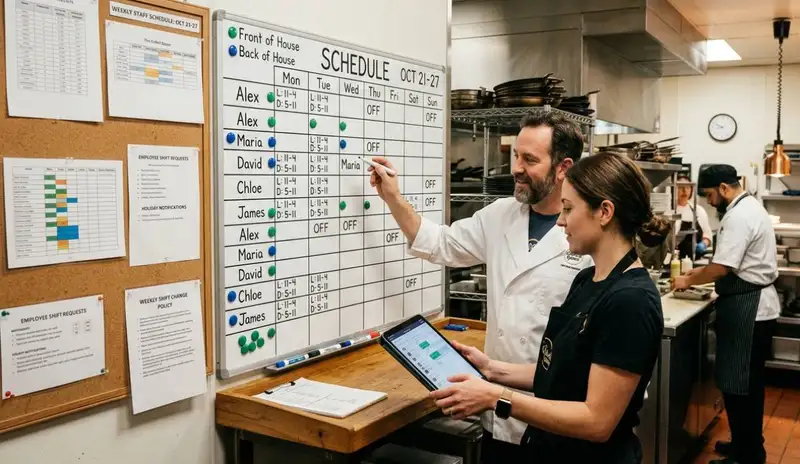
Overtime should not be a surprise at the end of the pay period. For restaurant owners, overtime is usually easier to control before the schedule is published than after employees have already worked the hours. That is why every restaurant scheduling checklist should include an overtime review before the weekly schedule goes live.
Overtime often happens for practical reasons. A strong employee may be scheduled too many shifts because managers trust them. A cook may pick up extra hours because another employee requested time off. A server may work a double because the restaurant is short-staffed. These decisions may solve the immediate coverage problem, but they can quietly increase labor costs if no one is tracking total scheduled hours.
Before publishing the schedule, owners should review total hours by employee, not just coverage by shift. A schedule can look balanced by day, but still create overtime if one employee is assigned too many hours across the week. This is especially important for managers, cooks, bartenders, and experienced employees who are often used to fill gaps.
A strong overtime review should focus on these areas -
1. Total scheduled hours by employee - Review each employee's weekly hours before the schedule is posted. If anyone is approaching overtime, adjust the schedule early instead of reacting later.
2. Daily overtime rules where applicable - Some locations have daily overtime requirements. Owners should check long shifts, double shifts, and extended closing shifts to avoid unexpected premium pay.
3. Double shifts and "clopens" - A clopen happens when an employee closes at night and opens the next morning. Even when legal, too many clopens can lead to fatigue, slower service, and higher call-out risk.
4. Uneven distribution of hours - If one employee is scheduled for too many hours while others are under-scheduled, the restaurant may be creating unnecessary overtime. Balancing hours across trained employees can protect labor cost and reduce burnout.
5. Call-out coverage plans - Overtime can happen when managers always call the same reliable employee to cover missed shifts. Owners should have a backup list so coverage does not depend on one or two people every time.
This step is not only about reducing payroll expense. It is also about protecting employee performance. Long hours can lead to fatigue, mistakes, slower ticket times, lower morale, and higher turnover. In a restaurant, labor cost control and service quality are connected. A tired team may still show up, but they may not perform at the level guests expect.
Before finalizing the schedule, owners should ask -
- Are any employees scheduled near overtime?
- Can any hours be moved to another qualified employee?
- Are double shifts truly necessary?
- Are closing and opening shifts spaced reasonably?
- Will projected labor still match the weekly sales forecast?
Watching overtime before it happens gives owners more control over labor costs. Instead of cutting hours randomly or reacting after payroll is already high, managers can make smarter decisions before the week begins. This keeps the schedule cleaner, the team more balanced, and the restaurant better prepared to operate profitably.

Confirm Breaks, Minors, and Compliance Rules
Restaurant scheduling is not only about coverage and labor cost. It also needs to protect the business from compliance mistakes. Before the schedule is published, owners should review whether each shift follows required break rules, minor labor restrictions, overtime rules, and any local scheduling requirements that may apply.
This step is especially important because scheduling errors often turn into payroll problems later. If an employee is scheduled for a long shift without enough break coverage, the restaurant may end up with missed meal breaks, rushed rest periods, premium pay, or employee complaints. If minors are scheduled too late, too long, or during restricted school hours, the business may face unnecessary risk. A schedule that looks complete on paper can still create compliance issues if the rules are not checked before the week begins.
Owners should build compliance into the scheduling process instead of relying on managers to fix issues during service. Once the restaurant is busy, it becomes harder to send employees on time for breaks, adjust coverage, or correct staffing gaps without hurting operations. Planning ahead gives managers enough people on the floor while still allowing employees to take required breaks.
A practical compliance review should include these areas -
1. Meal and rest breaks - Review shift lengths and make sure employees have enough coverage to take required breaks. Breaks should be planned around rush periods, not forgotten until the middle of service.
2. Minor labor rules - If the restaurant employs minors, check their allowed hours, latest work times, maximum shift lengths, and any restricted duties. These rules may vary by state, age, school schedule, and day of the week.
3. Overtime and premium pay triggers - Look for long shifts, double shifts, and employees scheduled across multiple days in a way that may trigger overtime or other premium pay requirements.
4. Predictive scheduling rules - Some cities and states have rules around advance notice, schedule changes, shift cancellations, and additional pay when schedules are changed too late. Owners should know whether these rules apply to their location.
5. Schedule and timekeeping records - Keep records of published schedules, changes, employee acknowledgments, break punches, and time edits. Good records help owners answer questions if there is ever a payroll dispute or compliance review.
A simple checklist can help managers slow down and review the schedule before it is shared -
- Are all long shifts reviewed for break coverage?
- Are employees scheduled with enough time between shifts?
- Are minors scheduled within legal limits?
- Are overtime and premium pay risks flagged?
- Are schedule changes documented clearly?
- Is there enough coverage to allow breaks during busy periods?
Compliance should not be treated as separate from restaurant scheduling. It is part of building a schedule that works in real life. When owners review breaks, minors, and local rules before the week begins, they reduce risk, improve manager accountability, and create a more stable work environment for employees.
Publish the Schedule Clearly and Early
After the schedule has been reviewed for sales demand, labor needs, availability, time-off requests, overtime, and compliance, the next step is to publish it clearly and early. A schedule only works if employees can access it, understand it, and plan around it before the workweek begins.
For restaurant owners, timing matters. When schedules are posted too late, employees have less time to arrange transportation, childcare, school commitments, second jobs, or personal responsibilities. Late schedules also increase the chance of last-minute conflicts, missed shifts, shift swaps, and call-outs. Even when the restaurant is properly staffed on paper, poor communication can create coverage problems during service.
Owners should set a consistent schedule release deadline each week. For example, if the workweek starts on Monday, the schedule may need to be posted by Thursday or Friday of the previous week. The exact timeline may depend on the restaurant's operation, but the rule should be clear - employees should know when the schedule will be available and managers should follow that deadline consistently.
The schedule should also have one official version. This is important because confusion often happens when employees are looking at different copies. One person may check a printed schedule in the breakroom, another may rely on a text message, and another may look at an old screenshot. When changes are made, everyone needs to know which version is current.
A strong schedule publishing process should include -
1. Post the schedule by the same deadline every week. Consistency helps employees plan ahead and reduces unnecessary questions.
2. Use one official schedule location. Whether the schedule is posted digitally, printed in-store, or shared through scheduling software, there should be one source employees are expected to follow.
3. Notify employees when the schedule is live. Managers should communicate when the new schedule is posted so employees know to review it.
4. Require employees to confirm their shifts. Shift confirmation helps managers identify issues before the week starts.
5. Document any changes after publishing. If a shift is changed, added, swapped, or removed, the update should be recorded clearly.
6. Communicate changes directly to affected employees. Employees should not be expected to discover schedule changes by accident. If their shift changes, they should be notified directly.
Clear schedule communication protects both the business and the team. Employees are more likely to show up prepared when they know their shifts in advance. Managers spend less time answering repeated questions or fixing avoidable confusion. Owners gain better control over labor planning because the published schedule becomes a reliable operating tool, not a moving target.
Before the schedule is finalized, owners should ask -
- Was the schedule published on time?
- Can every employee access it?
- Is there only one official version?
- Have employees reviewed or confirmed their shifts?
- Are changes documented after posting?
- Are affected employees notified directly when changes happen?
Publishing the schedule clearly and early helps prevent small communication problems from becoming larger operational issues. It gives employees time to plan, gives managers time to correct conflicts, and gives the restaurant a stronger chance of starting the week fully staffed and organized.
Review Weekly Schedule Results
A restaurant scheduling checklist should not end when the schedule is published. Owners should review what actually happened after the week is complete. This step helps turn scheduling from a weekly task into a better operating system.
Start by comparing scheduled labor vs. actual labor. If employees clocked in early, stayed late, skipped breaks, swapped shifts, or worked unplanned overtime, the actual labor cost may be very different from the original schedule. This review helps owners see whether the schedule was realistic or whether managers had to make too many adjustments during service.
Next, compare forecasted sales vs. actual sales. If sales were higher than expected, the restaurant may have been understaffed during key hours. That can lead to longer ticket times, slower service, missed upsell opportunities, and employee stress. If sales were lower than expected, the restaurant may have carried too many labor hours, which can reduce profitability.
Owners should also review schedule issues by shift. A Saturday dinner rush may show that the kitchen needed one more line cook, while a Monday afternoon shift may show that labor could be reduced by staggering start times. The most useful scheduling insights often come from looking at specific days, roles, and time periods instead of only reviewing total weekly labor cost.
A strong post-week review should answer these questions -
1. Did actual sales match the forecast?
If the forecast was wrong, identify why. Weather, events, promotions, holidays, delivery demand, or local traffic patterns may have affected results.
2. Did actual labor match scheduled labor?
Look for early clock-ins, late clock-outs, missed breaks, shift swaps, call-outs, and overtime.
3. Which shifts were overstaffed?
Slow shifts with too many employees should be adjusted in the next schedule.
4. Which shifts were understaffed?
Busy shifts with long wait times, delayed orders, or stressed employees may need more coverage.
5. Were the right roles scheduled?
The issue may not be total headcount. The restaurant may need a stronger cook, an extra host, more prep time, or better closing coverage.
6. What should change next week?
Turn the review into action. Adjust labor targets, shift start times, role coverage, availability rules, or time-off approval decisions.
This review also helps owners improve accountability. Managers can explain why labor ran high, why overtime happened, or why a shift struggled. Instead of relying on opinions, owners can review actual numbers and make better scheduling decisions.
Over time, this process improves labor control. Each week gives the restaurant more data about demand patterns, staffing needs, employee reliability, and schedule accuracy. When owners review schedule performance consistently, they can reduce waste, avoid repeated staffing mistakes, and build schedules that better support sales, service, and profitability.
Managing restaurant schedules manually can make it harder to control labor costs, track availability, prevent overtime, and keep employees connected. Altametrics Workforce Scheduling helps restaurant owners simplify scheduling, improve communication, and keep labor planning aligned with business needs.
Learn how Altametrics Workforce Scheduling can help you build smarter schedules, keep your team connected, manage labor more effectively, and reduce scheduling confusion. Click "Book a Demo" below to see how it works for your restaurant.


Inventory management
How to Conduct a Food Waste Audit in Your Restaurant

Software integration
Smart Ways to Use AI in Your Restaurant

Employee scheduling
Employee Time Tracking Tips for Restaurants

Employee scheduling
7 Scheduling Mistakes Restaurant Owners Should Stop Making

Employee scheduling
Human Resource Management for Restaurants
Employee scheduling
Common Payroll Challenges in Restaurants

Sales forecasting
How to Use Restaurant Analytics to Improve Profitability

Restaurant management
The Complete Guide to Restaurant Reputation Management

Accounting payroll
Restaurant Cash Handling Procedures

Frequently Asked Questions
How can scheduling software help restaurant owners?
Scheduling software can help owners manage availability, time-off requests, shift changes, employee communication, overtime visibility, and labor planning in one place. It can also reduce confusion by giving employees access to the most current schedule.
What is the best way to manage employee availability?
The best way to manage availability is to require employees to submit updates by a set weekly deadline. Managers should review approved availability before building the schedule and avoid scheduling employees outside their available times.
How can scheduling affect employee retention?
Scheduling affects retention because employees value consistency, fair hours, advance notice, and respect for availability. Poor scheduling can lead to frustration, burnout, missed shifts, and turnover. A clear scheduling process helps build trust with the team.
How can restaurant owners make scheduling more consistent?
Owners can make scheduling more consistent by using the same weekly process, setting deadlines for availability and time-off requests, reviewing labor targets, publishing the schedule on time, and tracking results after each week.