
Set Clear Server Training Goals
Start by outlining the service standards that every server should follow. These may include greeting guests within a specific amount of time, accurately entering orders, checking on tables after food is delivered, maintaining clean sections, processing payments correctly, and thanking guests before they leave. The goals should reflect the restaurant's concept, service style, menu, and customer expectations.
Restaurant owners should also create separate goals for knowledge, skills, and behavior. Knowledge goals may cover menu ingredients, allergens, preparation methods, promotions, and restaurant policies. Skill-based goals may include using the POS system, carrying trays, opening wine, splitting checks, and managing multiple tables. Behavioral goals should address punctuality, teamwork, communication, appearance, and professionalism.
Whenever possible, make each goal measurable. Instead of saying servers should "know the menu," require them to pass a menu quiz or explain key dishes without assistance. Rather than expecting "good customer service," define the steps of service managers will observe during a practice shift.
Document these goals in a restaurant server training checklist and review them with every new hire. When expectations are clear from the beginning, servers can focus on building the specific knowledge and habits required to provide consistent service.
Complete New-Hire Orientation

Restaurant owners can make orientation measurable by tracking the following requirements -
1. 100% completion of employment documents - Confirm that tax forms, payroll information, work authorization documents, emergency contacts, and required acknowledgments are complete before the employee begins regular shifts.
2. Six essential policy areas reviewed - Cover scheduling, attendance, uniforms, tip procedures, employee meals, and workplace conduct. Servers should know whom to contact when they are late, sick, or unable to work.
3. One complete restaurant tour - Show new hires the dining room, kitchen, server stations, storage areas, emergency exits, restrooms, break areas, and locations of safety equipment.
4. At least three team introductions - Introduce the server to a manager, trainer, and kitchen team member. This creates clear points of contact when questions arise.
5. An orientation knowledge check - Use a short quiz or verbal review and require a score of at least 80% before moving into detailed service training.
The first 30 to 90 days are especially important for restaurant employee retention, making structured onboarding, mentorship, and communication valuable management priorities.
Record every completed activity on the restaurant server training checklist. Managers should also measure orientation success through completion rates, early turnover, employee feedback, and time required for new servers to work independently. These are among the onboarding metrics recommended for evaluating whether new employees are becoming productive and engaged.
Perfect Solution for Your Training and Development Needs
Teach Your Staff with Altametrics LMS
Teach Menu and Product Knowledge
Use the following training targets -
1. 100% menu-item recognition - Servers should identify every permanent menu item, its main ingredients, preparation method, portion size, side options, and available modifications.
2. Nine major allergen categories - Training should cover milk, eggs, fish, crustacean shellfish, tree nuts, peanuts, wheat, soybeans, and sesame - the nine major food allergens recognized under current U.S. federal law.
3. At least an 85% menu quiz score - Test employees on ingredients, allergens, cooking methods, substitutions, pricing, and commonly asked guest questions. Require additional coaching before servers work independently when they fall below the restaurant's target score.
4. Three recommendations per menu category - Each server should be able to confidently recommend at least three appetizers, entrees, beverages, and desserts. They should explain why an item may appeal to the guest rather than merely naming the most expensive option.
5. Daily knowledge of specials and unavailable items - Review limited-time dishes, ingredient changes, sold-out products, and pricing updates before every shift. Servers should repeat the information during the pre-shift meeting to confirm understanding.
Allergen knowledge requires particular attention. A CDC study of 278 restaurants found that only 33.3% of the servers interviewed had received food-allergy training. Although the study reflects an earlier industry sample, it demonstrates the operational gap restaurants should avoid. The CDC continues to recommend training restaurant employees - especially less-experienced staff - on allergens and cross-contact prevention.
Complete this section of the restaurant server training checklist with tasting sessions, flashcards, kitchen demonstrations, role-playing, and written quizzes. Managers should repeat testing whenever recipes or ingredients change so servers provide information based on current menu documentation rather than memory or assumptions.
Standardize the Steps of Service
Use the following training benchmarks, adjusting the timing to match the restaurant's concept and staffing model -
1. Greet tables within 60 seconds - Servers should welcome guests promptly, introduce themselves, provide menus, and explain relevant specials.
2. Offer beverages within two minutes - Drink orders should be taken early and delivered according to the restaurant's established service-time target.
3. Confirm 100% of modified orders - Servers should repeat allergy requests, substitutions, cooking temperatures, removed ingredients, and special instructions before sending the order.
4. Check back within two minutes or two bites - After food is delivered, servers should confirm that the order is correct and resolve missing items before the guest has waited too long.
5. Scan assigned tables every three to five minutes - Servers should look for empty beverages, finished plates, guest signals, and additional ordering opportunities without repeatedly interrupting conversations.
6. Process payments within three minutes - Once guests request the check, servers should deliver it promptly, verify the bill, and return cards or change without unnecessary delays.
7. Complete every farewell - Servers should thank guests, invite them to return, and report unresolved concerns to a manager before the party leaves.
Managers can evaluate these standards through three mock-service scenarios, at least two observed training shifts, and a final service assessment. Track greeting times, order-entry errors, missing modifiers, check-back completion, payment speed, and guest complaints.
Servers must balance speed with attentiveness, accuracy, and hospitality. The National Restaurant Association describes accurate and prompt order fulfillment as a core restaurant responsibility, reinforcing the need for coordination between servers, kitchen employees, and managers. Document each completed skill on the restaurant server training checklist before allowing the employee to manage a full section independently.
POS and Payment Procedures
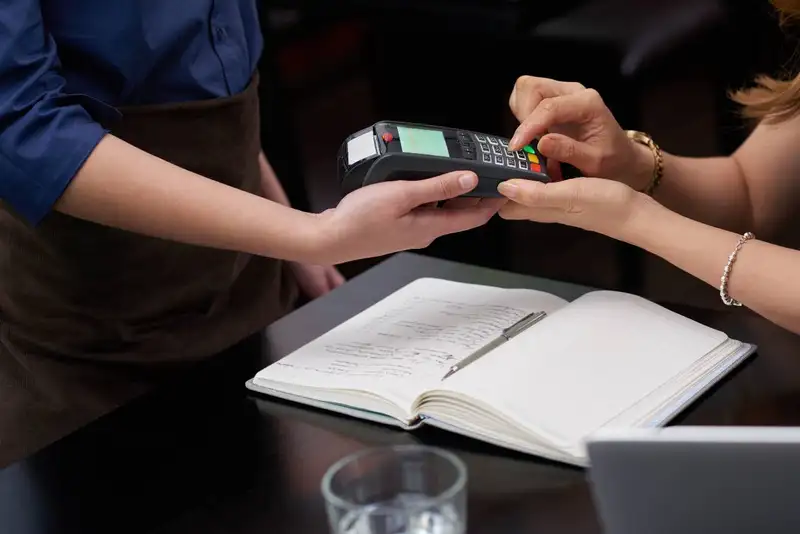
Restaurant owners can use the following measurable training standards -
1. Complete at least 20 practice orders - Include appetizers, entrees, beverages, desserts, substitutions, cooking temperatures, and special requests. Require a minimum order-entry accuracy rate of 95%.
2. Enter 100% of critical modifiers correctly - Test servers on allergies, ingredient removals, side substitutions, add-ons, and preparation instructions. Any missed allergy-related modifier should require immediate retraining.
3. Meet an order-entry time target - Set a benchmark appropriate for the restaurant, such as entering a standard four-person order within 60 to 90 seconds without sacrificing accuracy.
4. Practice at least five payment situations - Servers should process cash, chip cards, contactless payments, gift cards, and split checks. Training should also cover combining checks, transferring tables, adding tips, and printing receipts.
5. Complete three check-splitting exercises - Include splitting evenly, dividing by menu item, and accepting multiple payment methods. Servers should complete each scenario without changing totals or assigning items to the wrong guest.
6. Achieve zero cash-drawer variance - During practice transactions, the expected cash amount should match the actual amount collected. Servers must understand how to count change back accurately and report discrepancies.
7. Follow 100% of authorization procedures - Discounts, voids, refunds, complimentary items, and deleted orders should require the correct manager approval. Employees should never use another person's login credentials.
Payment security should also be part of POS training. The Payment Card Industry Data Security Standard establishes technical and operational requirements for businesses that store, process, or transmit payment account data. Servers should be trained never to write down card numbers, photograph payment information, share passwords, or leave payment devices unattended.
Managers should track order-entry accuracy, modifier errors, void rates, payment-processing time, cash variance, and manager interventions during training shifts. Record each completed task on the restaurant server training checklist and require additional practice whenever a server misses the restaurant's performance target.
Invest in Training and Development
Coach Your Employees with Altametrics LMS
Customer Service and Sales Skills
Restaurant owners can use the following suggested training benchmarks -
1. Complete five customer-service role-plays - Include an undecided guest, an incorrect order, a long ticket time, a dietary request, and an unhappy customer. Require servers to complete at least four of the five scenarios correctly.
2. Use a three-step complaint response - Servers should listen without interrupting, acknowledge the concern, and offer an appropriate next step. Set an internal target of notifying a manager within two minutes when approval or additional assistance is needed.
3. Learn two recommendations per category - Each server should confidently suggest at least two appetizers, premium beverages, entrees, add-ons, and desserts. Recommendations should be based on the guest's preferences rather than automatically promoting the highest-priced item.
4. Track recommendation acceptance rates - Divide the number of recommended items purchased by the number of recommendation opportunities. For example, 12 accepted recommendations from 40 attempts produce a 30% acceptance rate.
5. Measure add-on sales separately - Monitor appetizer, beverage, side, and dessert attachment rates. Establish a four-week baseline and set a realistic improvement goal for each server instead of using the same target for every restaurant.
6. Require an 85% service assessment score - Test active listening, menu explanations, sales language, complaint handling, guest privacy, and manager escalation procedures before assigning a full section.
Suggestive selling can raise average checks through items such as desserts, soups, specialty beverages, and other extras. The National Restaurant Association also recommends training employees to explain the menu, anticipate guest needs, handle special requests, and respond to customer feedback.
Managers should track average guest check, add-on rate, complaint frequency, complimentary-item value, guest feedback, and repeat visits. Sales performance should never be measured alone. A server who increases check averages but creates complaints or pressures guests is not delivering effective service. The goal is to train servers to improve revenue by making helpful, relevant recommendations while maintaining hospitality and guest trust.
Safety, Sanitation, and Compliance
Use the following measurable training standards -
1. Complete a 20-second handwashing demonstration - Servers should wash their hands with soap and water for at least 20 seconds and identify when handwashing is required, including after using the restroom, handling dirty dishes, touching the face, or cleaning spills.
2. Achieve 100% accuracy on allergy procedures - Servers must record the allergy, alert the kitchen and manager, use the correct POS modifier, and avoid promising that a meal is safe without kitchen confirmation. The CDC recommends training restaurant employees on food allergies and preventing allergen cross-contact.
3. Complete five workplace-safety scenarios - Practice responding to broken glass, wet floors, burns, cuts, chemical spills, and blocked walkways. OSHA advises restaurants to keep floors clean and dry, display wet-floor warnings, and keep passageways clear.
4. Pass a safety assessment with at least 90% - Include questions about tray carrying, hot plates, cleaning chemicals, emergency exits, fire procedures, and accident reporting.
5. Report 100% of incidents and near misses - Servers should immediately notify a manager about injuries, unsafe conditions, guest accidents, or situations that could have caused harm. OSHA encourages employers to investigate injuries and near misses so underlying hazards can be corrected.
6. Verify alcohol-service requirements before serving - Employees should know how to check identification, refuse service, recognize possible intoxication, and contact a manager. Alcohol-server rules, age requirements, and mandatory training programs vary by state and locality, so restaurant owners should use guidance from their licensing authority.
These standards address a measurable workplace risk. In 2024, food services and drinking places recorded 2.4 workplace injury and illness cases per 100 full-time workers.
Managers should document quiz scores, safety demonstrations, allergy exercises, incident-reporting practice, and required certifications on the restaurant server training checklist. Local health, labor, and alcohol regulations should always take priority because the FDA Food Code serves as a model that jurisdictions may adopt or modify.
Evaluate Performance and Continue Training
This matters financially because new hourly restaurant employees take an average of 31.8 days to generate enough value to offset hiring and training costs. The first 30 to 90 days are also a critical retention period, making regular manager support and structured follow-up essential.
Use the following suggested performance benchmarks -
1. Require a final score of at least 90% - Evaluate menu knowledge, POS use, steps of service, allergens, sanitation, payment procedures, and complaint handling. Any missed safety or allergy question should require retraining regardless of the overall score.
2. Complete at least two observed shifts - A trainer or manager should watch the server manage real tables and record greeting speed, order accuracy, check-backs, table organization, payment handling, and teamwork.
3. Set a time-to-productivity target - Measure how many shifts or days each new server needs before independently managing a standard section. SHRM identifies time-to-productivity as a key onboarding metric and recommends establishing role-specific performance indicators.
4. Track six operational metrics - Review order-error rate, average check, add-on sales, table-turn time, guest complaints, and complimentary-item value. Compare each server with the restaurant's own baseline rather than relying on one universal industry target.
5. Schedule three formal check-ins - Meet with the employee after approximately 7, 30, and 90 days. Discuss strengths, questions, training gaps, scheduling concerns, and progress toward performance goals.
6. Provide weekly coaching during the first month - Use brief, specific feedback based on observed behavior. For example, ask the server to improve modifier accuracy from 92% to 98% rather than simply telling them to "be more careful."
7. Trigger retraining when performance declines - Additional instruction may be necessary when order errors, guest complaints, voids, safety violations, or cash discrepancies exceed the restaurant's approved threshold.
SHRM recommends evaluating onboarding through several measures, including retention, employee surveys, performance results, engagement, and informal feedback. It also emphasizes that effective performance management depends on clear goals, regular feedback, and strategic use of performance data - not only annual reviews.
Restaurant owners should update the server training checklist whenever menus, technology, policies, or regulations change. Monthly refreshers, pre-shift quizzes, role-playing exercises, and quarterly skill assessments help reinforce standards. Ongoing evaluation turns server training into a continuous management system that supports better service, stronger retention, and more consistent restaurant performance.
Looking for Training Your Employees Effectively?
Elevate Your Training and Development with Altametrics LMS
Frequently
Asked Questions
What score should servers receive on a training test?
How should servers be trained on menu knowledge?
How can restaurant owners measure server performance?
What are the most common server training mistakes?
Must-Read Content
10 Employee Retention Strategies for Restaurant Owners
Restaurant owners can cut turnover by paying fairly, onboarding well, scheduling flexibly, promoting growth, recognizing effort, offering meaningful benefits, listening to feedback, and hiring carefully for fit.

Employee Time Tracking Tips for Restaurants
Use these time tracking tips to improve restaurant employee timekeeping, reduce payroll errors, monitor overtime, track breaks, and simplify workforce management.
7 Scheduling Mistakes Restaurant Owners Should Stop Making
Avoid common scheduling mistakes by improving labor forecasting, balancing shift coverage, respecting employee availability, controlling overtime, and using scheduling software to optimize restaurant operations.