
Why Restaurant Owners Need to Calculate Cost of Sales
Running a profitable restaurant requires more than generating sales. Restaurant owners must understand how much they spend on the ingredients and inventory used to prepare the food and beverages they sell. One of the most important metrics for measuring these expenses is cost of sales. It shows how much inventory a restaurant consumes over a specific period and helps owners understand how purchasing decisions affect profitability.
Unlike total purchasing expenses, cost of sales accounts for the inventory used during an accounting period. This distinction matters because ingredients purchased in one week may remain in storage and be used later. Without accounting for opening and closing inventory, restaurant owners may overestimate or underestimate their actual food expenses.
Calculating cost of sales helps restaurant owners -
1. Measure inventory consumption - Understand how much food and beverage inventory is actually used during a reporting period.
2. Monitor food costs - Identify changes in ingredient expenses and recognize when costs begin increasing.
3. Evaluate profitability - Understand how much revenue remains after accounting for the cost of inventory sold.
4. Identify inventory problems - Detect potential waste, spoilage, overportioning, and discrepancies in stock records.
5. Improve purchasing decisions - Use accurate inventory data to determine how much stock to order and avoid unnecessary purchases.
Regular cost of sales calculations also make it easier to compare financial performance across different weeks, months, and business locations. Restaurant owners can use these figures to identify spending patterns, establish cost targets, and make adjustments before rising inventory expenses affect profit margins.
Understanding how to calculate cost of sales starts with three essential figures - opening inventory, inventory purchases, and closing inventory. By learning how these numbers work together, restaurant owners can measure inventory consumption more accurately and gain better control over food costs.
Unlike total purchasing expenses, cost of sales accounts for the inventory used during an accounting period. This distinction matters because ingredients purchased in one week may remain in storage and be used later. Without accounting for opening and closing inventory, restaurant owners may overestimate or underestimate their actual food expenses.
Calculating cost of sales helps restaurant owners -
1. Measure inventory consumption - Understand how much food and beverage inventory is actually used during a reporting period.
2. Monitor food costs - Identify changes in ingredient expenses and recognize when costs begin increasing.
3. Evaluate profitability - Understand how much revenue remains after accounting for the cost of inventory sold.
4. Identify inventory problems - Detect potential waste, spoilage, overportioning, and discrepancies in stock records.
5. Improve purchasing decisions - Use accurate inventory data to determine how much stock to order and avoid unnecessary purchases.
Regular cost of sales calculations also make it easier to compare financial performance across different weeks, months, and business locations. Restaurant owners can use these figures to identify spending patterns, establish cost targets, and make adjustments before rising inventory expenses affect profit margins.
Understanding how to calculate cost of sales starts with three essential figures - opening inventory, inventory purchases, and closing inventory. By learning how these numbers work together, restaurant owners can measure inventory consumption more accurately and gain better control over food costs.
The Restaurant Cost of Sales Formula
Before calculating cost of sales, restaurant owners need to understand how inventory moves through their operations. Every reporting period begins with existing stock, includes additional purchases, and ends with whatever inventory remains unused. The cost of sales formula accounts for these changes to determine the value of inventory consumed during that period.
The basic restaurant cost of sales formula is -
Cost of Sales = Opening Inventory + Purchases - Closing Inventory
Each component represents a different part of the restaurant's inventory activity.
1. Opening Inventory
Opening inventory is the total value of food, beverages, and other applicable stock available at the beginning of an accounting period. It represents the inventory carried over from the previous reporting period.
For example, if a restaurant begins the month with $8,000 worth of ingredients and beverages, that amount becomes its opening inventory.
2. Inventory Purchases
Purchases represent the additional inventory acquired during the reporting period. These include ingredients, beverages, and other products used to prepare menu items.
For example, if the restaurant purchases another $12,000 worth of inventory throughout the month, this amount is added to opening inventory.
3. Closing Inventory
Closing inventory is the total value of unused stock remaining at the end of the reporting period. It is subtracted from the combined value of opening inventory and purchases because these products have not yet been consumed.
For example, if the restaurant has $5,000 worth of inventory remaining at the end of the month, that amount is deducted from the total available inventory.
Understanding the Cost of Sales Percentage
Calculating the total cost of sales provides an important financial figure, but restaurant owners should also understand how much of their revenue goes toward inventory consumption. This is measured using the cost of sales percentage.
The formula is -
Cost of Sales = Cost of Sales / Net Sales x 100
For example, if a restaurant has $15,000 in cost of sales and generates $50,000 in net sales, its cost of sales percentage is 30%.
This means the restaurant spends $0.30 on inventory for every dollar of net sales.
Understanding both figures is essential for effective cost management. Total cost of sales shows the value of inventory consumed, while the percentage helps restaurant owners evaluate inventory expenses relative to revenue. Together, these calculations provide a clearer picture of restaurant cost performance and help identify areas where expenses may need attention.
The basic restaurant cost of sales formula is -
Cost of Sales = Opening Inventory + Purchases - Closing Inventory
Each component represents a different part of the restaurant's inventory activity.
1. Opening Inventory
Opening inventory is the total value of food, beverages, and other applicable stock available at the beginning of an accounting period. It represents the inventory carried over from the previous reporting period.
For example, if a restaurant begins the month with $8,000 worth of ingredients and beverages, that amount becomes its opening inventory.
2. Inventory Purchases
Purchases represent the additional inventory acquired during the reporting period. These include ingredients, beverages, and other products used to prepare menu items.
For example, if the restaurant purchases another $12,000 worth of inventory throughout the month, this amount is added to opening inventory.
3. Closing Inventory
Closing inventory is the total value of unused stock remaining at the end of the reporting period. It is subtracted from the combined value of opening inventory and purchases because these products have not yet been consumed.
For example, if the restaurant has $5,000 worth of inventory remaining at the end of the month, that amount is deducted from the total available inventory.
Understanding the Cost of Sales Percentage
Calculating the total cost of sales provides an important financial figure, but restaurant owners should also understand how much of their revenue goes toward inventory consumption. This is measured using the cost of sales percentage.
The formula is -
Cost of Sales = Cost of Sales / Net Sales x 100
For example, if a restaurant has $15,000 in cost of sales and generates $50,000 in net sales, its cost of sales percentage is 30%.
This means the restaurant spends $0.30 on inventory for every dollar of net sales.
Understanding both figures is essential for effective cost management. Total cost of sales shows the value of inventory consumed, while the percentage helps restaurant owners evaluate inventory expenses relative to revenue. Together, these calculations provide a clearer picture of restaurant cost performance and help identify areas where expenses may need attention.
Get Accurate Inventory Valuations
Manage Your Workforce with Altametrics
Step 1. Calculate Your Opening Inventory Value
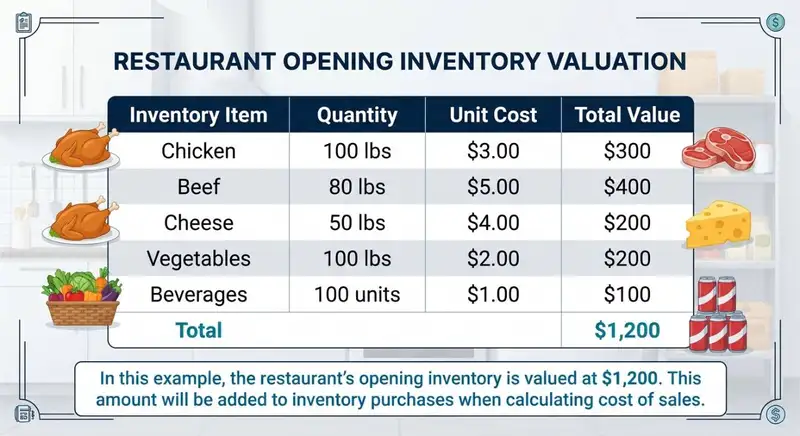
The first step in calculating restaurant cost of sales is determining the value of inventory available at the beginning of the reporting period. Opening inventory represents all usable food, beverages, and other applicable stock carried over from the previous accounting period. An accurate opening inventory figure is essential because it establishes the starting point for measuring how much inventory the restaurant consumes.
To calculate opening inventory, restaurant owners should conduct a physical stock count and assign a monetary value to each item.
Follow these steps to calculate opening inventory -
1. Identify all inventory items - List the ingredients, beverages, frozen products, dry goods, and other applicable supplies stored in refrigerators, freezers, pantries, and storage areas.
2. Count available quantities - Record the quantity of each item on hand. Use consistent measurement units, such as pounds, kilograms, gallons, liters, or individual units.
3. Determine the unit cost - Use purchase invoices or inventory records to establish the cost of each item.
4. Calculate the value of each item - Multiply the quantity available by its unit cost.
5. Add all inventory values - Combine the individual amounts to determine the restaurant's total opening inventory value.
Choose a Consistent Inventory Valuation Method
Restaurant owners also need to determine how inventory items are valued, particularly when ingredient prices change between purchases. Two common inventory valuation methods are -
1. FIFO (First In, First Out) - Assumes the oldest inventory items are used or sold first. This method is useful for restaurants that prioritize using older ingredients before newer stock to reduce spoilage.
2. Weighted Average Cost - Calculates an average unit cost based on the total value and quantity of inventory available. This helps restaurants maintain a consistent valuation when purchasing the same ingredients at different prices.
Regardless of the method selected, restaurant owners should apply it consistently across reporting periods to maintain reliable financial records.
Accurate opening inventory calculations provide the foundation for cost of sales reporting. Missing items, incorrect quantities, or outdated unit costs can distort the final calculation and make it harder to understand actual inventory consumption. Regular stock counts and organized purchase records help maintain accuracy from the beginning of each reporting period.
To calculate opening inventory, restaurant owners should conduct a physical stock count and assign a monetary value to each item.
Follow these steps to calculate opening inventory -
1. Identify all inventory items - List the ingredients, beverages, frozen products, dry goods, and other applicable supplies stored in refrigerators, freezers, pantries, and storage areas.
2. Count available quantities - Record the quantity of each item on hand. Use consistent measurement units, such as pounds, kilograms, gallons, liters, or individual units.
3. Determine the unit cost - Use purchase invoices or inventory records to establish the cost of each item.
4. Calculate the value of each item - Multiply the quantity available by its unit cost.
5. Add all inventory values - Combine the individual amounts to determine the restaurant's total opening inventory value.
Choose a Consistent Inventory Valuation Method
Restaurant owners also need to determine how inventory items are valued, particularly when ingredient prices change between purchases. Two common inventory valuation methods are -
1. FIFO (First In, First Out) - Assumes the oldest inventory items are used or sold first. This method is useful for restaurants that prioritize using older ingredients before newer stock to reduce spoilage.
2. Weighted Average Cost - Calculates an average unit cost based on the total value and quantity of inventory available. This helps restaurants maintain a consistent valuation when purchasing the same ingredients at different prices.
Regardless of the method selected, restaurant owners should apply it consistently across reporting periods to maintain reliable financial records.
Accurate opening inventory calculations provide the foundation for cost of sales reporting. Missing items, incorrect quantities, or outdated unit costs can distort the final calculation and make it harder to understand actual inventory consumption. Regular stock counts and organized purchase records help maintain accuracy from the beginning of each reporting period.
Step 2. Calculate Total Inventory Purchases
After determining opening inventory, the next step is calculating the total value of inventory purchased during the reporting period. Restaurant purchases include the food ingredients, beverages, and other stock items acquired to support daily operations. These purchases are added to opening inventory to determine the total value of stock available for consumption.
Accurate purchase records are important because incomplete invoices, unrecorded deliveries, or incorrectly categorized expenses can lead to inaccurate cost of sales calculations.
Follow these steps to calculate total inventory purchases -
1. Collect supplier invoices - Gather invoices, receipts, and delivery records for all inventory purchases made during the reporting period.
2. Identify applicable purchases - Include food ingredients, beverages, and other inventory items used in preparing and selling menu products.
3. Record purchase quantities and costs - Verify the quantities received and the prices charged by suppliers. Compare invoices against delivery records to identify discrepancies.
4. Account for returns and discounts - Subtract returned goods, supplier credits, and applicable purchase discounts from the total purchase value.
5. Calculate total purchases - Add the value of all eligible inventory purchases to determine the amount for the reporting period.
What Should Be Included in Restaurant Inventory Purchases?
Not every restaurant expense belongs in the cost of sales calculation. Restaurant owners should distinguish inventory purchases from general operating expenses to avoid overstating inventory costs.
Common inventory purchases include -
1. Food ingredients - Meat, seafood, vegetables, fruits, dairy products, grains, spices, and cooking ingredients.
2. Beverages - Soft drinks, bottled water, coffee, tea, juices, and other drinks sold to customers.
3. Preparation ingredients - Sauces, seasonings, oils, condiments, and other items used in menu preparation.
4. Other saleable inventory - Packaged snacks, desserts, and retail products sold directly to customers.
Expenses such as rent, employee wages, utilities, insurance, and marketing should generally be recorded separately because they are operating expenses rather than inventory purchases.
Account for Purchase Returns and Discounts
Restaurant owners should calculate purchases using the net cost of inventory rather than simply adding every supplier invoice together. Returned products, supplier credits, and purchase discounts can reduce the actual amount spent on inventory.
For example, suppose a restaurant purchases $12,500 worth of ingredients and beverages during the month. It also receives a $300 credit for damaged products and a $200 supplier discount.
The calculation would be -
$12,500 - $300 - $200 = $12,000
The restaurant's total inventory purchases for the period would therefore be $12,000.
Maintaining accurate purchase records helps restaurant owners understand how much inventory enters their operations and what it actually costs. When combined with opening and closing inventory values, these figures provide a more reliable calculation of cost of sales and help identify unnecessary purchasing expenses.
Accurate purchase records are important because incomplete invoices, unrecorded deliveries, or incorrectly categorized expenses can lead to inaccurate cost of sales calculations.
Follow these steps to calculate total inventory purchases -
1. Collect supplier invoices - Gather invoices, receipts, and delivery records for all inventory purchases made during the reporting period.
2. Identify applicable purchases - Include food ingredients, beverages, and other inventory items used in preparing and selling menu products.
3. Record purchase quantities and costs - Verify the quantities received and the prices charged by suppliers. Compare invoices against delivery records to identify discrepancies.
4. Account for returns and discounts - Subtract returned goods, supplier credits, and applicable purchase discounts from the total purchase value.
5. Calculate total purchases - Add the value of all eligible inventory purchases to determine the amount for the reporting period.
What Should Be Included in Restaurant Inventory Purchases?
Not every restaurant expense belongs in the cost of sales calculation. Restaurant owners should distinguish inventory purchases from general operating expenses to avoid overstating inventory costs.
Common inventory purchases include -
1. Food ingredients - Meat, seafood, vegetables, fruits, dairy products, grains, spices, and cooking ingredients.
2. Beverages - Soft drinks, bottled water, coffee, tea, juices, and other drinks sold to customers.
3. Preparation ingredients - Sauces, seasonings, oils, condiments, and other items used in menu preparation.
4. Other saleable inventory - Packaged snacks, desserts, and retail products sold directly to customers.
Expenses such as rent, employee wages, utilities, insurance, and marketing should generally be recorded separately because they are operating expenses rather than inventory purchases.
Account for Purchase Returns and Discounts
Restaurant owners should calculate purchases using the net cost of inventory rather than simply adding every supplier invoice together. Returned products, supplier credits, and purchase discounts can reduce the actual amount spent on inventory.
For example, suppose a restaurant purchases $12,500 worth of ingredients and beverages during the month. It also receives a $300 credit for damaged products and a $200 supplier discount.
The calculation would be -
$12,500 - $300 - $200 = $12,000
The restaurant's total inventory purchases for the period would therefore be $12,000.
Maintaining accurate purchase records helps restaurant owners understand how much inventory enters their operations and what it actually costs. When combined with opening and closing inventory values, these figures provide a more reliable calculation of cost of sales and help identify unnecessary purchasing expenses.
Step 3. Calculate Your Closing Inventory Value
After calculating opening inventory and total purchases, the next step is determining the value of inventory remaining at the end of the reporting period. Closing inventory represents all usable food, beverages, and other applicable stock that has not been consumed or sold. This amount is subtracted from opening inventory and purchases to calculate the restaurant's actual cost of sales.
An accurate closing inventory figure is important because it prevents unused stock from being counted as an expense for the current period. Without a reliable closing inventory calculation, restaurant owners may overstate their cost of sales and underestimate profitability.
Follow these steps to calculate closing inventory -
1. Conduct a physical stock count - Count all remaining inventory in refrigerators, freezers, storage rooms, pantries, and other designated areas.
2. Record remaining quantities - Document the quantity of each ingredient and product using consistent measurement units.
3. Verify inventory condition - Identify expired, spoiled, damaged, or unusable products that should not be treated as available stock.
4. Assign unit costs - Use the same inventory valuation method applied when calculating opening inventory, such as FIFO or weighted average cost.
5. Calculate total inventory value - Multiply the remaining quantity of each item by its applicable unit cost and add the individual values together.
Account for Spoiled, Expired, and Damaged Inventory
Not all inventory remaining in a restaurant's storage areas represents usable stock. Ingredients that have spoiled, expired, or become damaged may need to be written off rather than included in the value of available closing inventory.
For example, suppose a restaurant has $5,000 worth of inventory remaining at the end of the month. During the stock count, employees identify $300 worth of spoiled ingredients that can no longer be used.
The restaurant should record the $300 inventory loss separately and value its usable closing inventory at $4,700, assuming the spoiled products have not already been recorded as consumed or written off.
This distinction helps restaurant owners understand how much inventory remains available while keeping waste and inventory losses visible in their financial records.
Maintain Consistent Inventory Counting Practices
Closing inventory calculations should follow a consistent process to produce reliable financial results. Restaurant owners should consider the following practices -
1. Schedule regular stock counts - Conduct counts at consistent intervals, such as weekly or monthly, depending on inventory turnover.
2. Use standardized measurement units - Record ingredients using consistent weights, volumes, or individual quantities.
3. Assign counting responsibilities - Make specific employees responsible for counting and verifying inventory.
4. Reconcile physical counts with inventory records - Investigate differences between recorded stock levels and actual quantities.
5. Keep inventory documentation organized - Maintain stock sheets, supplier invoices, and adjustment records for future reference.
Accurate closing inventory calculations help restaurant owners avoid overstating expenses and improve visibility into inventory usage. By tracking remaining stock, identifying unusable ingredients, and maintaining consistent valuation methods, restaurants can establish a reliable foundation for calculating cost of sales.
An accurate closing inventory figure is important because it prevents unused stock from being counted as an expense for the current period. Without a reliable closing inventory calculation, restaurant owners may overstate their cost of sales and underestimate profitability.
Follow these steps to calculate closing inventory -
1. Conduct a physical stock count - Count all remaining inventory in refrigerators, freezers, storage rooms, pantries, and other designated areas.
2. Record remaining quantities - Document the quantity of each ingredient and product using consistent measurement units.
3. Verify inventory condition - Identify expired, spoiled, damaged, or unusable products that should not be treated as available stock.
4. Assign unit costs - Use the same inventory valuation method applied when calculating opening inventory, such as FIFO or weighted average cost.
5. Calculate total inventory value - Multiply the remaining quantity of each item by its applicable unit cost and add the individual values together.
Account for Spoiled, Expired, and Damaged Inventory
Not all inventory remaining in a restaurant's storage areas represents usable stock. Ingredients that have spoiled, expired, or become damaged may need to be written off rather than included in the value of available closing inventory.
For example, suppose a restaurant has $5,000 worth of inventory remaining at the end of the month. During the stock count, employees identify $300 worth of spoiled ingredients that can no longer be used.
The restaurant should record the $300 inventory loss separately and value its usable closing inventory at $4,700, assuming the spoiled products have not already been recorded as consumed or written off.
This distinction helps restaurant owners understand how much inventory remains available while keeping waste and inventory losses visible in their financial records.
Maintain Consistent Inventory Counting Practices
Closing inventory calculations should follow a consistent process to produce reliable financial results. Restaurant owners should consider the following practices -
1. Schedule regular stock counts - Conduct counts at consistent intervals, such as weekly or monthly, depending on inventory turnover.
2. Use standardized measurement units - Record ingredients using consistent weights, volumes, or individual quantities.
3. Assign counting responsibilities - Make specific employees responsible for counting and verifying inventory.
4. Reconcile physical counts with inventory records - Investigate differences between recorded stock levels and actual quantities.
5. Keep inventory documentation organized - Maintain stock sheets, supplier invoices, and adjustment records for future reference.
Accurate closing inventory calculations help restaurant owners avoid overstating expenses and improve visibility into inventory usage. By tracking remaining stock, identifying unusable ingredients, and maintaining consistent valuation methods, restaurants can establish a reliable foundation for calculating cost of sales.
Streamline Operations
Control Menus, Items, and Prices Seamlessly with Altametrics
Step 4. Calculate Restaurant Cost of Sales With a Practical Example
Once opening inventory, total purchases, and closing inventory have been calculated, restaurant owners can combine these figures to determine their cost of sales. This step brings together the inventory values from the beginning and end of the reporting period to show how much inventory was consumed.
The basic formula is -
Cost of Sales = Opening Inventory + Purchases - Closing Inventory
To understand how this works, consider a restaurant that wants to calculate its cost of sales for an entire month.
Calculate Cost of Sales Using Inventory Values
Suppose the restaurant has the following inventory figures -
Inventory component
Opening inventory. $8,000
Total inventory purchases. $12,000
Closing inventory. $5,000
The calculation would be -
$8,000 + $12,000 - $5,000 = $15,000
The restaurant's cost of sales for the month is $15,000.
This means the restaurant consumed $15,000 worth of inventory during the reporting period. The calculation accounts for both the stock available at the beginning of the month and additional purchases, while excluding the inventory that remains unused.
Calculate the Cost of Sales Percentage
After determining total cost of sales, restaurant owners should calculate the cost of sales percentage to understand how much of their revenue goes toward inventory consumption.
The formula is -
Cost of Sales = Cost of Sales / Net Sales x 100
For example, suppose the restaurant generates $50,000 in net sales during the same month and has $15,000 in cost of sales.
$15,000 / $50,000 x 100 = 30%
The restaurant's cost of sales percentage is 30%.
This means that for every $1 in net sales, the restaurant spends $0.30 on inventory consumed.
What Do These Results Tell Restaurant Owners?
Both calculations provide useful information about restaurant financial performance -
1. Total cost of sales - Shows the monetary value of inventory consumed during the reporting period.
2. Cost of sales percentage - Shows how much of restaurant revenue is used to cover inventory consumption.
3. Remaining revenue - Helps owners understand how much revenue remains after accounting for inventory costs, before other operating expenses.
For example, with $50,000 in net sales and $15,000 in cost of sales, the restaurant has $35,000 remaining before accounting for labor, rent, utilities, marketing, and other expenses.
Restaurant owners should also remember that a lower cost of sales percentage does not automatically indicate better performance. Menu pricing, ingredient quality, product mix, and operational requirements can all influence the appropriate cost level.
Calculating cost of sales consistently helps restaurant owners understand inventory consumption and evaluate how purchasing and food costs affect revenue. Comparing these figures across reporting periods makes it easier to recognize unusual changes and investigate potential cost-control problems.
The basic formula is -
Cost of Sales = Opening Inventory + Purchases - Closing Inventory
To understand how this works, consider a restaurant that wants to calculate its cost of sales for an entire month.
Calculate Cost of Sales Using Inventory Values
Suppose the restaurant has the following inventory figures -
Inventory component
Opening inventory. $8,000
Total inventory purchases. $12,000
Closing inventory. $5,000
The calculation would be -
$8,000 + $12,000 - $5,000 = $15,000
The restaurant's cost of sales for the month is $15,000.
This means the restaurant consumed $15,000 worth of inventory during the reporting period. The calculation accounts for both the stock available at the beginning of the month and additional purchases, while excluding the inventory that remains unused.
Calculate the Cost of Sales Percentage
After determining total cost of sales, restaurant owners should calculate the cost of sales percentage to understand how much of their revenue goes toward inventory consumption.
The formula is -
Cost of Sales = Cost of Sales / Net Sales x 100
For example, suppose the restaurant generates $50,000 in net sales during the same month and has $15,000 in cost of sales.
$15,000 / $50,000 x 100 = 30%
The restaurant's cost of sales percentage is 30%.
This means that for every $1 in net sales, the restaurant spends $0.30 on inventory consumed.
What Do These Results Tell Restaurant Owners?
Both calculations provide useful information about restaurant financial performance -
1. Total cost of sales - Shows the monetary value of inventory consumed during the reporting period.
2. Cost of sales percentage - Shows how much of restaurant revenue is used to cover inventory consumption.
3. Remaining revenue - Helps owners understand how much revenue remains after accounting for inventory costs, before other operating expenses.
For example, with $50,000 in net sales and $15,000 in cost of sales, the restaurant has $35,000 remaining before accounting for labor, rent, utilities, marketing, and other expenses.
Restaurant owners should also remember that a lower cost of sales percentage does not automatically indicate better performance. Menu pricing, ingredient quality, product mix, and operational requirements can all influence the appropriate cost level.
Calculating cost of sales consistently helps restaurant owners understand inventory consumption and evaluate how purchasing and food costs affect revenue. Comparing these figures across reporting periods makes it easier to recognize unusual changes and investigate potential cost-control problems.
Common Mistakes to Avoid
Calculating restaurant cost of sales requires accurate inventory records, consistent stock counts, and properly documented purchases. Even small errors can distort the final figures, making it difficult for restaurant owners to understand actual inventory consumption and evaluate profitability.
Recognizing common calculation mistakes helps restaurants maintain reliable financial records and make better cost-control decisions.
1. Using Total Purchases Instead of Actual Inventory Consumption
One common mistake is treating all inventory purchases as expenses for the current reporting period. However, some ingredients purchased during the month may remain unused in storage.
Restaurant owners should account for opening and closing inventory rather than relying exclusively on supplier invoices. This ensures that cost of sales reflects inventory consumed instead of the total amount purchased.
2. Forgetting to Include Opening or Closing Inventory
Missing either inventory figure can significantly affect the final calculation. Excluding opening inventory understates the stock available for consumption, while failing to subtract closing inventory overstates inventory usage.
Restaurants should conduct physical stock counts at the beginning and end of each reporting period to maintain accurate calculations.
3. Mixing Inventory Purchases With Operating Expenses
Not every restaurant expense belongs in cost of sales. Expenses such as rent, employee wages, insurance, utilities, and marketing should generally be recorded separately from inventory purchases.
Combining these expenses can inflate cost of sales and make it harder to evaluate food and beverage costs accurately.
4. Using Inconsistent Inventory Valuation Methods
Switching between FIFO and weighted average cost can create inconsistencies in inventory values. When ingredient prices fluctuate, different valuation methods may produce different cost figures.
Restaurant owners should select an appropriate inventory valuation method and apply it consistently across reporting periods to maintain comparable financial records.
5. Failing to Record Supplier Returns and Discounts
Returned products, damaged deliveries, supplier credits, and purchase discounts can affect the actual cost of inventory. If these adjustments are overlooked, total purchases may be higher than the amount the restaurant actually paid.
Maintaining accurate supplier invoices and purchase records helps ensure these adjustments are reflected correctly.
6. Overlooking Waste and Spoilage
Spoiled ingredients, expired products, preparation waste, and damaged inventory can increase the amount of stock consumed without generating additional sales.
Restaurants should document inventory losses and distinguish between usable closing stock and products that need to be written off. This makes it easier to identify recurring waste and investigate its causes.
7. Comparing Cost of Sales Without Considering Seasonal Changes
Restaurant sales and inventory consumption can fluctuate because of holidays, weather, seasonal menus, and changes in customer demand. Comparing cost of sales percentages without considering these factors can lead to misleading conclusions.
Restaurant owners should review financial performance across comparable reporting periods and consider changes in sales volume, menu mix, and ingredient prices.
Maintaining accurate inventory records and consistent accounting practices helps prevent these mistakes. By reviewing purchases, verifying stock counts, and documenting inventory adjustments, restaurant owners can calculate cost of sales more reliably and identify problems before they negatively affect profit margins.
Recognizing common calculation mistakes helps restaurants maintain reliable financial records and make better cost-control decisions.
1. Using Total Purchases Instead of Actual Inventory Consumption
One common mistake is treating all inventory purchases as expenses for the current reporting period. However, some ingredients purchased during the month may remain unused in storage.
Restaurant owners should account for opening and closing inventory rather than relying exclusively on supplier invoices. This ensures that cost of sales reflects inventory consumed instead of the total amount purchased.
2. Forgetting to Include Opening or Closing Inventory
Missing either inventory figure can significantly affect the final calculation. Excluding opening inventory understates the stock available for consumption, while failing to subtract closing inventory overstates inventory usage.
Restaurants should conduct physical stock counts at the beginning and end of each reporting period to maintain accurate calculations.
3. Mixing Inventory Purchases With Operating Expenses
Not every restaurant expense belongs in cost of sales. Expenses such as rent, employee wages, insurance, utilities, and marketing should generally be recorded separately from inventory purchases.
Combining these expenses can inflate cost of sales and make it harder to evaluate food and beverage costs accurately.
4. Using Inconsistent Inventory Valuation Methods
Switching between FIFO and weighted average cost can create inconsistencies in inventory values. When ingredient prices fluctuate, different valuation methods may produce different cost figures.
Restaurant owners should select an appropriate inventory valuation method and apply it consistently across reporting periods to maintain comparable financial records.
5. Failing to Record Supplier Returns and Discounts
Returned products, damaged deliveries, supplier credits, and purchase discounts can affect the actual cost of inventory. If these adjustments are overlooked, total purchases may be higher than the amount the restaurant actually paid.
Maintaining accurate supplier invoices and purchase records helps ensure these adjustments are reflected correctly.
6. Overlooking Waste and Spoilage
Spoiled ingredients, expired products, preparation waste, and damaged inventory can increase the amount of stock consumed without generating additional sales.
Restaurants should document inventory losses and distinguish between usable closing stock and products that need to be written off. This makes it easier to identify recurring waste and investigate its causes.
7. Comparing Cost of Sales Without Considering Seasonal Changes
Restaurant sales and inventory consumption can fluctuate because of holidays, weather, seasonal menus, and changes in customer demand. Comparing cost of sales percentages without considering these factors can lead to misleading conclusions.
Restaurant owners should review financial performance across comparable reporting periods and consider changes in sales volume, menu mix, and ingredient prices.
Maintaining accurate inventory records and consistent accounting practices helps prevent these mistakes. By reviewing purchases, verifying stock counts, and documenting inventory adjustments, restaurant owners can calculate cost of sales more reliably and identify problems before they negatively affect profit margins.
Take Your Restaurant to the Next Level
Let Altametrics Simplify Your Restaurant's Finances
Frequently
Asked Questions
What is the difference between cost of sales and food cost?
Food cost generally measures the cost of ingredients used to prepare food sold to customers. Cost of sales can cover a broader range of inventory, including beverages and other saleable products.
What should be included in the restaurant cost of sales?
Restaurant cost of sales generally includes food ingredients, beverages, and other inventory items directly associated with preparing and selling menu products. The exact classification depends on the restaurant's accounting policies.
How can restaurant technology improve the cost of sales tracking?
Restaurant technology can centralize inventory records, monitor purchasing activity, track stock levels, and generate cost reports. These capabilities help restaurant owners identify discrepancies and make better purchasing and cost-control decisions.
What is the difference between actual and theoretical cost of sales?
Actual cost of sales measures inventory consumption using opening stock, purchases, and closing stock. Theoretical cost of sales estimates expected inventory consumption based on standardized recipes, ingredient quantities, and sales volume.
Must-Read Content
How to Track Recipe Costs Over Time and Protect Restaurant Profit Margins
Track recipe costs by monitoring ingredient prices, updating calculations, identifying cost variances, reducing waste, and protecting restaurant profit margins through informed decisions.

Restaurant Cash Handling Procedures
Consistent cash handling procedures help restaurants prevent errors and theft by standardizing opening, payments, counting, closing, deposits, training, and regular audits.

How to Manage Restaurant Finances
Learn how to manage restaurant finances through budgeting, cost control, cash flow management, financial tracking, reporting, and technology.