What AI Means in a Multi-Unit Restaurant Context
This is where artificial intelligence changes the picture. Artificial intelligence (AI) in multi-unit restaurant management refers to the use of intelligent technologies that analyze operational data, automate repetitive processes, and support decision-making across multiple restaurant locations. These technologies help restaurant owners coordinate different aspects of their business without relying entirely on manual tracking, spreadsheets, or individual branch reports.
AI works by collecting information from restaurant systems, identifying patterns, and generating insights that managers can use to improve operations. For example, it can analyze historical sales data to predict customer demand, evaluate inventory movements to identify potential shortages, and review labor trends to recommend staffing adjustments. Instead of manually reviewing information from every location, restaurant operators can use AI to process large amounts of data more efficiently.
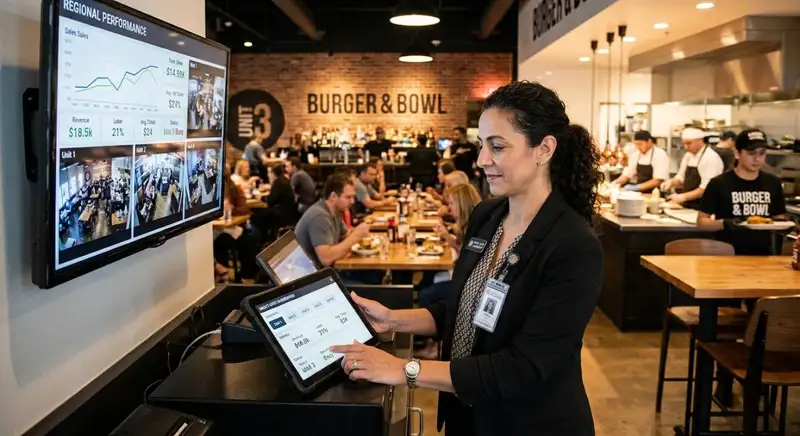
One important application is connecting information from different restaurant branches. When sales, inventory, workforce, and financial data are accessible through centralized systems, AI can help managers understand how individual locations perform compared with the wider business. This provides greater visibility into operational trends and makes it easier to identify areas that require attention.
AI also differs from traditional automation. Traditional automation follows predefined rules, such as sending an alert when inventory falls below a specific level. AI can analyze historical consumption, sales trends, and other relevant information to estimate when stock will run low and recommend appropriate purchasing quantities.
Common applications of AI in multi-unit restaurant management include -
1. Inventory forecasting - Predicting ingredient requirements and identifying potential stock shortages.
2. Workforce management - Analyzing customer demand and recommending appropriate employee schedules.
3. Sales forecasting - Estimating future revenue based on historical performance and demand patterns.
4. Operational monitoring - Identifying unusual activity, inconsistent performance, and potential inefficiencies.
5. Business analytics - Comparing location-level performance and generating insights to support management decisions.
By bringing these capabilities together, AI helps restaurant owners move from reactive management toward more proactive operations. Managers can identify potential problems earlier, understand what is happening across their branches, and make decisions based on more complete operational information.
Demand Forecasting and Smarter Inventory Control
How AI Predicts Demand for Each Branch
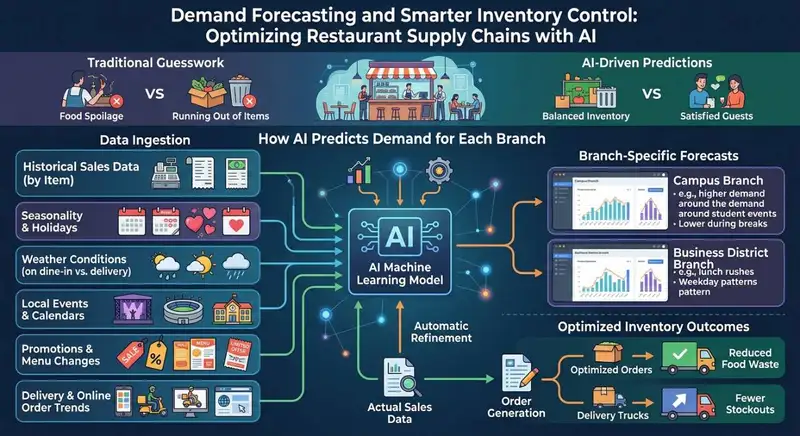
Traditional forecasting often relies on a manager's memory and a glance at last year's numbers. AI models go much deeper. They analyze historical sales at the item level, then layer in the factors that actually influence guest traffic -
1. Seasonality and day-of-week patterns, including how demand shifts around holidays and paydays
2. Weather conditions, since a rainy evening can boost delivery orders while hurting walk-in traffic
3. Local events, such as concerts, sports games, school schedules, or nearby road closures
4. Promotions and menu changes, and how they affected past sales
5. Delivery and online order trends, which often behave differently from dine-in demand
Because the model learns separately from each location's data, a branch near a university campus and one in a business district receive different forecasts, even if they share the same menu. As more data comes in, the predictions are refined automatically.
From Forecast to Accurate Ordering
A good forecast is only useful if it changes what gets ordered. AI connects the predicted sales mix to recipes and ingredient requirements, then calculates how much of each item every location will need. It compares that against current stock levels and supplier lead times to recommend order quantities.
This makes a noticeable difference in daily operations -
1. Less food waste. Ordering closer to actual need means fewer ingredients expire or get thrown away, which protects both margin and sustainability goals.
2. Fewer stockouts. Locations are less likely to run out of key ingredients on busy days, so guests get the full menu they expect.
3. Better prep planning. Kitchen teams can receive predicted prep quantities for the day, reducing both over-prepping and last-minute scrambling.
4. Lower cost of excess inventory. Less cash sits in storage, and there is less risk of spoilage in walk-in coolers.
Managing Inventory Across the Whole Group
For multi-unit operators, AI adds another layer of value - visibility across all branches at once. Rather than relying on individual managers to track their own counts, AI-enabled inventory systems can monitor usage patterns and compare actual consumption against what sales should have used. When a location's ingredient use doesn't match its sales, the system can flag possible causes such as over-portioning, waste, miscounts, or theft, so area managers know where to look.
AI can also support smarter group-level purchasing. By combining forecasted demand across locations, operators can consolidate orders, negotiate better pricing with suppliers, and even suggest transferring surplus stock from one branch to another instead of letting it go to waste. Many systems can automate routine reordering entirely, generating purchase orders for approval so managers spend less time with clipboards and spreadsheets.
Keeping Forecasts Reliable
Forecasting works best when the underlying data is clean. Accurate recipe costing, consistent inventory counts, and properly recorded waste all feed into better predictions. It also helps to treat forecasts as a starting point rather than a rule. Managers know things the data doesn't, such as an unannounced private party or a staff shortage, and the best systems allow them to adjust the numbers when needed.
Transform Your Restaurant Operations Now!
Effortless Inventory Tracking with Altametrics!
Intelligent Labor Scheduling and Workforce Management
Scheduling Based on Predicted Demand
The same forecasts that guide inventory ordering can drive staffing. Instead of copying last week's schedule or relying on a manager's instinct, AI estimates how busy each location will be hour by hour, then recommends how many people are needed in each role - servers, line cooks, hosts, dishwashers, and delivery packers.
This approach brings several practical benefits -
1. Better coverage at peak times. Staffing rises ahead of predicted rushes rather than in reaction to them.
2. Less overstaffing on slow shifts. Labor hours are trimmed where they aren't adding value, without cutting into service quality.
3. More accurate labor cost control. Operators can see projected labor percentage before the week begins, not after payroll is processed.
4. Faster adjustments. If a forecast changes because of weather or a local event, the schedule can be updated early rather than at the last minute.
Balancing Costs, Service Levels, and Employee Needs
A good schedule is more than a headcount calculation. AI scheduling tools can take multiple constraints into account at once, which is difficult to do manually across several locations. These typically include -
- Employee availability, time-off requests, and shift preferences
- Skill levels and role qualifications, so each shift has the right mix of experienced and newer team members
- Overtime thresholds and budget targets
- Legal and compliance requirements, such as required breaks, maximum hours, minimum rest between shifts, and rules for minors
Because the system checks these rules automatically, managers are less likely to create schedules that lead to compliance issues or unexpected overtime. Many platforms also let employees swap shifts, pick up open shifts, or submit availability through a mobile app, with AI suggesting suitable replacements and routing approvals. That reduces the endless texting and phone calls that often consume a manager's day.
Supporting Retention and Team Wellbeing
Turnover is a major cost in the restaurant industry, and scheduling is a frequent source of frustration. Unpredictable hours, back-to-back closing and opening shifts, and ignored availability all push people toward the exit. AI can help by spotting patterns that managers may not notice, such as an employee consistently working long stretches without a day off, frequent "clopening" shifts, or a location with unusually high shift changes and call-outs.
When these patterns are flagged early, managers can step in with adjustments before burnout turns into resignation. Fairer, more predictable schedules also help with morale, and a stable team generally delivers more consistent service.
Comparing Labor Efficiency Across Locations
At the group level, AI makes it easier to understand how labor performs across all branches. It can compare sales per labor hour, overtime trends, and productivity by daypart, then highlight outliers. If one location regularly runs higher labor costs than similar branches, the system can point to the specific shifts or roles where the gap appears. Area managers can then focus coaching and support where it will make the most difference, rather than reviewing every schedule line by line.
As with forecasting, AI scheduling works best as a recommendation engine rather than an autopilot. Local managers understand their teams, their regulars, and the unwritten realities of their restaurants, and their judgment should shape the final schedule.
Centralized Performance Monitoring and Anomaly Detection
One View Across Every Location
AI-powered platforms connect to the systems a restaurant group already uses and combine their data into a single, consistent view. Instead of opening five tools and a spreadsheet, an area manager or owner can see how every branch is performing against targets in one place, often in near real time.
A well-built central view typically brings together -
1. Sales and guest counts, broken down by daypart, channel, and menu category
2. Food cost and inventory variance, comparing actual usage to expected usage
3. Labor cost and productivity, including overtime and sales per labor hour
4. Delivery and online order performance, such as order accuracy and preparation times
5. Guest feedback and ratings, organized by location
Because the data is standardized, locations can be compared fairly with one another, and each branch can also be measured against its own history and goals.
Management by Exception
The real advantage of AI is not just showing more data, but deciding which data deserves attention. Traditional reports ask managers to scan rows of figures and notice what looks off. AI inverts that process. It learns what normal looks like for each location, taking into account the day of the week, the season, and typical patterns, and then alerts people when something deviates.
This is known as anomaly detection, and it allows leaders to manage by exception. Examples of what it can catch include -
- Food cost spikes at a single location that suggest over-portioning, waste, or receiving errors
- Unusual voids, refunds, or comps that could point to training gaps or possible employee misuse
- Discount patterns that don't match active promotions
- Sudden drops in sales or ticket size during a normally strong shift
- Rising ticket times or delivery delays that signal a bottleneck in the kitchen
- Labor overruns on specific shifts, such as a closing team that consistently stays past needed hours
- Inventory discrepancies, where ingredient use doesn't match what sales should have consumed
Instead of finding these issues weeks later in a monthly review, managers receive an alert while there is still time to respond.
Turning Alerts into Action
An alert is only helpful if it is clear and relevant. Good systems explain why something was flagged, show the supporting data, and, where possible, suggest likely causes or next steps. For instance, a flag for high food cost might point to specific ingredients with unusual variance, helping the manager decide whether to retrain on portioning, review supplier invoices, or audit counts.
Alerts can also be routed to the right person. A kitchen issue might go to the general manager, while a pattern of discount irregularities across several branches might go to an area director or finance lead. This keeps everyone focused on what they can actually influence and prevents notification overload.
Smarter Benchmarking and Coaching
Centralized data also makes benchmarking more meaningful. AI can group similar locations, such as those with comparable size, traffic, and format, and compare their results, rather than measuring a small suburban cafe against a high-volume downtown flagship. Underperforming branches can then be matched with the practices of stronger peers, and area managers can prioritize visits and coaching where they will have the greatest effect.
It is worth remembering that anomalies are signals, not verdicts. A spike in waste might come from a refrigeration failure, a supplier issue, or a one-time event, not poor management. The goal is to start informed conversations quickly, not to replace judgment with automated accusations.
Consistency in Quality, Compliance, and Customer Experience

Monitoring Food Quality and Preparation Standards
Computer vision and smart kitchen tools can help enforce standards that would otherwise depend on spot checks. Depending on the setup, these systems can -
1. Verify portion sizes and plating, comparing finished dishes against reference images or specifications
2. Track recipe adherence, using connected scales, timers, and digital recipe cards that guide cooks step by step
3. Monitor ticket times, showing how long orders wait at each station and where the bottlenecks form
4. Check order accuracy, especially for delivery and takeout, by confirming that each bag contains the right items before it leaves the restaurant
Over time, the data reveals patterns. If one location consistently over-portions a protein or lags on a particular dish, the issue can be addressed with targeted training rather than a broad, generic reminder. Consistent portioning also supports food cost control, linking quality directly to profitability.
Automating Food Safety and Compliance
Food safety and regulatory compliance are non-negotiable, but the paperwork behind them is time-consuming. AI-enabled tools can reduce that burden in several ways -
1. Digital checklists that are assigned automatically for opening, closing, cleaning, and prep tasks, with reminders and completion tracking
2. Connected temperature sensors that monitor refrigerators, freezers, and hot-holding equipment continuously and alert staff when readings drift out of safe ranges
3. Predictive maintenance alerts that spot unusual equipment behavior, such as a compressor working harder than normal, before it fails and spoils inventory
4. Automated record-keeping, so logs for temperatures, cleaning, and supplier deliveries are organized and ready for inspections or audits
5. Allergen and labeling controls, helping ensure that menu information stays accurate across locations when recipes or suppliers change
For multi-unit groups, the benefit is visibility. Instead of discovering missed tasks during an inspection, operators can see completion rates by location and step in early where compliance is slipping.
Understanding Guests Across Every Branch
Customer feedback arrives from many directions - online reviews, delivery app ratings, survey responses, social media comments, and direct messages. Reading it all manually is unrealistic, particularly across many locations. Natural language processing can analyze this feedback automatically, sorting it by theme and sentiment.
This allows operators to answer questions that are otherwise difficult to see clearly -
- Which locations receive the most comments about slow service or cold food?
- Are complaints about a specific dish concentrated in one branch or spread across the group?
- Which team members or shifts are mentioned most often in positive reviews?
- How has sentiment changed since a menu update or a new staffing model?
The analysis highlights both recurring group-wide issues and problems unique to a single location, so the response can be matched to the cause. AI can also draft suggested replies to reviews, which managers can personalize and approve, helping them respond promptly without spending hours writing.
Balancing Standards with Local Character
Consistency does not mean every restaurant should feel identical. Guests often value a location's local personality, and managers need room to serve their own communities. The goal of AI-supported standardization is to protect the fundamentals, such as food safety, recipe quality, and service speed, while leaving space for local touches in atmosphere, community involvement, and hospitality.
It is also worth being thoughtful about how monitoring tools are introduced. Cameras, sensors, and performance tracking can feel intrusive if teams don't understand their purpose. Positioning them as tools to support training, reduce paperwork, and recognize good work, rather than simply to police staff, leads to better adoption and morale.
With quality and guest experience tracked more closely, operators can turn their attention to the menu itself and ask how AI can help improve what is offered, how it is priced, and how it is marketed to each location's customers.
Discover Opportunities and Maximize Earnings!
Unlock Your Kitchen's Full Potential with Altametrcics
Menu Optimization, Pricing, and Personalization
Understanding Item-Level Profitability and Sales Mix
Traditional menu analysis often stops at which items sell the most. AI looks at how each item contributes to the business as a whole. By combining sales data with recipe costs, preparation time, and ingredient availability, it can show -
1. True contribution margin for each dish, not just its price or popularity
2. Items that sell well but earn little, which may need repricing, recipe adjustments, or smaller portions
3. High-margin items that are underpromoted, which may deserve better menu placement or server recommendations
4. Menu complexity costs, such as dishes that require unique ingredients, slow down the line, or generate disproportionate waste
5. Item pairings, showing which dishes, sides, and drinks guests commonly order together
Because the analysis can be run for each location and each channel, operators can see that a dish performing well in dine-in may underperform in delivery, or that a signature item is popular in one city but ignored in another.
Smarter Menu Decisions
With this visibility, AI can recommend practical changes - removing consistently low-performing items, simplifying ingredient lists to reduce waste, highlighting profitable dishes, or testing new items in a few locations before a wider rollout. When ingredient prices rise or a supplier becomes unreliable, the system can estimate the impact on dish costs and suggest substitutions or adjustments before margins erode.
Testing is especially valuable for multi-unit groups. A new dish, bundle, or limited-time offer can be introduced at selected branches, with AI comparing results against similar locations to separate real impact from normal fluctuation. Operators learn what works before committing the entire group.
Location-Specific and Dynamic Pricing
Pricing is another area where one-size-fits-all rarely fits. Rent, local wages, competition, and customer spending power differ from branch to branch. AI can analyze price sensitivity, meaning how demand changes when prices move, and recommend pricing that reflects local conditions while staying consistent with the brand.
Some operators also explore dynamic approaches, such as adjusting prices or promotions by daypart to encourage traffic during slow periods, or setting delivery menu prices to account for third-party platform fees. These strategies should be used carefully. Guests value fairness and transparency, and prices that fluctuate too aggressively can damage trust. The best use of AI here is typically to inform thoughtful, predictable pricing decisions rather than to change prices constantly.
Personalization and Targeted Marketing
When guests order through apps, loyalty programs, or online platforms, they leave a trail of preferences. AI can use this information, with proper consent, to deliver more relevant experiences -
1. Personalized offers based on a guest's favorite items, visit frequency, or typical order size
2. Smart upselling suggestions in online ordering, kiosks, and apps, such as recommending a drink or dessert that pairs well with the main course
3. Win-back campaigns for guests who haven't visited in a while
4. Segmented loyalty rewards that reflect how different groups of guests actually behave
5. Location-aware promotions, such as lunch deals for a branch near offices and family bundles for one in a residential area
Rather than sending the same message to the entire customer base, marketing can be matched to each branch's audience, improving response rates and avoiding wasted discounts on guests who would have visited anyway.
As with other applications of AI, human judgment remains essential. Data can show what sells, but it cannot fully capture a brand's identity, a chef's creativity, or the cultural role a dish plays for a community. Menu decisions should balance numbers with taste, brand positioning, and guest feedback. Personalization also depends on trust, so operators should be transparent about how guest data is used and comply with applicable privacy regulations.
Building a More Efficient Multi-Unit Restaurant Business With AI
From inventory forecasting and workforce scheduling to operational monitoring and business analytics, AI offers several ways to improve efficiency across restaurant branches. Restaurant owners can use these technologies to anticipate ingredient demand, control labor expenses, identify operational inconsistencies, and compare location-level performance. Centralized data analysis also makes it easier to understand business trends and identify problems that require attention.
However, successful AI adoption depends on more than choosing new technology. Restaurant operators must ensure their existing systems can share accurate information, establish consistent processes across locations, and provide employees with the training needed to use AI effectively. Human oversight also remains important because AI recommendations should support, rather than replace, informed management decisions.
For restaurant owners considering AI adoption, the best starting point is identifying operational challenges that consume the most time or create unnecessary expenses. Improving inventory accuracy, optimizing employee schedules, or consolidating branch performance reports can provide practical starting points for introducing AI.
Cut Down Prep Time and Boost Accuracy
Automate Your Kitchen with Altametrics!
Frequently
Asked Questions
How can AI improve consistency across restaurant locations?
How does AI help restaurant owners make better business decisions?
How does AI improve restaurant employee scheduling?
How does AI help restaurant managers monitor branch performance?
Must-Read Content

Restaurant ERP Explained - What It Is, How It Works, and Its Benefits
Restaurant ERP connects essential operations, improves cost control, centralizes business information, streamlines workflows, and helps owners make informed management decisions.
How Restaurant Automation Can Streamline Daily Operations
Restaurant automation streamlines daily operations by reducing manual tasks, improving workforce management, controlling inventory, minimizing errors, and increasing overall efficiency.
Smart Ways to Use AI in Your Restaurant
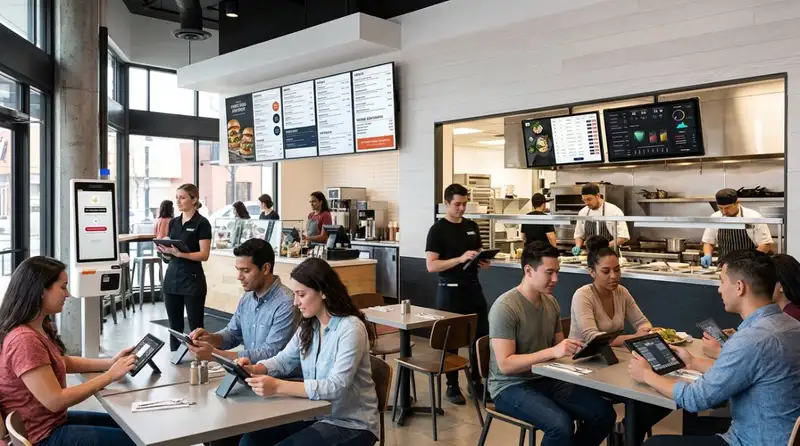
Discover smart ways to use AI in your restaurant to optimize operations, reduce costs, improve customer experiences, and increase profitability.