




What is a food safety auditor?
For something as essential and vital as food, the safety of which is becoming a serious concern, Food Safety Auditors sound nothing short of a magician someone who would ensure that the food we are consuming is good for our gut, the food supply chain system has been properly vetted, and safety programs have been run.
Certified Food Safety Auditors are professionals who have spent hours and months studying and understanding the standards and principles of auditing a Food Safety and HACCP-based (or process-safety) system. A food safety auditor could be assigned the task to check food safety and quality in a manufacturing unit, and they could also be given the charge to ensure that hygienic and healthy practices are followed on a farm.
In short, equipped with extensive knowledge and with the use of various tools and techniques, a food safety auditor examines, questions evaluates, and reports on whether a food system is healthy and hygienic or not.
They analyze all elements of the system, follow the current food safety regulations, take into account the latest news, and the guidelines set forth by the FDA (Food and Drug Administration) and report on how well a system adheres to those guidelines. The final goal of an auditor is to ensure that a facility is complying with all the industry regulations.
How do you become a food safety auditor?
For instance, the National Environmental Health Association (NEHA) offers CFSSA (Certified in Food Safety Supplier Audits), for which a Bachelor's Degree is required, along with three years of experience in the industry. Applicants are also required to be aware of the HAACP principles. Another credential offered by NEHA, RFSA (Registered Food Safety Auditor) that certifies food safety auditors to conduct third-party audits, can only be applied after procuring a CFSSA credential (all rights reserved).
You’ve been a food safety auditor for a while, but you are still not sure what the next step is.
You know that once you become an auditor, it will be a lot of work. What are your other options?
The 7 steps of becoming a food safety auditor
To become an auditor, one must also have food safety and quality training in the defined segment of the industry one wishes to work in. Training ensures that one identifies the differences in different departments of the food industry. For instance, there are alterations, sometimes very fine, in the food safety regulations followed in the poultry industry as compared to the farming industry.
The Safe Quality Food Institute's (SQFI) SQF Code -- a third-party site-specific, process and product certification standard with an emphasis on the systematic application of CODEX Alimentarius Commission HACCP principles and guidelines for control of food safety and food quality hazards -- for instance, insists that applicants should successfully complete the SQF Auditing SQF Systems (4 day duration) course. One must take into consideration that for a food safety auditor, training courses are a life-long norm with constant improvements and advancements in the food industry.
Broadly, however, the requirements to procure a Food Safety Auditor's certification could be broken down into seven distinctive points as discussed below.
1. Understand the definition of food safety
Liberally, Food Safety refers to handling, preparing and storing food in a way to best reduce the risk of foodborne illnesses in people consuming that food. Food Safety, in fact, is a global concern that aims to prevent food from becoming contaminated.
The number of potential food hazards in a food industry is numerous. Many of these can have serious consequences. Food Safety principles are applied to achieve the following-
- It protects consumers from health risks caused due to contaminated food.
- Following Food Safety principles ensures compliance with federal, provincial and municipal laws and bylaws.
- It ensures the food production environment is clean and hygienic.
- Ensures the storing, chilling and heating food is done correctly with regards to temperature, environment and equipment.
2. Understand the different types of food safety hazards
Briefly, here's what each of these hazards could mean-
Biological Hazards
Biological hazards refer to contamination of food by microorganisms found in the air, food, water, animals, and in the human body -- namely bacteria, viruses, and other parasites. These microorganisms may not always be threatening; many are also good for the human gut and anatomy. But when hazardous or pathogenic organisms are introduced to food, they pose a food safety concern to consumers. Biological hazards can be introduced to food from the environment (for instance, soil bacteria, agricultural run-off, etc). It could also be caused because of unhygienic practices, poor sanitation, cross-contamination during transportation, handling, processing, and storage.
Chemical hazards
Food can be contaminated with various types of chemicals, including but not limited to mycotoxins, natural toxins, marine Toxins, environmental contaminants, food additives, processing-induced chemicals, pesticides/agricultural products, and veterinary drugs residues. Chemical hazards could be caused because of water, food contact materials, cleaning agents, pest control substances, pesticides, biocides, food additives, and contaminants (environmental, agricultural, and other processes). For instance, environmental contaminants are chemicals that accidentally or deliberately enter the environment, often, but not always, as a result of human activities.
Physical or Extraneous Material hazards
Physical or Extraneous material includes all materials (excluding bacteria and their by-products (toxins), viruses, and parasites) which may be found in food that is foreign to that particular food. Usually non-toxic, these materials hamper the quality of food because they are often a result of unsanitary conditions of production, processing, handling, storage, and distribution of food. Some common examples of extraneous materials are insects, hair, metal fragments, pieces of plastic, wood chips, pest droppings, screws, and glass.
Allergens
Allergens are proteins that are capable of producing an abnormal immune response in sensitive persons. Allergic reactions to food can cause a skin rash or itching, migraine, and anaphylactic shock. At times, the severity of such reactions can even lead to death. The severity of an allergic response (not to be confused with a food intolerance) is determined by many factors, including dosage, route of administration, frequency of exposure, and genetic factors.
Congress passed the Food Allergen Labeling and Consumer Protection Act of 2004 (FALCPA), which identified eight foods as major food allergens- milk, eggs, fish, shellfish, tree nuts, peanuts, wheat, and soybeans. On April 23, 2021, the Food Allergy Safety, Treatment, Education, and Research (FASTER) Act was signed into law (effective from Jan 1, 2023), declaring sesame as the 9th major food allergen recognized by the United States. As per the law, food labels should identify the food source of all major food allergens used to make the food.
Food safety is a concern for everyone.
The job of being a food safety auditor can be difficult and tedious.
3. Learn how to identify and calculate food processing temperatures
Understanding the role temperature plays in food preservation and ensuring the safety of food is an elaborative subject. In fact, food systems thrive when they understand the role and importance of temperature management. For instance, food systems use high temperatures to preserve and ensure the safety of food. It is based on the effect of microbial destruction.
Thermal processing is one of the most widely used unit operations used in the food industry. The basic purpose for the thermal processing of foods is to reduce or destroy microbial activity, reduce or destroy enzyme activity, and produce physical or chemical changes to make the food meet a certain quality standard. It is also determined as a Critical Control Point (CCP). The two main temperature categories employed in thermal processing are Pasteurization and Sterilization.
It is also important to note that many pathogenic organisms are present in raw or undercooked meat, poultry, seafood, milk, eggs, and fruits and vegetables. Keeping them chilled slows the growth of bacteria reducing the risk of foodborne illness.
L. Huang, C-A. Hwang, in his research paper, Advances in Meat, Poultry and Seafood Packaging, 2012, writes about Ready-to-eat (RTE) foods. These food products are pre-cleaned, precooked, mostly packaged and ready for consumption without prior preparation or cooking. According to the 2009 United States Food code (FDA, 2009), RTE foods should be in an edible form without an additional preparation step to achieve food safety.
Foods in this category usually contain raw materials of animal origin, such as eggs, fish, meat, poultry and ratites, and must be cooked to allow the lowest internal temperature to reach a minimum temperature, for a minimum holding time, during manufacturing to destroy microorganisms of public health concern. In an industrial setting, the cooking step is achieved by thermal processing using steam, hot water, microwave, or infrared.
When auditing a food enterprise, food auditors need to be aware of all the distinctive rules of managing temperature and the effects it could have on a food item.
4. Become familiar with the terms used in HACCP systems

As per the US Food and Drug Administration (FDA), here's a list of terms that is important to understand as well as implement wherever needed for food auditors or anyone in the position of ensuring food safety.
- CCP Decision Tree- A sequence of questions to assist in determining whether a control point is a Critical Control Point (CCP).
- Control- (a) To manage the conditions of an operation to maintain compliance with established criteria. (b) The state where correct procedures are being followed and criteria are being met.
- Control Measure- Any action or activity that can be used to prevent, eliminate or reduce a significant hazard.
- Control Point- Any step at which biological, chemical, or physical factors can be controlled.
- Corrective Action- Procedures followed when a deviation occurs.
- Criterion- A requirement on which a judgment or decision can be based.
- Critical Control Point- A step at which control can be applied and is essential to prevent or eliminate a food safety hazard or reduce it to an acceptable level.
- Critical Limit- A maximum and/or minimum value to which a biological, chemical or physical parameter must be controlled at a CCP to prevent, eliminate or reduce to an acceptable level the occurrence of a food safety hazard.
- Deviation- Failure to meet a critical limit.
- Hazard- A biological, chemical, or physical agent that is reasonably likely to cause illness or injury in the absence of its control.
- Hazard Analysis- The process of collecting and evaluating information on hazards associated with the food under consideration to decide which are significant and must be addressed in the HACCP plan.
5. Learn how to inspect, evaluate, ensure food safety standards
HACCP is designed for use in all segments of the food industry from growing, harvesting, processing, manufacturing, distributing, and merchandising to preparing food for consumption. Food Safety systems based on the HACCP principles have been successfully applied in food processing plants, retail food stores, and food service operations.
6. Know why you should become certified as a food safety auditor
The audit experience, SQF describes, must follow the following criteria- "For each food sector category that is requested for registration, the applicant shall demonstrate a minimum of two (2) years work experience in food safety and/or quality management within the requested FSC, or one hundred-sixty (160) audit hours within the requested FSC, or a combination of work experience and audit experience for each FSC requested."
7. Become certified as a Food Safety Auditor
To become a food safety auditor, you have to be driven and passionate. One needs to tag along with already established food auditors as interns, trainees, assistants, etc, to finally gain enough experience to apply for their own certificate. As per the SQF, anyone applying to become a certified Food Safety Auditor, should have the following documentation ready before starting the application process-
- HACCP training certificate
- Lead auditor training certificate
- Auditing SQF Systems training certificate
- Work experience log
- Audit log
- Education records
- Professional development training records
- Sponsor verification form
You’re not sure where to start.
You don’t know what to do or how to do it.
Frequently
Asked Questions
What makes a good food safety auditor?
What is required to become a food safety auditor?
Do auditors make good money?
How do I become a food safety auditor in India?
What is required to become a food safety auditor?
Do auditors make good money?
Must-Read Content

The Ultimate Guide to Managing Food Allergens in Restaurants
Food allergens require accurate labeling, employee training, cross-contact prevention, safe food handling, and consistent procedures to protect customers and improve restaurant safety.
The Most Common Restaurant Health Code Violations
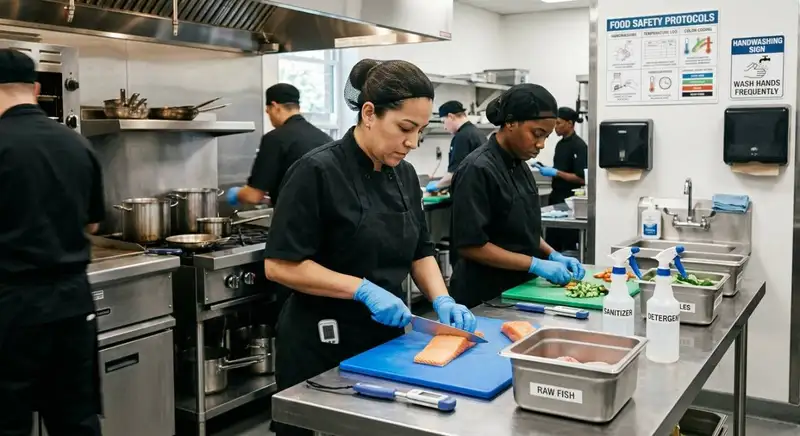
Identify health code violations across major restaurant operations and learn how consistent inspections, training, sanitation, and documentation can reduce risks.
The Complete Guide to OSHA Regulations for Restaurants
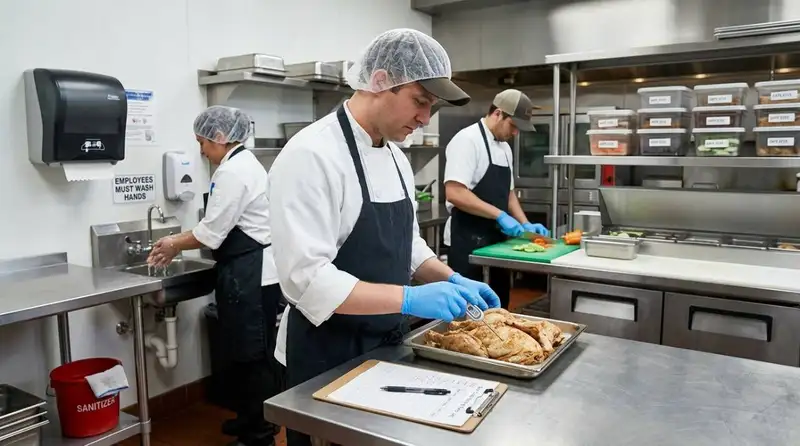
This guide explains essential OSHA regulations for restaurants, covering safety hazards, training, hazard communication, PPE, and recordkeeping requirements for owners.

