What is tip management software?
Tip management software automates how restaurants track, calculate, and distribute tips. It pulls tip totals from the POS and hours from timekeeping, applies tip pool or tip-out rules, generates audit trails, improves transparency for employees, and creates payroll-ready reports.
Tip Management Basics for Restaurant Owners

Overview
In restaurants, "fair" doesn't always mean "everyone gets the same amount." Most tip conflict starts because different people define fairness differently. One person thinks fairness means splitting evenly because "we're all a team." Another person thinks fairness means pay should match the difficulty of the section, the pace of the shift, or the amount of guest interaction. Both views are understandable - and if you don't define what fairness means in your restaurant, your team will define it for you (and they won't all agree).
A practical definition of fair tips is - a consistent method that rewards real contribution, is easy to follow, and is applied the same way every shift. Consistency matters as much as the formula. A "perfect" system that changes depending on who's managing will feel unfair fast.
Here are the most common reasons teams argue about tips -
1. Shift imbalance - Friday night servers feel they "carry" the week, while slower shifts feel punished.
2. Side work and closing duties - People who roll silverware, clean, stock, and close feel like they do more than those who leave early.
3. Role differences - Servers often feel tips are "earned at the table,"while support staff feel they enable service speed and quality.
4. Section assignments - Better sections can mean higher tips, which can feel like favoritism if assignments aren't rotated.
5. Cash vs. card tips - If cash tips aren't tracked consistently, it creates suspicion - even if nobody is doing anything wrong.
Your goal as an owner isn't to create a system everyone loves every shift. It's to create a system your team sees as predictable, explainable, and not biased. When employees can look at the rules and say, "I may not love my cut tonight, but I understand how we got there," you're already winning.
Know Your Tip Types

Before you can distribute tips fairly, you need to be clear on what money is actually being treated as a tip in your restaurant. Most "tip drama" starts with confusion at this level - especially when you have a mix of cash, credit card tips, auto-gratuity, and fees that guests think are tips. Tip management gets much easier when you define categories and handle each one consistently.
Start with the two big buckets -
1) Cash tips - Cash tips are the hardest to control because they can be collected and pocketed instantly. That doesn't mean you should treat cash tips as "untrackable." A fair tip system usually includes a simple expectation- cash tips are declared at the end of the shift and included in the same distribution rules as card tips (if you pool). If you don't pool, you still need a clear rule for reporting cash tips for payroll/tax purposes. The key is consistency - same process, every shift.
2) Credit card tips - Card tips are easier because the POS records them. But they introduce a different fairness issue - timing. If one shift gets paid out nightly and another waits until payroll, people will perceive that as unfair even if the totals are correct. You should decide how card tips are handled - end of shift, daily, or through payroll - then document it.
Next, understand the categories that create confusion
Auto-gratuity - A set percentage added to a guest check (often for large parties). Guests usually view it like a tip, but your policy must define how it's distributed.
Service charges / fees - These might be labeled as service fee, delivery fee, kitchen fee, wellness fee, etc. Guests often assume the staff receives it. If your restaurant charges fees, you need to be very clear internally - and ideally externally - about what is and isn't distributed to employees.
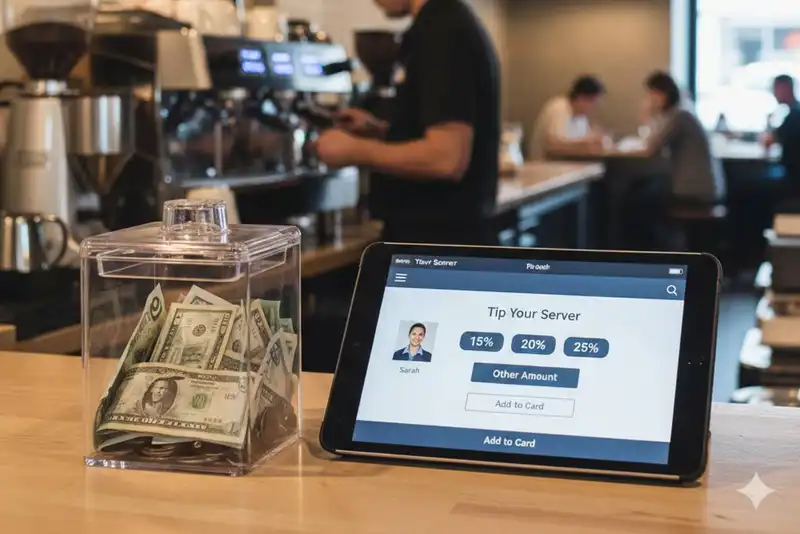
Finally, consider how tip prompts affect fairness. Counter service, kiosks, and QR ordering can generate tips that are more "team-based" than "server-based." In those setups, pooling often feels more natural because multiple roles contribute to the guest experience.
Choose a Tip Distribution Model
There isn't one "best" way to distribute tips - there's a best way for your service style, staffing setup, and guest experience. The fastest way to create conflict is to copy a tip model from another restaurant without matching it to how work actually happens in your dining room. Tip management should reflect who touches the guest experience, how much the team shares workload, and how consistent your shift structure is.
Here are the most common models restaurant owners use -
1) Direct tips - This is the classic full-service setup- servers keep the tips they receive, usually from their assigned tables. It can feel fair because the link between effort and earnings is clear. The downside is that it can create "section politics" (everyone wants the best tables) and can undervalue support roles who improve service speed and guest satisfaction but don't directly collect tips.
2) Tip-out model - In this setup, servers keep their tips but tip out bussers, runners, bar, or other support staff using a rule (like a percentage of tips or sales). This can work well when servers clearly benefit from support roles and you want to reward teamwork without fully pooling. The risk is confusion- if tip-out rules are vague or inconsistent, it becomes a daily argument.
3) Tip pooling - Tip pooling collects tips into a shared pool and distributes them using a formula (hours, points, role weights, etc.). Pools often feel more fair in restaurants where teamwork is high - shared sections, food runners, counter service, or frequent shift swaps. Pooling can also reduce "luck of the draw" differences between sections. The challenge is that pooling requires solid rules and tracking. If employees don't understand the math, they may assume it's unfair.
How to choose the right model
A simple way to decide is to ask - Is the guest experience primarily owned by one person, or by a team?
- If it's mostly one server per table and sections are stable, direct tips + structured tip-out often fits.
- If service is shared and roles overlap heavily, pooling usually matches reality better.
- If you're counter service, kiosk, or fast casual, pooling often feels natural because tips are earned collectively.
Whatever model you choose, fairness comes from alignment - the tip system should match how work is actually done. If it doesn't, employees will feel the system is "rigged," even when your intentions are good.
The Most Common Fair-Split Formulas
Once you've chosen a tip distribution model, the next step in tip management is picking the math. The fairest formula is the one that matches contribution and is simple enough to run every shift without confusion. If it takes 30 minutes of manual calculating - or only one manager understands it - you'll end up with mistakes, delays, and distrust.
Here are the most common fair-split formulas restaurant owners use -
1) Hours-worked split - This is the easiest pool formula - add all tips together, then divide by total hours worked by eligible employees.
Example - $600 in tips / 60 total eligible hours = $10 per hour.
If an employee worked 6 hours, they get $60.
Best for - counter service, smaller teams, consistent roles.
Watch out for - roles with very different responsibilities (a weighted system may feel fairer).
2) Points-based split by role - Assign points per hour by position based on responsibility and guest impact.
Example points - Server = 1.0, Bartender = 1.0, Runner = 0.8, Busser = 0.7, Host = 0.5.
Multiply hours by points to get weighted hours, then divide tip pool by total weighted hours.
Best for - full-service teams where multiple roles contribute.
3) Tip-out as a percentage of tips - Servers keep their tips but tip out support based on the tips they received.
Example - Server tips = $200; tip-out rule = 20% total (10% bar + 10% support).
Server keeps $160 and tips out $40.
Best for - traditional server-driven models.
Watch out for - servers feeling punished if tip-outs don't reflect actual support.
4) Tip-out as a percentage of sales - Tip-out is based on sales instead of tip totals, which makes support staff earnings more stable.
Example - 2% of food sales to bussers + 1% of alcohol sales to bar.
Best for - restaurants where tip percentages vary by shift.
5) Hybrid approach - Many restaurants use a blend - a pooled bucket for certain tips + a tip-out for specific roles, or pooling within FOH but separate bar rules. Hybrids can be fair - just document them clearly.
No matter what you choose, the biggest fairness factor isn't the formula - it's consistency and clarity. If employees can predict their payout and understand the "why," your tip management system will feel fair even on imperfect nights.
Set Clear Rules
Even the best tip formula will fail if your rules are fuzzy. Tip management breaks down in the "edge cases" - the situations that happen constantly in real restaurants- someone gets cut early, someone comes in late, a trainee shadows a shift, or a closer spends an extra hour doing side work. If you don't define how these situations affect tip shares, your managers will make judgment calls on the fly, and your team will assume favoritism.
Start with eligibility. Decide exactly who participates in tips (or the tip pool), and write it down by job role. Don't rely on "everyone knows" because teams change and expectations drift. Also define whether certain roles are eligible only when they're scheduled into that role (example - a host who runs food for two hours - are they earning host points or runner points during that time?).
Next, define rules for side work and closing duties. This is one of the biggest fairness triggers. If closers stock, sweep, reset, and handle end-of-night tasks, they'll feel resentful if they earn the same tip share as someone who leaves at 8.30. You have a few options -
- Pay tips strictly by hours (so closers naturally earn more because they work longer).
- Use a points-based system where closing duties have a higher weight.
- Add a small "closing premium" rule (example - an extra half-point for the last hour) if it fits your operations and stays compliant.
Then cover breaks. Decide whether you calculate tip share based on paid hours, clocked-in time, or working time excluding breaks. Whichever you choose, apply it consistently. The key is to align your tip policy with your timekeeping records so you're not doing manual adjustments that create mistakes.
Finally, address shift changes and partial shifts -
1. Late arrivals - Do they join the pool immediately, or after a minimum time worked?
2. Early cuts - Do they keep earning tips until clock-out, or until they are cut from the floor?
3. Shift swaps - How do you handle section handoffs so the first half and second half of a table don't create conflict?
4. Training shifts - Are trainees included in the pool? If yes, at what rate (full points, reduced points, or excluded)?
A "fair tips every shift" system doesn't depend on everyone being in a good mood. It depends on rules that remove judgment calls. When your tip management policy answers these common scenarios upfront, you reduce arguments, protect managers, and make payouts feel trustworthy.

Transform The Way You Manage Tips!
Manage and Distribute Tips Seamlessly with Altametrics
Build the Tip Management Process
A fair tip system isn't just a formula - it's a repeatable process. If your tip management process changes based on who closes, you'll eventually see missing money, incorrect payouts, or complaints that are hard to prove or disprove. The goal is a simple "(1) shift close (2) calculate (3) document (4) pay" workflow that anyone trained can follow.
Here's a practical step-by-step process you can run every shift -
Step 1. Close out sales and lock the numbers
At shift close, make sure the POS totals are finalized - sales, tip totals, comps, voids, discounts, and refunds. Tip distribution should be based on confirmed numbers, not mid-close estimates. If you allow post-close edits, define who can do them and how they're documented.
Step 2. Confirm tip totals by type
Separate tips into clear categories -
- Credit card tips (from the POS report)
- Cash tips (declared amount, if you pool or track them)
- Auto-gratuity (if applicable and treated as tip income in your policy)
This is also where you decide whether any fees or service charges are part of tip distribution (only if your policy says so). Don't mix categories without defining it - nothing creates mistrust faster than unclear totals.
Step 3. Confirm eligible employees and hours/points
Pull a list of eligible staff for that shift and the correct time data -
- Hours worked (from timeclock)
- Role points/weights (if you use a points-based pool)
- Any role changes during shift (example. host - runner for two hours)
The key is accuracy. If the hours are wrong, the tip split will be wrong - even if your formula is perfect.
Step 4. Run the tip distribution calculation
Use your chosen method (hours, points, % tip-out, % of sales, or hybrid). Keep it consistent. If there's any manual adjustment, document why.
Step 5. Document the distribution (your audit trail)
Save a simple record every shift -
- Total tips by type
- Employee list + hours/points
- Final tip payout amounts
- Manager approval (signature or digital approval)
- Any exception notes (example. "John left early due to illness - clock-out 8.10pm")
Step 6. Pay out tips using a defined schedule
Choose a payout cadence and stick to it -
- End-of-shift payouts (fast, but requires strong controls)
- Daily payouts
- Payroll payouts (clean accounting, but slower for staff)
A clean tip management process prevents "he said/she said" disputes because the numbers are visible, repeatable, and backed by documentation. When your team knows there's a system - and the system doesn't change - fairness becomes the default.
Stay Compliant
A tip system can feel fair and still create legal risk if it's not structured correctly. Tip management isn't just an operations issue - it's also a compliance issue, and the stakes can be high because tips intersect with wages, payroll records, and who is allowed to participate. You don't need to be a lawyer to run this well, but you do need a few non-negotiable guardrails.
First, treat tips as employee money. In most cases, tips are considered the property of employees, not the restaurant. Your job is to track and distribute them according to a clear policy and applicable laws. That means you should never "borrow" from tips to cover shortages, mistakes, broken dishes, or walkouts unless you have a legally compliant process (and even then, it's often a red flag).
Second, be careful about who can be in a tip pool. One of the biggest compliance pitfalls is including ineligible roles. In many jurisdictions, owners, managers, and supervisors should not participate in tip pools. Even when a manager helps on the floor, tip participation can create legal exposure. Build your policy so it's unambiguous - management is excluded, period. That clarity also reduces team resentment.
Third, understand tip credit rules (if they apply where you operate).bSome states allow a "tip credit" toward minimum wage, while others restrict or prohibit it. If you take a tip credit, you must follow the rules tightly - especially around wage floors, notice requirements, and recordkeeping. If you don't take a tip credit, you still need to ensure employees are paid at least the required minimum wage and that tips are tracked properly.
Fourth, decide how you handle credit card processing fees (and document it). Some restaurants reduce card tips by a small amount to cover processing costs. In some places this is allowed with restrictions; in others it can be regulated or risky. The operational takeaway- if you do it, be transparent, apply it consistently, and keep it within legal limits for your jurisdiction.
Fifth, keep clean records. Tip management should produce a clear audit trail - total tips, distribution method, hours/points used, payout amounts, and when tips were paid. This protects you in payroll questions, employee disputes, and any audit scenario.
If you want a simple rule of thumb - fair tips require transparent math; compliant tips require documented math. When your process is consistent and your documentation is solid, you protect the business and build trust with the team at the same time.
Use Tip Management Software
Manual tip calculations work - until they don't. One missed clock-out, one role change that didn't get recorded, or one spreadsheet formula that breaks can turn fair tips into a headache fast. Tip management software helps because it does two things owners care about - it reduces human error and it creates transparency. When the numbers are pulled automatically from the POS and timekeeping system, and the rules are applied the same way every shift, tip payouts become more consistent - and complaints are easier to resolve with facts.
Here are the most important features to look for in tip management software -
1) Flexible rule setup - You should be able to build your policy inside the system - pools, tip-outs, points by role, hours-based splits, hybrids, and exceptions like training shifts. If you can't match the software to your real operation, it will create workarounds - and workarounds create errors.
2) POS + timeclock integrations - This is huge. The software should pull -
- Credit card tip totals and sales reports from the POS
- Hours worked and job roles from timekeeping
The more data is automated, the less manual entry you rely on (and the fewer arguments you'll have about what's correct).
3) Role-based weighting and job code support - If you run a points-based pool or different tip-out rates by role, the software needs strong job code logic. Bonus points if it supports mid-shift role changes (host - runner) without messy edits.
4) Audit trail and edit controls - Look for logs that show who changed what, when, and why. You want manager permissions, approvals, and locked periods once tips are finalized. This protects you from both honest mistakes and intentional tampering.
5) Employee-facing transparency - Trust goes up when employees can see a clear breakdown- tips collected, hours/points counted, and final payout. The best systems let staff view tip summaries without exposing sensitive data.
6) Payroll-ready exports and reporting - Tip management doesn't end at payout. You need clean exports for payroll, reporting by daypart/location, and records you can keep for compliance.
7) Payout options that match your process - Some restaurants want end-of-shift payouts, others prefer daily or payroll payouts. Make sure the software supports your payout cadence with controls (like approval steps) so cash flow and oversight stay clean.
Tip management software won't fix a broken policy - but it will help a good policy run smoothly. When the system is automated, documented, and transparent, "fair tips every shift"p0-p becomes something you can deliver consistently instead of something you're constantly defending.

Employee scheduling
Human Resource Management for Restaurants

Employee scheduling
Common Payroll Challenges in Restaurants

Sales forecasting
How to Use Restaurant Analytics to Improve Profitability

Restaurant management
The Complete Guide to Restaurant Reputation Management

Accounting payroll
Restaurant Cash Handling Procedures


Accounting payroll
How to Manage Restaurant Finances

Employee scheduling
How to Motivate Restaurant Staff

Software integration
10 Ways Technology Can Help Control Food Cost in Restaurants

Frequently Asked Questions
Should I use tip pooling or tip-outs?
Tip pooling fits team-based service (shared workload, runners, counter service). Tip-outs fit server-owned sections where support roles assist but servers still "own" tips.
How do I choose the best tip split formula?
Pick a formula that matches how your team works and is easy to run daily. Hours-based is simplest; points-based is often fairer when roles differ.
How do I handle cash tips fairly?
Set a clear rule - cash tips are declared at shift end and included in the same distribution method as card tips (if you pool). Consistency prevents distrust.
What should my tip policy include in writing?
Eligibility, distribution model (pool/tip-out), formula, how hours/points are calculated, handling of breaks/shift changes, payout timing, and dispute steps.