What causes par levels to become inaccurate?
Par levels often become inaccurate when restaurants do not update them after menu changes, seasonal demand shifts, vendor delays, or sales increases and decreases.
Guide to Restaurant Par Levels and Reordering

Par Levels as a Daily Control Tool
Par levels are not just inventory targets. They are one of the most practical control tools a restaurant has to keep operations stable day to day.
In a typical restaurant, demand changes constantly. One shift runs heavier than expected. A delivery arrives late. A prep item gets overused. Without clear par levels, teams are forced to react in real time - placing emergency orders, 86'ing menu items, or over-prepping "just in case." All of these decisions create cost, stress, and inconsistency.
Par levels solve this by giving operators a clear answer to a simple but critical question - How much of each item should we have on hand to run the business without interruption?
When par levels are set correctly, several things improve immediately -
1. Fewer Stockouts - Running out of key ingredients leads directly to lost sales and frustrated guests. Par levels help ensure core items are always available, especially during peak periods.
2. Reduced Overordering and Waste - Without a target, managers often overorder to avoid running out. This ties up cash and increases spoilage. Par levels create a ceiling that keeps ordering disciplined and aligned with actual usage.
3. More Consistent Prep and Execution - Kitchen teams rely on predictable inventory levels. When pars are stable, prep lists become more accurate, and teams spend less time adjusting on the fly.
4. Stronger Cost Control - Inventory is one of the largest expenses in a restaurant. Even small overages across multiple items add up quickly. Par levels help limit excess inventory and improve food cost performance.
5. Less Operational Stress - When managers are constantly reacting to inventory gaps, it pulls focus away from service, labor management, and guest experience. Par levels reduce last-minute decision-making and create a more controlled environment.
Restaurants that do not use structured par levels are operating reactively. Restaurants that do use them are operating with intention.
Understanding Restaurant Par Levels
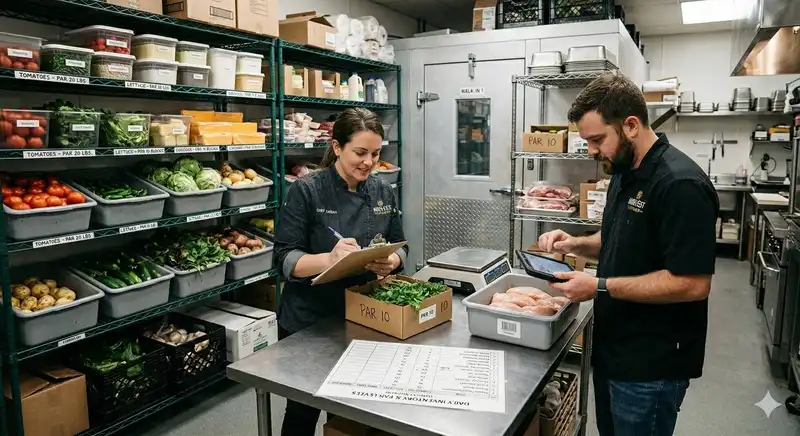
Par levels are often misunderstood because they get treated as rough estimates instead of defined operating targets. To use them effectively, restaurant teams need to understand exactly what they represent - and what they do not.
At the most basic level, a par level is the ideal quantity of an item a restaurant should have on hand to operate smoothly between deliveries. It is not the maximum you could hold, and it is not a guess. It is a calculated number based on how your restaurant actually runs.
To make this practical, it helps to separate par levels from a few closely related terms that are often confused -
1. Par Level vs. On-Hand Inventory
Par Level = your target
On-Hand Inventory = what you currently have
The gap between these two numbers is what drives your ordering decisions. If your on-hand quantity is below par, you need to reorder. If it is above, you may already be overstocked.
2. Par Level vs. Reorder Point
Par Level = how much you want to have
Reorder Point = when you should place the order
The reorder point usually triggers before you hit zero. It accounts for vendor lead time so you do not run out while waiting for delivery.
3. Par Level vs. Safety Stock
- Par Level includes your buffer
- Safety Stock is the buffer itself
Safety stock protects you from variability - unexpected demand spikes, delivery delays, or prep errors. In most restaurants, par levels already include this cushion, even if it is not labeled separately.
When these terms are mixed up, ordering becomes inconsistent. One manager may order to "fill the shelf," while another orders based on last week's usage. The result is uneven inventory levels, missed items, and unnecessary waste.
Clear definitions create consistency across shifts and locations -
- Everyone knows what "full" actually means
- Ordering decisions become repeatable
- Inventory counts connect directly to action
Instead of guessing, the team follows a simple logic -
Check what you have - Compare to par - Order the difference
Par levels are not just numbers written on a sheet. They are the standard that connects inventory counts, purchasing, and daily execution.
Efficient Ordering at Your Fingertips
Experience Flawless Inventory Management with Altametrics
Par Level Factors
Par levels should never be set by habit alone. They should be based on the real conditions of your restaurant. When operators use the same numbers week after week without reviewing demand, delivery timing, or storage limits, inventory stops being a control system and becomes a guess. That is when overordering, stockouts, and waste start to build.
A strong par level reflects how much of an item your restaurant truly needs to operate without interruption. To get there, owners and managers need to look at a small set of practical factors.
1. Average Usage - The starting point is simple - how much of the item do you normally use? This should come from actual sales, prep, and inventory data when possible. If a store goes through 20 pounds of chicken in two days, the par level should reflect that pattern, not a rough estimate based on memory.
2. Sales Volume Patterns - Demand is rarely flat. Weekends, holidays, promotions, game days, and weather shifts can all change product usage. A par level that works on Tuesday may not be enough for Friday dinner. Restaurants need pars that match real traffic patterns, not average demand alone.
3. Vendor Delivery Frequency - How often can you reorder the item? If produce arrives six days a week, the par may stay lower. If a key supplier only delivers twice a week, the restaurant needs a higher par to bridge the longer gap. Delivery schedules directly shape how much inventory must be kept on hand.
4. Lead Time - It is not enough to know the delivery days. You also need to know how long it takes from placing the order to receiving it. Longer lead times increase inventory risk and usually require a larger buffer.
5. Shelf Life - Par levels must respect perishability. High pars on short-life items often create spoilage before they create security. Dairy, cut produce, seafood, and fresh bakery items all need tighter controls than shelf-stable goods.
6. Storage Capacity - A restaurant may need more product, but that does not mean it has space for it. Cooler space, freezer space, and dry storage limits should all be considered. Practical par levels must fit the physical operation.
7. Menu Mix and Item Importance - Not every ingredient carries the same operational weight. Core items tied to best-selling menu items usually need more protection than low-volume specialty ingredients.
The goal is to build par levels around how the restaurant actually sells, stores, receives, and uses inventory. That is what makes reordering more accurate and operations more stable.
How to Calculate Par Levels
Calculating par levels does not need to be complicated. The goal is not to create a perfect formula for every ingredient. The goal is to create a repeatable method that gives your team a reliable target for ordering. A simple, practical calculation is usually more useful than a complex system no one updates.
A good way to calculate par levels is to start with actual usage, then build in timing and a reasonable buffer.
1. Measure Average Usage - Start by identifying how much of an item your restaurant uses during a normal period. This can be measured daily, every few days, or weekly depending on the item. For example, if a restaurant uses 35 pounds of cheese over 5 days, average daily usage is 7 pounds.
Formula -
Average Daily Usage = Total Usage / Number of Days
This gives you the base number that par levels should be built on.
2. Account for Lead Time - Next, calculate how much inventory you need to cover the time between placing an order and receiving it. If your vendor lead time is 2 days and you use 7 pounds per day, you need 14 pounds just to cover that period.
Formula -
Lead Time Inventory = Average Daily Usage x Lead Time in Days
This step matters because a restaurant does not order inventory for the moment. It orders for the time until the next delivery arrives.
3. Add Safety Stock - Now add a buffer for normal variability. This protects the restaurant from small demand spikes, delivery delays, prep waste, or counting errors. The buffer should be reasonable, not excessive. If average daily usage is 7 pounds, maybe safety stock is 3 to 5 pounds depending on the item and risk level.
Formula -
Par Level = Lead Time Inventory + Safety Stock
Using the example above -
Average Daily Usage = 7 pounds
Lead Time = 2 days
Lead Time Inventory = 14 pounds
Safety Stock = 4 pounds
Par Level = 18 pounds
4. Compare Par to What You Have - Once the par level is set, ordering becomes easier. Count current inventory, compare it to par, and order the difference.
Formula -
Order Quantity = Par Level - On-Hand Inventory
The key is consistency. Use the same method across items, review the numbers regularly, and adjust when demand or vendor patterns change. A practical par system is not about complex math. It is about giving managers a clear, repeatable way to order with confidence.
How to Build a Reordering System

Par levels only create value if they lead to better ordering decisions. A restaurant can have accurate par numbers on paper and still struggle with stockouts, waste, and rushed purchasing if the reordering process is inconsistent. That is why reordering needs to be treated as a routine, not a last-minute task.
A working reordering system starts with one principle - orders should be based on inventory counts compared to par, not on memory or urgency.
1. Set a Consistent Counting Schedule - Inventory should be counted on a predictable schedule tied to vendor ordering cycles. If a supplier delivers on Monday, Wednesday, and Friday, then counts should happen before each order is placed. This gives managers current information instead of forcing them to estimate what is left.
The more consistent the count schedule, the more reliable the orders become.
2. Assign Clear Responsibility - Someone has to own the process. When reordering is everyone's job, it often becomes no one's job. Restaurants should decide -
- who counts inventory
- who reviews par gaps
- who places the order
- who checks the delivery when it arrives
Even in smaller operations, defined accountability reduces missed items and duplicate ordering.
3. Order From Actual Need, Not Fear - One of the most common problems in restaurant ordering is defensive buying. Managers order extra because they do not trust the count, the vendor, or tomorrow's volume. That creates overstock, spoilage, and unnecessary cash tied up in inventory.
A good reorder system uses this logic -
On-hand inventory + incoming delivery = what you will have
Then compare that to par and expected usage before ordering more.
4. Build in Review Before Submission - Before an order is sent, someone should quickly review it for obvious issues -
- unusually high quantities
- items that were already ordered
- products with short shelf life
- menu items with upcoming promotions or lower demand
This step catches expensive mistakes before they become waste.
5. Use Reordering as an Operating Discipline - The strongest restaurants do not wait until an item is almost gone to think about purchasing. They build reordering into the management rhythm of the business. That means counts are timely, orders are tied to par, and receiving is verified against what was requested.
The result is simple but powerful- fewer emergencies, more consistent product availability, lower waste, and tighter cost control. A good reordering system does not just keep shelves full. It helps the entire restaurant operate with more stability and less guesswork.
Streamline Your Inventory. Order Smartly.
Start Simplifying Your Orders with Altametrics
Common Par Level Mistakes
Par levels are meant to reduce chaos, but when they are set or managed poorly, they can create a different kind of problem. Instead of helping the restaurant stay in control, bad par practices lead to excess inventory, preventable shortages, and inconsistent ordering decisions. In most cases, the issue is not that operators are ignoring inventory. It is that the numbers they are using no longer match reality.
Here are some of the most common mistakes that cause par levels to fail.
1. Setting Par Levels Too High - This is one of the most expensive mistakes. Managers often raise pars to "play it safe," especially after a stockout. But overly high pars tie up cash, fill storage space, and increase spoilage risk. This is especially costly for produce, dairy, proteins, and other short-shelf-life items.
Higher inventory does not always mean lower risk. In many restaurants, it simply means more waste.
2. Using the Same Pars Year-Round - Demand changes throughout the year. Weather, holidays, school schedules, local events, and seasonal traffic all affect sales volume. A par level that makes sense in one period may be too high or too low in another. When pars stay fixed while demand shifts, ordering becomes inaccurate.
3. Forgetting to Update Pars After Menu Changes - When menu items are added, removed, promoted, or repriced, usage patterns change. If par levels are not updated, the restaurant may overorder ingredients tied to slow-moving items or understock ingredients for new high-volume items.
4. Ignoring Vendor and Delivery Changes - Par levels should reflect supplier reality. If delivery days change, lead times get longer, or an item becomes less reliable, the old par may no longer protect the operation. Many stock problems happen because the restaurant is still ordering based on outdated delivery assumptions.
5. Applying the Same Pars Across All Locations - Multi-unit operators often make the mistake of copying the same pars to every store. But each location has different sales patterns, storage constraints, and product movement. A downtown location, suburban store, and high-volume drive-thru may all need different inventory targets.
6. Treating Pars as Permanent - Par levels should be reviewed regularly. When teams stop checking whether the numbers still make sense, small mismatches grow into repeated problems.
The bottom line is simple - par levels only work when they stay connected to actual operations. When they become outdated, inflated, or copied without thought, they stop being a control tool and start creating the very problems they were meant to prevent.
How to Review and Adjust Par Levels
Par levels should not be treated as fixed numbers that stay on the shelf forever. They need to be reviewed and adjusted as the business changes. A restaurant that sets par levels once and never revisits them will eventually run into the same problems par levels were meant to solve - overordering, stockouts, waste, and rushed purchasing.
The reason is simple. Restaurant operations are always moving. Sales patterns shift. Vendor performance changes. Menu items come and go. Storage conditions, staffing habits, and prep volumes all change over time. If par levels do not change with them, they stop reflecting what the restaurant actually needs.
A practical review process starts with watching for common triggers.
1. Changes in Sales Volume - If customer traffic increases or slows down, inventory movement changes with it. A location doing stronger weekend business may need higher pars on key items, while a slower period may require a reduction to prevent overstock.
2. Menu Updates - Any change to the menu should trigger a review of related inventory items. New promotions, seasonal items, bundle offers, and recipe updates can all shift product usage. If the pars stay the same, ordering will quickly become inaccurate.
3. Vendor or Delivery Changes - When a supplier changes delivery days, minimum order quantities, or reliability, the par may need to be updated. A longer lead time usually requires a larger buffer. A more frequent delivery schedule may allow the restaurant to lower pars and carry less inventory.
4. Waste and Stockout Patterns - Repeated spoilage is often a sign that par levels are too high. Repeated shortages usually mean they are too low. These are not just ordering problems. They are signals that the target itself needs to be reviewed.
5. Operational Changes by Location - As teams improve prep systems, storage organization, or ordering routines, par levels may need to be adjusted to match the new workflow.
A monthly or periodic check on key items can make a major difference. Focus first on high-cost ingredients, fast movers, and items that regularly create problems.
Transform Your Restaurant Operations Now!
Effortless Inventory Tracking with Altametrics!

Employee scheduling
Human Resource Management for Restaurants

Employee scheduling
Common Payroll Challenges in Restaurants

Sales forecasting
How to Use Restaurant Analytics to Improve Profitability

Restaurant management
The Complete Guide to Restaurant Reputation Management

Accounting payroll
Restaurant Cash Handling Procedures


Accounting payroll
How to Manage Restaurant Finances

Employee scheduling
How to Motivate Restaurant Staff

Software integration
10 Ways Technology Can Help Control Food Cost in Restaurants

Frequently Asked Questions
What is the difference between par level and reorder point?
A par level is the ideal quantity you want to have on hand. A reorder point is the level at which you should place a new order so you do not run out before the next delivery arrives.
How often should restaurant par levels be reviewed?
Par levels should be reviewed regularly, especially when sales patterns, menu items, vendor schedules, or storage conditions change. Many restaurants benefit from checking key par levels monthly.
What types of items need tighter par level control?
High-cost ingredients, fast-moving items, and products with short shelf life usually need tighter par control because mistakes in these categories affect food cost and operations more quickly.
Can technology help manage par levels?
Yes. Inventory and purchasing systems can help restaurants track usage, compare counts to par, and reorder more accurately. Technology makes the process faster and easier to maintain.